
The Data Deluge and the Need for Speed
Fiber optic data centers are facilities that use fiber optic cables instead of traditional copper cables to connect servers, switches, storage, and networking equipment, enabling data transmission at speeds from 10 Gbps to 1+ Tbps with minimal signal loss over long distances.
Key characteristics of fiber optic data centers:
- Speed: Transmit data at 10-100 Gbps commonly, scaling to 400 Gbps, 800 Gbps, and beyond
- Distance: Support long-distance transmission without signal degradation (up to kilometers for single-mode fiber)
- Bandwidth: Handle terabits per second of total throughput
- Efficiency: Consume 5-20 times less power than copper for data transmission
- Density: Use smaller, lighter cables that improve airflow and space utilization
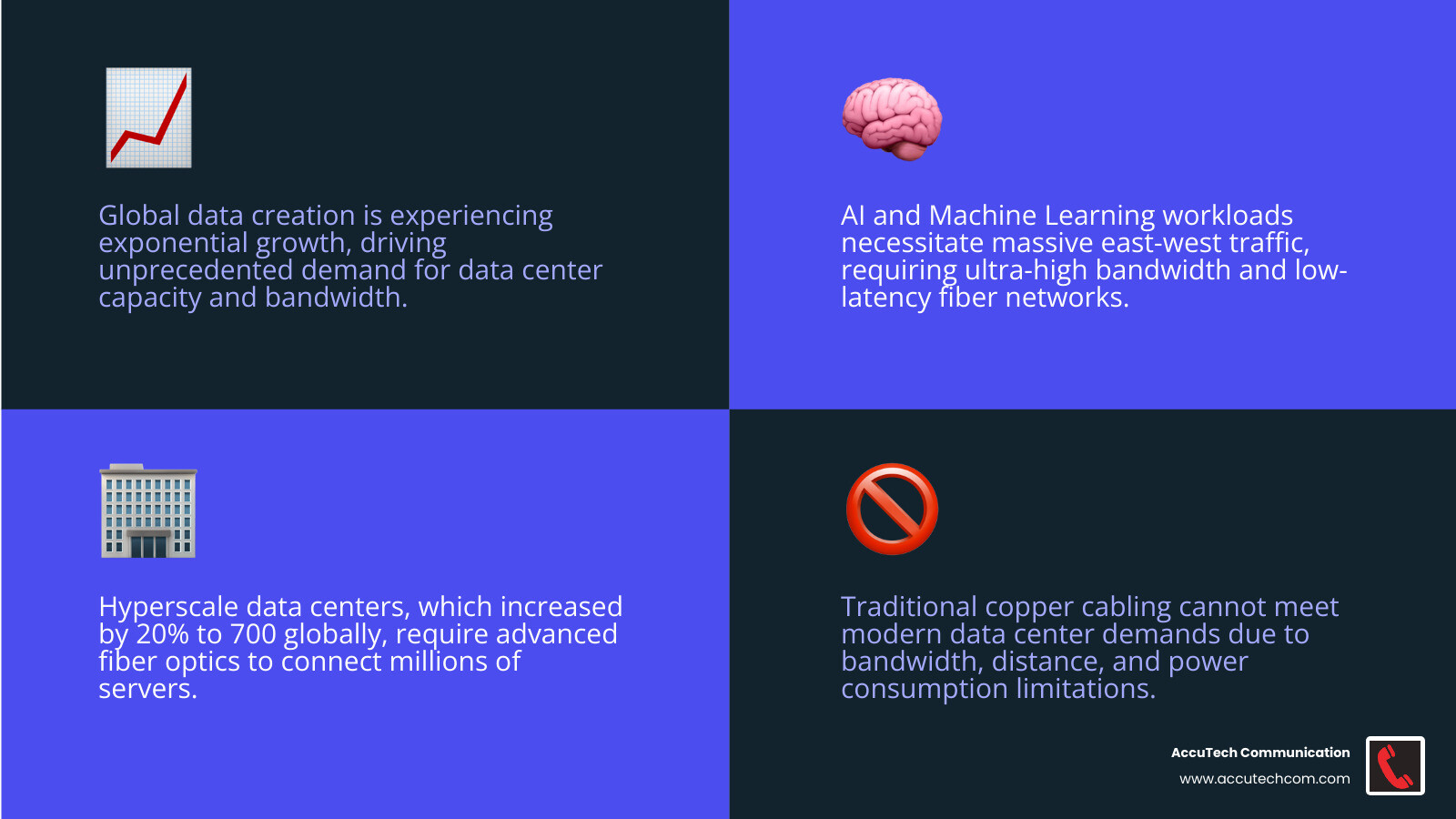
The digital world is exploding. As of 2026, the United States is home to around 4,000 data centers, with spending on data center and cloud infrastructure jumping over 30% in a single year to reach $130 billion. Meta alone committed to spending $600 billion in the U.S. by 2028 on data centers and their infrastructure—and their Louisiana data center will require 8 million miles of fiber.
This isn’t just growth. It’s a fundamental shift.
AI and machine learning are rewriting the rules for data center infrastructure. What used to be a “cautious yellow alert” for capacity has turned into “flashing bright red.” Hyperscale data centers now house millions of servers, and by the end of 2021, some 700 hyperscale centers with at least 10,000 servers each were operating globally—a 20% increase from the previous year.
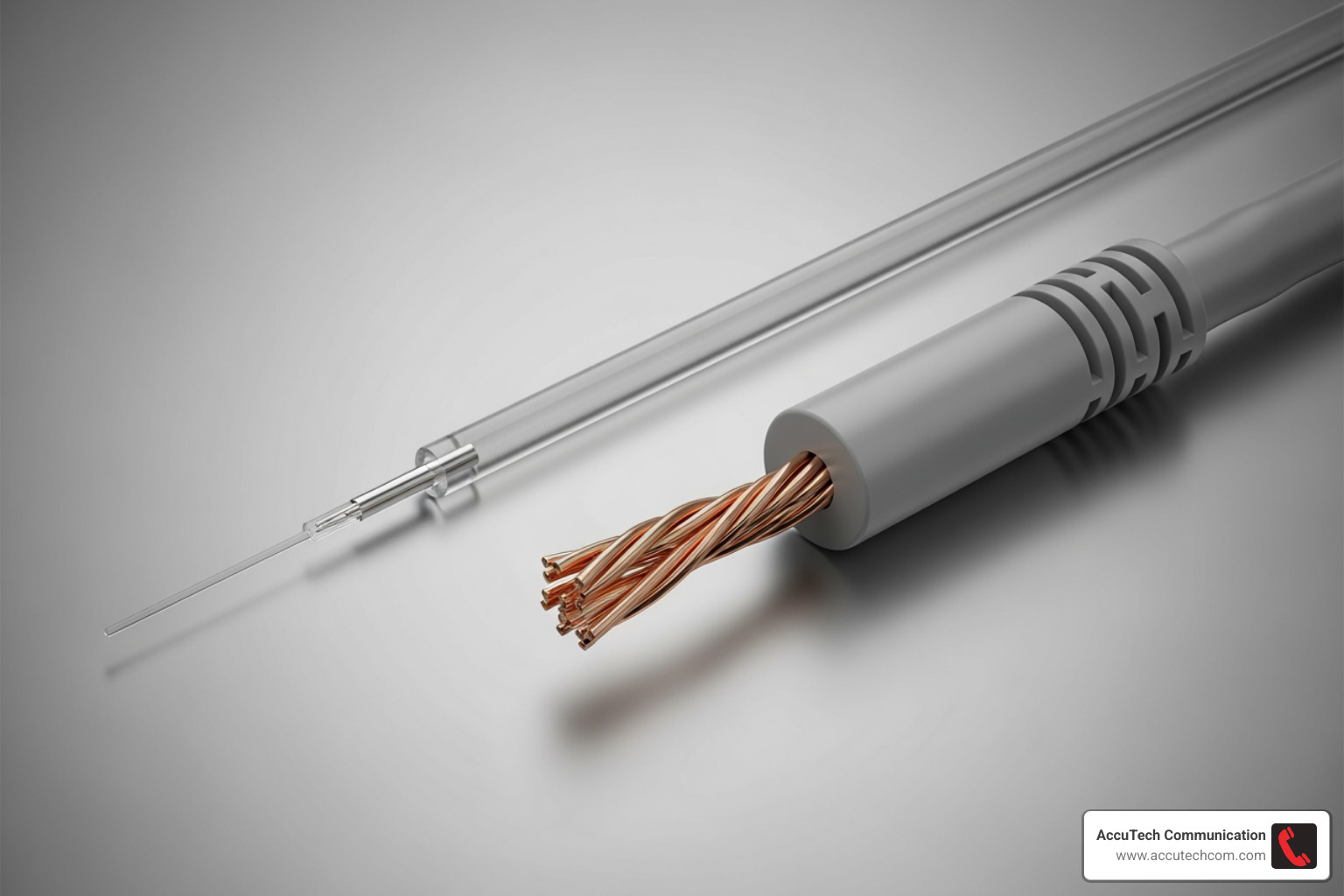
Traditional copper cabling simply can’t keep up. Copper is limited by distance (typically under 100 meters for high-speed connections), suffers from electromagnetic interference, and consumes significantly more power. As data rates climb from 10 Gbps to 100 Gbps and beyond, the physical limitations of moving electrons through copper become a bottleneck.
Fiber optics, by contrast, move data as photons—pulses of light traveling through glass strands at near the speed of light. This fundamental difference open ups higher bandwidth, longer distances, lower latency, and far greater energy efficiency.
For businesses in Massachusetts, New Hampshire, and Rhode Island that depend on robust, high-performance communication systems—especially in healthcare, finance, or any sector with demanding data workloads—the choice is clear. The future of data centers is fiber, and the time to plan for that future is now.
I’m Corin Dolan, owner of AccuTech Communications, and for over 30 years I’ve been designing and installing structured cabling systems for commercial clients across Massachusetts, New Hampshire, and Rhode Island, including mission-critical fiber optic data centers that power some of the region’s most demanding operations. Let me walk you through why fiber is no longer optional—it’s essential.
The Unbeatable Advantages of Fiber Optic Cabling
Modern data centers represent the pinnacle of fiber optic technology implementation, demanding unprecedented levels of performance, reliability, and scalability. The advantages of fiber optic cabling over traditional copper are profound and directly address the escalating demands of our digital world.
Why Fiber Outperforms Copper in Data Centers
When we talk about the backbone of a data center network, connecting major switches, routers, and servers, fiber optics are the undisputed champion.
- Higher Bandwidth: Fiber optic cables transmit data at speeds commonly ranging from 10 to 100 gigabits per second (Gbps) and can extend to terabits per second (Tbps). This colossal capacity is crucial for big data, cloud computing, AI, and other data-intensive applications. Copper, while capable of 10 Gbps and even 40 Gbps over very short distances (like with Category 8 Ethernet), quickly hits its limits.
- Lower Latency: Fiber optic cables experience less signal degradation over long distances. Since data travels as light pulses at near the speed of light, fiber significantly reduces latency. For real-time applications, high-frequency trading, or AI inference, where every millisecond counts, this is a game-changer.
- Greater Distance: Unlike copper, which suffers significant signal loss and attenuation over relatively short runs, fiber optic cables can transmit data reliably over much longer distances—from hundreds of meters within a data center to tens of kilometers for data center interconnects (DCI) between facilities in, say, Boston and a remote backup site in New Hampshire.
- Signal Integrity: Fiber optics are impervious to electromagnetic interference (EMI) and radio frequency interference (RFI). Copper cables, on the other hand, are susceptible to these external disturbances, which can corrupt data and necessitate costly shielding. In the electrically noisy environment of a data center, fiber’s immunity to EMI ensures a clean, reliable signal.
- Improved Security: Fiber optic cables are inherently more secure than copper. Tapping into a fiber optic cable without detection is extremely difficult, as it would disrupt the light signal, immediately alerting network administrators to a breach.
- Smaller Size and Weight: Fiber optic cables are remarkably thin and lightweight compared to their copper counterparts. This allows for higher cable density in congested pathways, improves airflow within server racks, and simplifies installation and management. For instance, rollable ribbon fiber cable can accommodate as many as 3,456 fibers into one two-inch duct, a feat impossible with copper.
Cost, Power, and Environmental Impact
While the initial investment in fiber optic cabling and transceivers might seem higher than copper, the total cost of ownership (TCO) often favors fiber, especially for modern, high-performance data centers.
- Reduced Power Consumption: This is a major factor in our energy-conscious world. Fiber optics use significantly less energy—between five and 20 times lower—than copper for transmitting data. This translates directly into substantial operational savings for businesses in Massachusetts, New Hampshire, and Rhode Island.
- Lower Cooling Requirements: Less power consumption means less heat generation. This directly reduces the demand on a data center’s cooling systems, which are often the largest energy consumers. Optimizing cable management and layout, as highlighted by the U.S. Department of Energy’s Best Practices Guide, can directly improve energy performance and lower operational costs.
- Smaller Carbon Footprint: The reduced energy consumption and cooling needs of fiber optic data centers contribute to a smaller carbon footprint. Furthermore, innovations in fiber cable design, such as flexible high-fiber count optic cabling and rollable ribbon fiber, allow for more efficient use of materials and higher fiber counts per duct, reducing plastic and related materials. This aligns perfectly with growing sustainability initiatives.
- Material Usage Reduction: High-density fiber solutions allow us to pack more bandwidth into less physical space, reducing the overall amount of cabling material needed. This not only saves space but also contributes to a more sustainable infrastructure.
For a deeper dive into the practicalities of setting up your data center with fiber, explore our insights on More info about fiber optic installation.
The Technical Backbone of Fiber Optic Data Centers
At its heart, fiber optic technology is neat in its simplicity and powerful in its execution. Data travels as pulses of light through incredibly thin strands of glass or plastic, each composed of a core, cladding, and a protective coating. The core is where the light signal travels, and the cladding, with its lower refractive index, reflects the light back into the core, preventing signal loss.
Single-Mode vs. Multi-Mode Fiber: Choosing the Right Cable
The choice between single-mode fiber (SMF) and multi-mode fiber (MMF) is one of the most fundamental decisions in fiber optic data center design, dictating reach, bandwidth, and cost.
| Feature | Single-Mode Fiber (SMF) | Multi-Mode Fiber (MMF) |
|---|---|---|
| Core Size | Small (typically 9µm) | Larger (typically 50µm or 62.5µm) |
| Bandwidth | Very high (Gbps to Tbps) | High (Gbps) |
| Distance | Long (tens of kilometers) | Shorter (hundreds of meters) |
| Cost | Higher (due to transceivers) | Lower |
| Light Source | Laser (more precise) | LED or VCSEL (less expensive) |
| Dispersion | Minimal (no modal dispersion) | Significant modal dispersion |
| Typical Use Cases | Long-haul telecom, DCI, high-speed backbone | Within data center, server-to-switch, SANs |
- Single-Mode Fiber (SMF): With its narrow 9µm core, SMF allows only a single path (mode) for light to travel. This eliminates modal dispersion, a phenomenon where light signals arrive at different times due to taking different paths, which limits distance and bandwidth in MMF. SMF is ideal for long-distance, high-bandwidth transmissions, making it the go-to for data center interconnects (DCI) between facilities, or for long-haul connections from a data center in Massachusetts to a network hub in New York.
- Multi-Mode Fiber (MMF): MMF has a larger core, allowing multiple light paths. While this simplifies coupling and allows for less expensive light sources, it introduces modal dispersion, limiting its effective distance and bandwidth. MMF is typically used for shorter distances within data centers, such as server-to-switch connections or within a single row of racks. MMF has evolved through several standards:
- OM3 and OM4: Optimized for 10 Gbps and 40 Gbps, with OM4 offering greater reach.
- OM5: Also known as wideband MMF, it supports multiple wavelengths using Wavelength Division Multiplexing (WDM), extending its capabilities for 40 Gbps and 100 Gbps over shorter distances.
High-Density Connectivity: MPO/MTP Connectors and Beyond
As data centers scale, the sheer number of connections can quickly become unmanageable. This is where high-density connector technologies shine.
- MPO/MTP Connectors: These are multi-fiber push-on/pull-off connectors that house multiple fibers (typically 12, 24, or even 16 fibers) in a single ferrule. MPO/MTP connectors are critical for:
- Port Density: Enabling massive port densities on network equipment, allowing many connections in a compact space.
- Streamlined Cable Management: Simplifying cable management by replacing many individual patch cords with a single multi-fiber cable.
- Accelerated Deployment: Pre-terminated MPO/MTP trunk cables significantly reduce installation time and labor costs, which is a huge advantage for rapid data center build-outs or upgrades in our region.
- Parallel Optics: MPO/MTP connectors are essential for parallel optics, where data is transmitted simultaneously over multiple fibers (e.g., 8 or 16 fibers for 400G and 800G applications).
- Very Small Form Factor (VSFF) Connectors: Emerging connectors like SN, MDC, and CS are designed to further increase port density on transceivers. These VSFF connectors provide duplex or parallel application support, with common fiber counts including 2, 8, or 16 fibers, allowing for even more connections in the same footprint.
Achieving high-density and efficient cable management is a cornerstone of modern data center design. We emphasize these principles in our More info about structured cabling services, ensuring your infrastructure is organized and scalable.
Designing and Managing a High-Performance Fiber Network
The sheer scale and complexity of modern fiber optic data centers demand meticulous design and management strategies. It’s not just about running cables; it’s about architecting a nervous system that can handle vast amounts of data with flawless precision.
Data center topologies, such as the leaf-and-spine architecture, are carefully planned to ensure predictable traffic flows, redundant paths, and modular scaling. This design is crucial for handling the “east-west” traffic (server-to-server communication) that dominates today’s cloud and AI workloads. Cross-connect systems, often centralized in a Main Distribution Area (MDA), play a vital role in simplifying cable management and allowing for easier reconfiguration and patching. This centralized approach reduces cable clutter, improves airflow, and makes troubleshooting a breeze.
Best Practices for Fiber Installation and Certification
Proper installation is paramount to achieving the expected performance from your fiber optic infrastructure. We follow stringent best practices to ensure every link meets its specifications:
- Pre-Installation Checks: Before any cable is laid, we carefully verify the cable path, ensuring no sharp bends or obstructions, and confirm environmental conditions are suitable.
- Cable Routing and Management: Maintaining minimum bend radii (often >30mm) is critical to prevent signal loss. Proper pulling tension and the use of cable trays or innerducts during routing protect the delicate fibers. Our expertise in innerduct installation services ensures optimal protection for your fiber infrastructure.
- Termination and Polishing: Fiber optic connectors (like MPO/MTP or LC) must be terminated and polished with extreme precision. Even microscopic imperfections can cause significant signal loss or reflection.
- Testing Methodologies: Comprehensive testing is non-negotiable. We conduct:
- OTDR Testing: Optical Time Domain Reflectometer (OTDR) tests provide a “fingerprint” of the fiber link, identifying splices, connectors, and any anomalies along the cable.
- Insertion Loss Measurement: This measures the total signal loss across a link, ensuring it stays within the specified budget.
- Link Integrity Verification: We perform end-to-end checks to confirm that every fiber link meets industry standards and is ready for service.
Our certified technicians in Massachusetts, New Hampshire, and Rhode Island adhere to these best practices, ensuring reliable, high-performance installations. Following guidelines like those in the U.S. Department of Energy’s Best Practices Guide is foundational to our approach.
Optimizing Performance and Troubleshooting Common Issues in Fiber Optic Data Centers
Even with the best installation, ongoing performance optimization and efficient troubleshooting are vital to minimize downtime and ensure reliability.
- Proactive Network Monitoring: Continuous monitoring of key metrics like optical signal-to-noise ratio (OSNR), bit error rate (BER), and Q-factor allows us to identify potential issues before they become critical.
- Systematic Troubleshooting: When an issue arises, we employ a systematic approach. First, determine if the problem is high loss, high reflection, or complete signal loss. Then, follow targeted steps:
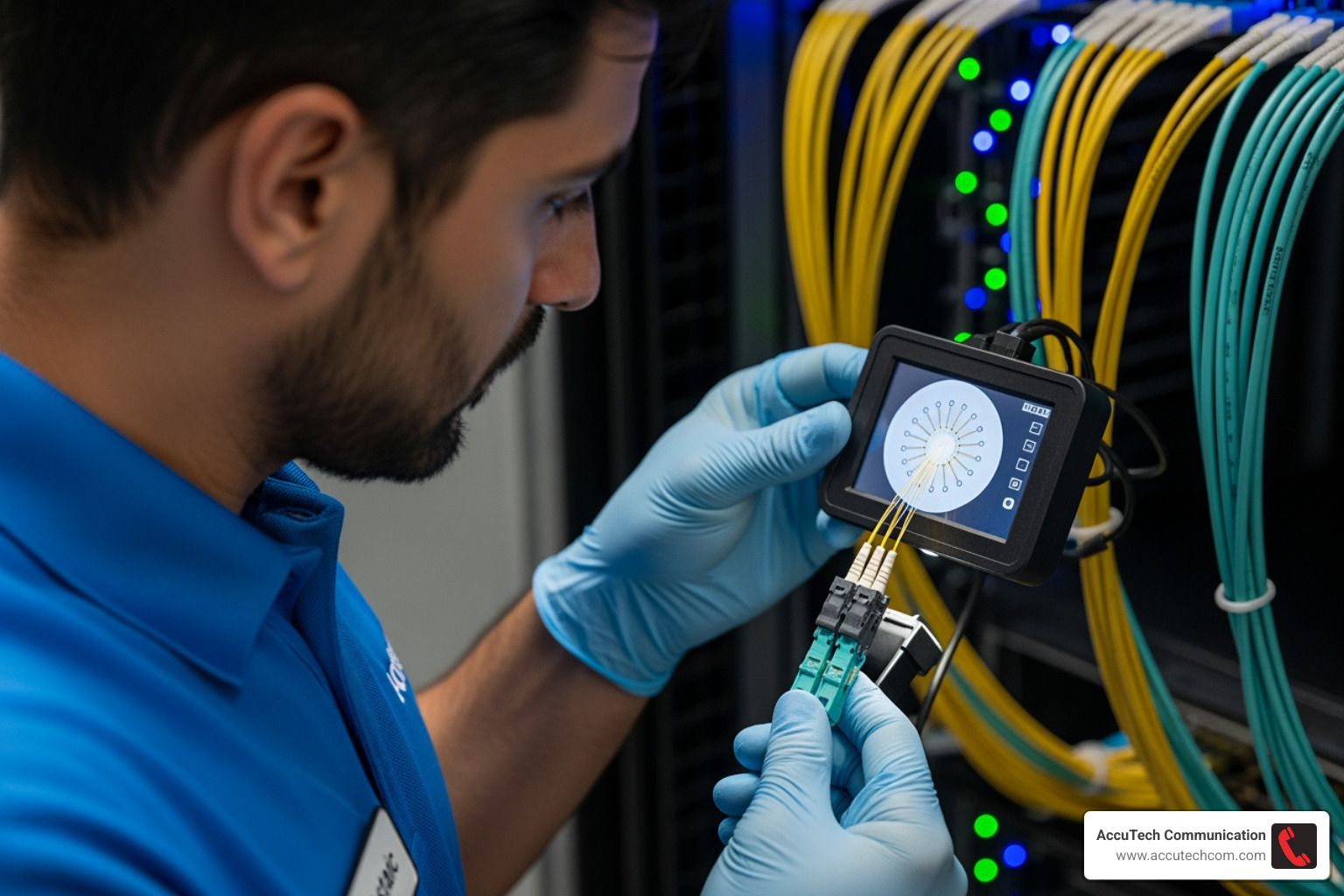
- Dirty Connectors: The most common culprit! Microscopic dust particles can block light signals. Thorough cleaning with specialized tools often resolves this.
- Bad Splices or Terminations: Improperly fused or terminated fibers can introduce significant loss.
- Macrobends: Bending a fiber beyond its minimum bend radius can cause light to leak out, leading to signal attenuation.
- Equipment Failure: A faulty transceiver or network card can also be the cause.
- Advanced Diagnostic Tools: We use advanced tools like high-resolution OTDR scans and connector end-face microscopes to pinpoint subtle issues that might otherwise go undetected.
For businesses in our region, minimizing downtime is critical. Our team is equipped with the expertise and tools to quickly diagnose and resolve fiber optic issues, keeping your operations running smoothly.
Future-Proofing with Next-Generation Fiber Technologies
The relentless demand for data, particularly from AI and machine learning workloads, continues to push the boundaries of fiber optic data centers. These applications require more than just additional servers; they necessitate a re-architecting of data center networks with more capable infrastructure. The future is about higher speeds, new fiber types, and integrated photonics.
High-Performance Computing (HPC) and cloud computing architectures within data centers have specific fiber optic requirements. HPC clusters, for example, demand ultra-low latency and massive bandwidth for rapid data exchange between computing nodes. Cloud platforms require flexible, scalable fiber networks to support on-demand provisioning and rapid scaling. The industry is rapidly moving towards 400G, 800G, and even 1.6T speeds, with transceivers already being deployed or standardized for these rates. As Google’s research highlights, Fiber Optic Communication Technologies: What’s Needed for Datacenter Network Operations is a continuous evolution.
Emerging Trends Shaping the Future of Fiber Optic Data Centers
The innovation in fiber optics is relentless, bringing exciting new technologies to the forefront:
- Higher Data Rates: We’re seeing rapid advancements from 100G to 400G, with 800G transceivers already being deployed in hyperscale data centers. The first generation of 800G transceivers will use eight fiber pairs (16 fibers total) for transmission, and 1.6T transceivers are already specified. This constant push for speed means infrastructure must be ready.
- Rollable Ribbon Fiber: This innovative cable design allows for extremely high fiber counts in smaller diameters, making it ideal for maximizing conduit space in older data center campuses that are experiencing conduit congestion. It’s more flexible than traditional ribbon cables, simplifying routing.
- Hollow-Core Fibers: These fibers have an air-filled core, promising significantly lower latency because light travels faster through air than glass. This could be for latency-sensitive applications.
- Multi-Core Fibers: Packing multiple cores (and thus multiple data pathways) into a single fiber strand dramatically increases density and bandwidth without increasing cable thickness.
- Silicon Photonics: This technology integrates optical components, like lasers and detectors, directly onto silicon chips. This leads to smaller, more power-efficient transceivers and simplifies manufacturing.
- Coherent Optics for DCI: Traditionally used for long-haul telecommunications, coherent optics are now migrating to Data Center Interconnect (DCI) applications. They allow for much higher bandwidth and longer reaches over fewer fibers, making them ideal for connecting data centers across metropolitan areas in our region.
When considering migrating from older fiber infrastructure (e.g., multi-mode) to newer standards (e.g., single-mode) to support higher data rates like 100G and beyond, there are key considerations:
- Cost: While SMF transceivers can be more expensive, the reduced fiber count and longer reach can lead to overall TCO savings, especially for DCI.
- Complexity: Migrating requires careful planning for new transceiver types, cabling pathways, and potential connector changes.
- Compatibility: Ensuring new equipment is compatible with existing infrastructure is crucial.
- Installation Expertise: Specialized knowledge is needed for SMF termination and testing.
- Future-Proofing: SMF offers superior future-proofing due to its inherent bandwidth and distance capabilities.
The Impact of Fiber on Data Center Site Selection
The availability and proximity of fiber optics now critically impact data center site selection and land values, especially in our densely populated region of Massachusetts, New Hampshire, and Rhode Island.
- Fiber Proximity and Land Values: The physical location of a data center is increasingly dictated by what lies beneath the soil: high-capacity fiber optics. A site without a clear path to multi-terabit connectivity isn’t just a challenge—it’s a liability. Proximity to major fiber backbones and internet exchange points (IXPs) significantly increases a parcel’s market value by minimizing latency and reducing the cost of trenching for “last mile” connections. If a developer has to build five miles of new fiber lateral to reach a backbone, the project costs can skyrocket by millions of dollars.
- Latency-Sensitive Applications: For modern applications like autonomous vehicles, high-frequency trading, and real-time AI inference, every millisecond counts. Every mile of glass fiber adds microseconds of delay. Therefore, data centers catering to these workloads must be located as close as possible to major fiber arteries.
- Path Diversity and Redundancy: Valuable data center sites offer access to multiple, physically separate fiber routes (path diversity). This ensures redundancy, protecting against outages from cable cuts or network failures, which is paramount for businesses in our service area.
- Importance for Businesses in Massachusetts, New Hampshire, and Rhode Island: For local businesses, access to robust fiber infrastructure is not just a convenience; it’s a competitive advantage. Data centers in Boston, Marlborough, or Providence, for example, leverage extensive metro fiber networks to provide low-latency connectivity to businesses throughout the region.
- Dark Fiber Availability: The presence of dark fiber networks (unused fiber optic cables available for lease) offers businesses the ultimate control and scalability. Leasing dark fiber allows organizations to deploy their own optical equipment, customizing bandwidth, speed, and security to their exact needs without being tied to a service provider’s lit services.
Frequently Asked Questions about Fiber in Data Centers
How fast is fiber optic cabling in a data center?
Fiber optic speeds commonly range from 10 Gbps to 100 Gbps and are scaling to 400 Gbps, 800 Gbps, and beyond, with the theoretical limit being near the speed of light. Modern DCI solutions can achieve speeds exceeding 400 Gbps and even reach Tbps. The precise speed depends on the type of fiber, transceivers, and network equipment used.
Why do AI and hyperscale data centers require so much fiber?
AI and ML require a massive east-west traffic flow between thousands of servers for model training, creating a complex, interconnected fabric that needs the ultra-high bandwidth and low latency that only dense fiber optic networks can provide. AI data centers require significantly more fiber than traditional cloud computing infrastructure to create these extensive “neural network”-like connections, consuming 8 million miles of fiber for just one Meta data center in Louisiana, for example.
Can I upgrade my existing data center to fiber optics?
Yes, migrating from older copper or multi-mode fiber infrastructure to modern single-mode fiber is a common project to support higher data rates, though it requires careful planning for cabling pathways, hardware compatibility, and installation. Our team at AccuTech Communications specializes in assessing your current infrastructure and designing a seamless upgrade path custom to your specific needs in Massachusetts, New Hampshire, or Rhode Island.
Conclusion: Building the Data Center of Tomorrow, Today
The digital landscape is evolving at an unprecedented pace, driven by the insatiable demands of AI, machine learning, cloud computing, and a data deluge that shows no signs of slowing down. In this environment, fiber optic data centers are not just a luxury; they are a necessity.
Fiber optics provide the speed, scalability, reliability, and energy efficiency that copper simply cannot match. From delivering ultra-low latency for critical applications to supporting multi-terabit data flows across vast hyperscale infrastructures, fiber is the fundamental medium enabling the future of computing. Emerging technologies like rollable ribbon fiber, hollow-core fibers, and silicon photonics promise even greater capabilities, ensuring fiber’s continued dominance for decades to come.
For businesses in Massachusetts, New Hampshire, and Rhode Island, a robust fiber infrastructure is key to competitive advantage. Whether you’re building a new data center from the ground up, upgrading an existing facility, or connecting multiple sites, the right fiber optic solution will ensure your operations are fast, reliable, and future-proof.
At AccuTech Communications, we understand the complexities of modern data center infrastructure. Since 1993, we’ve been partnering with commercial clients across MA, NH, and RI, providing expert design and installation for future-ready data centers. We bring certified, reliable service and competitive pricing to every project, ensuring your data infrastructure is built to excel.
Ready to open up the full potential of your data operations? Let us help you Plan your next data center build-out with the power of fiber optics.
