
What Is Network Cable Management — and Why Does It Matter for Your Business?
Network cable management is the practice of organizing, routing, securing, and labeling the physical cables that make up your network infrastructure.
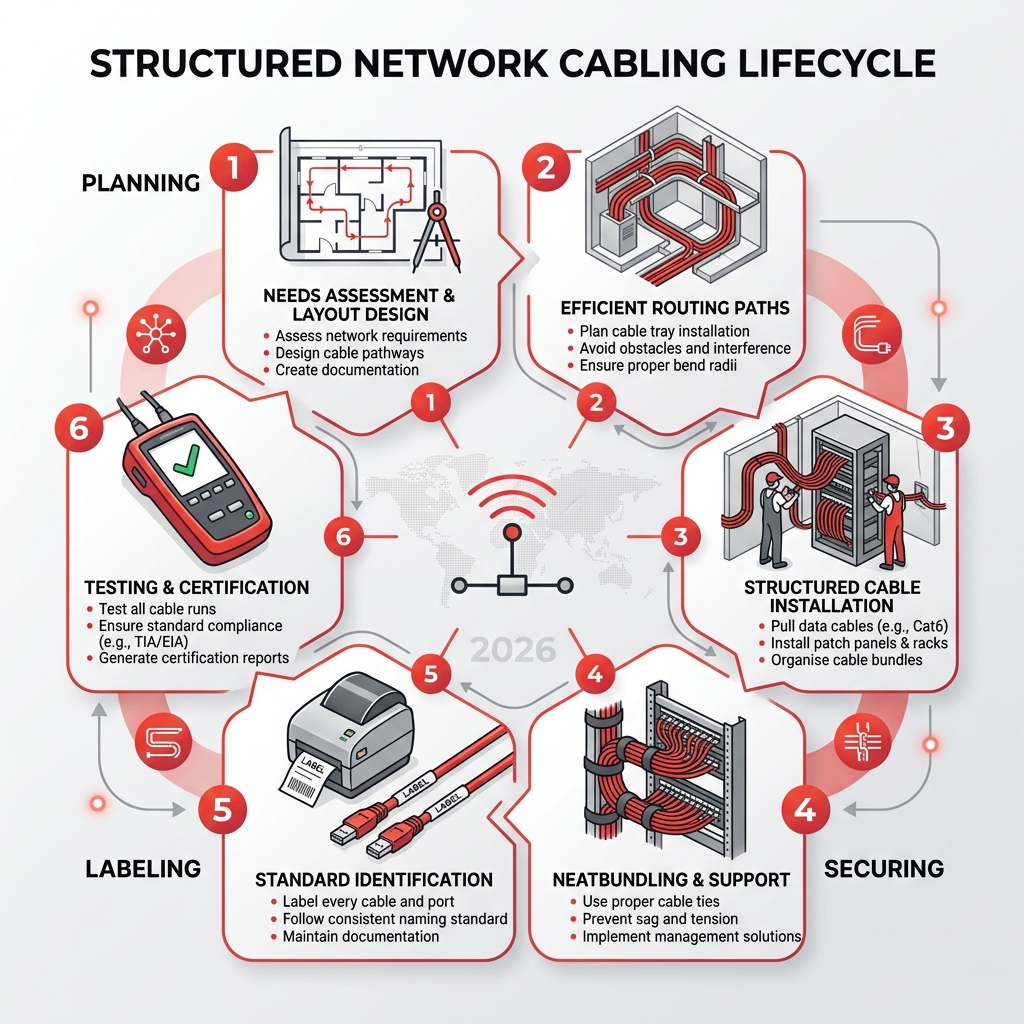
Here’s what good cable management looks like in practice:
- Organize cables using trays, raceways, and rack managers
- Label both ends of every cable with a consistent naming system
- Separate power cables from data cables to prevent interference
- Secure bundles with hook-and-loop fasteners or cable ties
- Document all cable runs, lengths, and connection points
- Review your cabling layout every 6–12 months
Done right, it keeps your network fast, safe, and easy to maintain. Done wrong, it becomes one of the biggest hidden risks to your business uptime.
Most people don’t think about their cabling until something breaks. And that’s exactly the problem.
Cable bundles are usually tucked away inside racks, above ceilings, or behind walls — out of sight, out of mind. But poor organization has real consequences. Research shows that poor cable management contributes to up to 70% of troubleshooting delays in enterprise networks. More than 68% of intermittent network errors trace back to structured cabling problems. And human error — often caused by unlabeled or tangled cables — remains one of the leading causes of network downtime.
For businesses in Massachusetts, New Hampshire, and Rhode Island that depend on reliable communications infrastructure, that’s not a small risk. A single misidentified cable during routine maintenance can trigger hours of downtime, lost productivity, and frustrated teams.
I’m Corin Dolan, owner of AccuTech Communications, and I’ve spent decades helping commercial businesses across New England design and implement structured network cable management systems that perform reliably for the long term. In this guide, I’ll walk you through everything you need to know — from the right tools and planning steps to labeling standards and why professional certification matters.
The Fundamentals of Effective Cable Organization
At its core, network cable management is about more than just making a server room look pretty. While a “spaghetti mess” of wires is an eyesore, the technical risks are far more concerning. Proper organization directly impacts the physical environment of your hardware. When cables are tangled and heaped in front of intake fans or exhaust vents, they block critical airflow.
Airflow optimization is essential for maintaining cooling efficiency. In high-density environments, restricted airflow leads to “hot spots,” which force equipment fans to work harder, increasing energy costs and significantly shortening the equipment lifespan. According to the U.S. Department of Energy’s Best Practices Guide for Energy-Efficient Data Center Design, optimizing your layout and cable management can directly enhance your facility’s energy efficiency.
Furthermore, signal integrity is a major factor. When data cables are crushed or tightly kinked, it can lead to signal crosstalk—where signals “leak” between adjacent wires—causing intermittent data transmission errors. By following data center cable management best practices, we ensure that your infrastructure supports the high-speed performance your business requires.
Innovative Solutions for Network Cable Management
Modern technology has moved beyond simple plastic ties. Today, we utilize sophisticated products designed for flexibility and protection. Hook-and-loop fasteners (often referred to by the brand name VELCRO®) have become the industry standard because they secure cables without applying the crushing pressure that plastic zip ties often do. They are also reusable, making “moves, adds, and changes” much simpler.
For high-density racks, ZeroU managers are a game-changer. These allow us to manage cables in the space along the sides of the rack, saving precious “U” space for actual servers and switches. We also utilize grid-based routing systems, such as Cablox, which use a series of pegs to allow for highly customizable cable paths on almost any flat surface. You can explore more about these essential products for data cable management to see how they fit into a professional install.
The Impact of Poor Organization on Uptime
We’ve seen it happen too many times in offices from Boston to Providence: a minor network glitch turns into a multi-hour outage because a technician couldn’t find the right port. When cables aren’t organized, troubleshooting delays skyrocket. In fact, poor cable management contributes to up to 70% of troubleshooting delays in enterprise settings.
Human error is the most common cause of downtime. If a technician accidentally pulls the wrong power cord or disconnects a critical trunk line because it was tangled with a dead cable, the business suffers. Intermittent connectivity issues are also frequently caused by “cable strain,” where the weight of an unsupported bundle pulls on a connector, leading to a loose or failing physical connection.
Essential Tools and Hardware for Server Racks
To achieve a professional-grade setup, you need the right hardware. A “one-size-fits-all” approach doesn’t work for complex commercial networks.
- Horizontal Managers: These are typically installed between switches and patch panels. They act as “handy helpers” to guide patch cords neatly to the sides of the rack.
- Vertical Managers: These run up the sides of the rack, housing the bulk of the vertical cable runs and feeding them into the horizontal managers.
- Cable Trays and Ladder Racks: For overhead routing, these systems provide a “highway” for your cables, keeping them off the floor and away from potential damage.
- J-Hooks: These are used for supporting cable bundles above drop ceilings, ensuring they don’t rest on ceiling tiles or fluorescent light fixtures (which can cause interference).

Implementing these tools is a core part of establishing a robust structured cabling system that can grow with your company.
Strategies for Effective Network Cable Management in Data Centers
In larger data centers, we organize cables by functional areas to maintain order. This includes the Main Distribution Area (MDA), where the core switching happens, and Horizontal Distribution Areas (HDA), which serve specific rows of racks.
This functional approach is vital for scalability. When your business expands and you need to add ten more servers, a structured system allows you to plug in and go without creating a new mess. We specialize in these types of data center build-outs throughout Massachusetts and Rhode Island, ensuring that today’s installation doesn’t become tomorrow’s headache.
Step-by-Step Guide to Planning Your Network Cable Management
Before a single cable is pulled, a comprehensive plan must be in place. We start by mapping the cable routes to ensure the shortest, most efficient paths are taken while avoiding obstacles.
- Route Design: Determine if cables will run overhead via trays or under a raised floor.
- Load Calculation: We calculate the weight of the cable bundles to ensure the support hardware (like J-hooks or trays) can handle the physical load.
- Fill Capacity: Industry standards suggest keeping cable trays under 40% fill capacity to allow for proper cooling and future expansion.
| Feature | Overhead Routing (Trays/Ladders) | Underfloor Routing (Raised Floors) |
|---|---|---|
| Accessibility | High – easy to see and change | Low – requires lifting floor tiles |
| Airflow | Better – doesn’t block floor vents | Can be restrictive if overfilled |
| Aesthetics | Visible (unless above ceiling) | Hidden and very clean |
| Cost | Generally lower installation cost | Higher cost due to floor infrastructure |
Planning these details is what separates a DIY project from professional network cabling systems.
Proper Separation of Power and Data Cables
One of the most critical rules in network cable management is the separation of power and data lines. Power cables emit electromagnetic interference (EMI). If a data cable runs parallel to a high-voltage power line for a long distance, that EMI can bleed into the data stream, causing “noise,” dropped packets, and slow speeds.
To maintain signal integrity, we ensure data and power cables are separated by at least 6 to 12 inches whenever possible. If they must cross, they should cross at a 90-degree angle to minimize the area of interference. This is a hallmark of high-quality cabling infrastructure solutions.
Best Practices for Labeling and Documentation
A network is only as good as its documentation. We follow the TIA-606-C standards, which provide a standardized “language” for labeling every part of the system.
- Both-End Labeling: Every cable must be labeled at the switch/patch panel end AND at the wall outlet/device end.
- Color-Coding: Using different colors for different services (e.g., Blue for Data, White for Voice, Red for Security) allows for instant visual identification.
- Asset Tracking: We create a digital map or spreadsheet that links every port on a patch panel to a specific desk or device in the building.
Proper labeling is one of the primary benefits of upgrading your business cabling infrastructure, as it slashes the time required for future moves or repairs.
Why Professional Certification and Standards Matter
You might wonder why you should hire a certified professional instead of just having a general handyman run some wires. The answer lies in certification and adherence to strict engineering standards like ANSI/TIA-942.
Professional installers understand the “bend radius.” If you bend a Category 6 or Fiber Optic cable too sharply (exceeding its bend radius), you cause internal micro-fractures that degrade performance. We also implement proper strain relief to ensure that the weight of the cable isn’t pulling on the delicate gold pins inside a jack.
Finally, we perform performance validation. We use specialized testing equipment to certify that every single line we install meets or exceeds the TIA/EIA speed standards. This is the core of our structured cabling services; we don’t just “plug it in”—we prove it works.
Frequently Asked Questions about Cable Organization
How often should a cable audit be performed?
For most commercial businesses in MA, NH, and RI, we recommend a cable audit every 6 to 12 months. This is especially important after any major staff changes, office reconfigurations, or hardware upgrades. An audit ensures that “temporary” patches haven’t become permanent messes and that labeling remains accurate.
What are the risks of using plastic zip ties on high-speed data cables?
Plastic zip ties are often over-tightened by well-meaning installers. This creates “pinch points” that compress the internal twisted pairs of an Ethernet cable, changing its electrical properties and causing signal reflections (Return Loss). In high-speed networks, this leads to data errors. Hook-and-loop fasteners are a much safer, adjustable alternative.
Why is maintaining the proper bend radius critical for fiber optics?
Fiber optic cables transmit data using light. If the cable is bent too sharply, the light can no longer reflect properly down the core of the fiber and instead “leaks” out into the cladding. This is called attenuation. If the bend is severe enough, the glass core can actually snap, rendering the cable useless.
Conclusion
Effective network cable management is the foundation of a reliable business. It ensures your hardware stays cool, your signals stay clear, and your IT team can resolve issues in minutes rather than hours. At AccuTech Communications, we’ve been the trusted partner for businesses throughout Massachusetts, New Hampshire, and Rhode Island since 1993.
Our team of certified technicians is dedicated to providing high-quality, organized, and certified cabling solutions that help your New England business thrive. Whether you are moving into a new office in Boston, upgrading a data center in Worcester, or expanding your warehouse in Manchester, we have the expertise to get the job done right.
Contact us for a professional structured cabling consultation today and let’s get your network organized for the future.
