
Network Cabling Systems: 5 Essential Benefits for Flawless Connectivity
Why Network Cabling Systems Are Essential for Modern Businesses
Network cabling systems are organized infrastructures of cables and associated components that connect computers, phones, and devices within a network, enabling high-speed data transmission and communication.
Here’s what you need to know at a glance:
- Purpose: Provide reliable and efficient connectivity for data, voice, and video communications.
- Components: Include cables (fiber optic, twisted pair, coaxial), patch panels, connectors, switches, and routers.
- Benefits: Improved performance, improved security, flexibility to scale, reduced downtime, and simplified troubleshooting.
- Applications: Essential in healthcare, data centers, education, government, and commercial buildings.
Simply put, your network cabling is the backbone of your business communication—it’s what keeps your organization reliably connected, secure, and adaptable for future growth.
I’m Corin Dolan, owner of AccuTech Communications, with over 30 years of hands-on experience designing and installing network cabling systems for diverse sectors including healthcare, manufacturing, education, and retail. I’ve seen first-hand how smart infrastructure investments empower businesses to thrive.
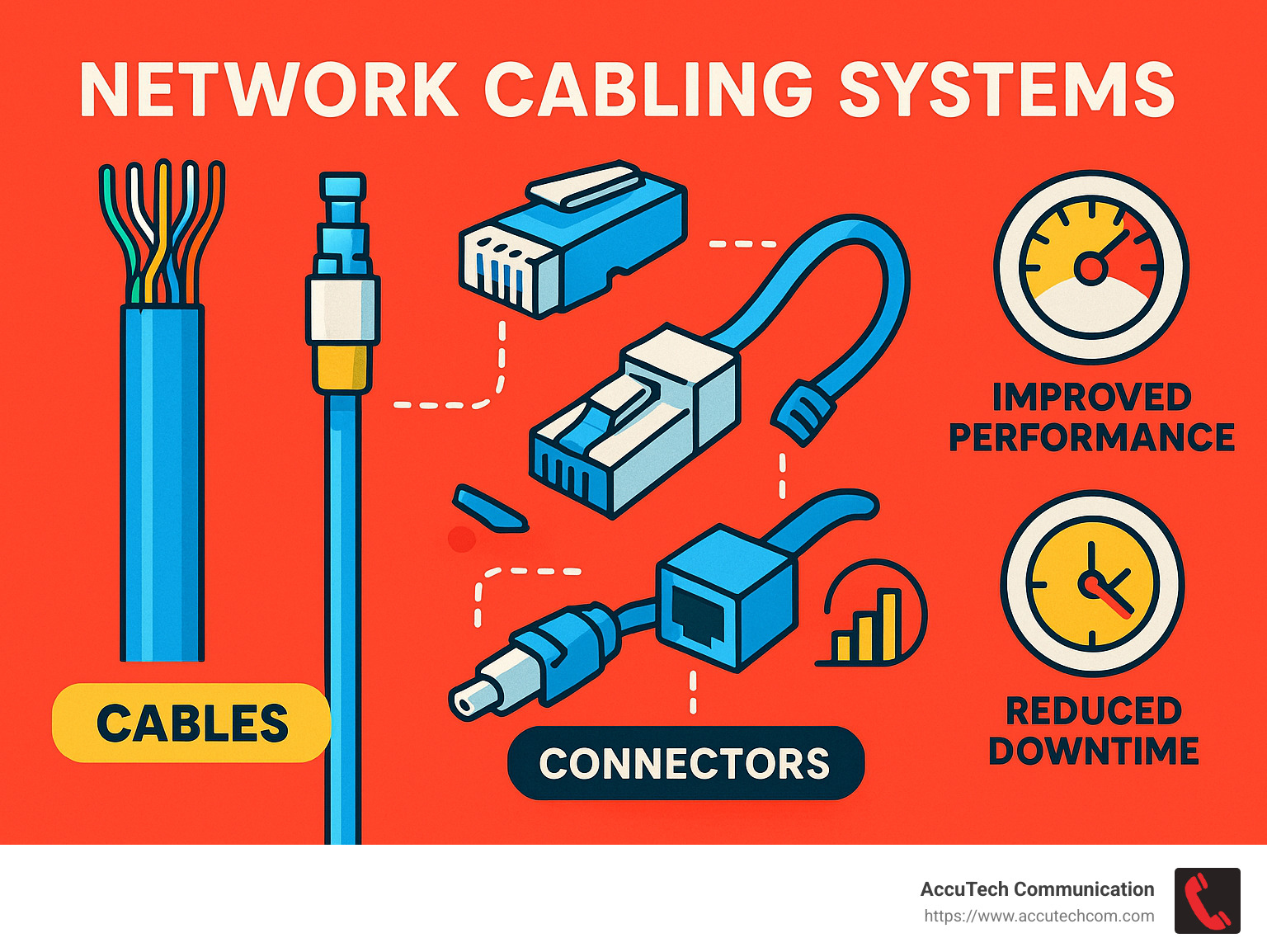
Network cabling systems terms to learn:
– cabling installation
– structured cable systems
– office cabling solutions
1. What Are Network Cabling Systems?
Network cabling systems are the hidden heroes behind your business communication—it might not sound as exciting as robots or AI, but trust me, they’re just as essential! Think of your network cabling as the nervous system of your building. It quietly connects computers, servers, phones, printers, and countless other devices, helping them communicate quickly and effectively.
At its most basic, a network cabling system is an organized framework of cables and components. But it’s really much more than that. It’s a carefully designed infrastructure that supports high-speed data transfer, voice communication, and even video conferencing. This organized approach is known in the industry as “structured cabling,” and it’s all about making things reliable, neat, and future-ready.
As one industry pro puts it: “Network cabling isn’t just wires and connectors—it’s the backbone that keeps business tech running smoothly today and prepared for whatever comes next.”
Let’s break down exactly what makes up a structured network cabling system.
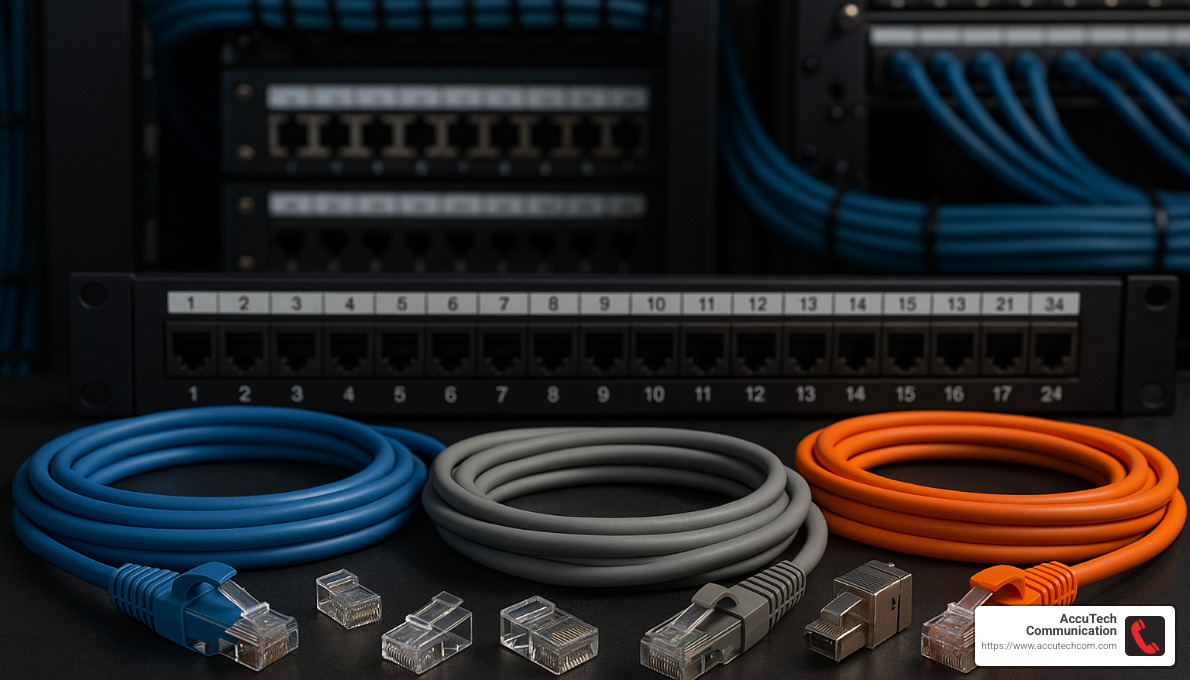
Components of a Network Cabling System
At AccuTech Communications, we’ve installed thousands of these systems over the years, and we’ve learned that a successful network consists of six key components—each playing its own important role:
Every network cabling system starts with the entrance facilities, which is really just a fancy term for the spot where your internet and phone lines enter the building. Think of it as the front door of your network infrastructure—this is where outside services connect to your building. Entrance facilities might come in through overhead wires, underground lines, or even buried cables, depending on your location and needs.
Next, we have equipment rooms—the heart and soul of your network. These centralized spaces house critical hardware, such as network switches, routers, servers, and patch panels. Because they’re like command centers, equipment rooms need careful planning for power supply, cooling, and security measures.
Connecting these vital rooms to each other is your backbone cabling (sometimes called vertical cabling). This high-capacity cabling typically involves fiber optic cables designed to handle heavy data loads between entrance facilities, equipment rooms, and telecommunications rooms. Picture this like the main highways connecting the towns of your network.
Branching off from these main highways is the horizontal cabling. It’s what brings connectivity right to your desks, conference rooms, Wi-Fi access points, and anywhere else you need it. Horizontal cables usually run through ceiling spaces, under floors, or in walls, reaching all the way to work areas.
Telecommunications rooms are like mini equipment hubs. They connect the backbone cabling to the horizontal cabling throughout different parts of your building. They’re strategically placed to efficiently distribute network resources and keep things running smoothly.
Finally, we’ve got work-area components, which include the cables, connectors, wall outlets, and adapters that physically link your computer, phone, or printer to the network through telecommunications outlets. These are the “last-mile” connections that make your devices part of the larger communication system.
When designed properly, a structured network cabling system meets industry standards (like those from the EIA/TIA TR42 committee) and supports multiple technologies. It makes your network reliable today and flexible enough to handle upgrades tomorrow, ensuring you won’t have to rip everything out and start from scratch every few years.
Here at AccuTech Communications, we’ve seen how a thoughtfully planned and professionally installed network cabling system can improve productivity and reduce headaches. Whether it’s in healthcare offices in Boston, manufacturing plants in Worcester, or busy retail spaces in Providence, the right cabling infrastructure makes a huge difference in keeping businesses competitive.
Want to learn more? Check out our articles on cabling installation, structured cable systems, and office cabling solutions.
2. Types of Network Cabling Systems
Not all network cabling systems are created equal—and thank goodness for that! Just like shoes, you wouldn’t wear slippers for hiking or boots to the beach. The same logic applies to network cables; each type is suited for different scenarios, providing varying speeds, distances, bandwidth, and interference resistance.
Let’s explore the main cable types so you can confidently pick the best fit for your network.

Here’s a quick breakdown of the key cable types used in modern network cabling systems:
| Cable Type | Speed | Max Distance | Cost | Best For |
|---|---|---|---|---|
| Twisted Pair | Up to 10 Gbps | 100 meters | $ | Office environments, general networking |
| Coaxial | Up to 1 Gbps | 500 meters | $$ | Cable TV, broadband internet |
| Fiber Optic | Up to 100+ Gbps | Several kilometers | $$$ | Data centers, backbone cabling, high-bandwidth applications |
Twisted Pair Network Cabling Systems
Twisted pair cables are the most common cables you’ll find in modern offices. Why “twisted pair”? Because the cables literally twist pairs of insulated wires together, helping to minimize interference and improve signal quality.
You’ve probably heard of these two main varieties:
Unshielded Twisted Pair (UTP): This is your everyday network cable. It’s affordable, easy to install, and perfect for most indoor office applications. Because it keeps costs down, UTP is popular in schools, small businesses, and commercial buildings.
Shielded Twisted Pair (STP): An extra protective layer shields these cables, providing better resistance against electrical noise. STP cables come in handy in manufacturing facilities or hospitals where heavy equipment might interfere with network signals.
Twisted pair cables are also categorized by their performance:
- Cat5e: Supports speeds up to 1 Gbps (gigabit per second) and frequencies up to 100 MHz. While newer cables have taken center stage, Cat5e remains widespread in older setups.
- Cat6: A solid step up, supporting speeds of 10 Gbps—but only up to 55 meters. At the standard 100-meter run, it delivers speeds of 1 Gbps. It can handle frequencies up to 250 MHz and reduces interference better than Cat5e.
- Cat6A: Now we’re talking future-proofing! Cat6A supports 10 Gbps speeds over the full 100-meter distance and can handle frequencies up to 500 MHz. It’s ideal for businesses planning ahead for high-speed data needs.
Here at AccuTech Communications, we’ve guided many customers in Massachusetts and throughout New England who have upgraded from Cat5e to Cat6 or Cat6A. Trust us—future-you will appreciate the extra bandwidth!
Coaxial Network Cabling Systems
Remember your cable TV connections? Those typically use coaxial cables—often called “coax.” These cables have a single copper wire at their center, surrounded by insulation, a metallic shield, and an outer jacket. This layered design makes coaxial cables great at resisting interference and signal loss.
Today, coaxial cables are mainly used in network cabling systems for specialized purposes, such as:
- Cable television distribution
- Broadband internet services
- Surveillance video systems
While standard Ethernet cables (twisted pair) have become the go-to for most office networking, coax still plays an important role in specific applications needing its unique strengths, like longer distance and stable connectivity.
Fiber Optic Network Cabling Systems
Fiber optic cables are the superheroes among network cables—fast, reliable, and virtually future-proof. Instead of copper wires, these cables use tiny strands of glass or plastic to transmit data through pulses of light. Pretty cool, right?
There are two main types of fiber optic cables:
Single-mode Fiber: Think laser-focused. Single-mode cables have a tiny core (just 8-10 microns), allowing only one path for the light. This means less signal weakening over very long distances, making single-mode ideal for connecting buildings or distant network points.
Multi-mode Fiber: A bit larger (50 or 62.5 microns), multi-mode fiber allows several paths for the light. It’s more affordable and best suited for shorter distances, like within buildings or across campuses.
Fiber optic cables come with significant perks:
- Massive bandwidth: Easily handles enormous amounts of data.
- Immune to electromagnetic interference: Ideal near heavy machinery or electrical equipment.
- Better security: Extremely difficult for unauthorized users to tap in.
- Greater distance: Transmits data over kilometers without losing signal quality.
- Compact and lightweight: Easier to install in tight spaces and reduces clutter.
At AccuTech Communications, we’ve installed fiber optic network cabling systems in data centers and facilities throughout Massachusetts, New Hampshire, and Rhode Island. One hospital administrator in Boston recently told us, “Upgrading to fiber optics was night-and-day. Systems that previously had occasional delays now run flawlessly. No more waiting for critical patient information!”
Want to know more about these cable types? Check out our helpful article, “What is Network Cabling?”, for a deeper dive.
Whatever your unique network needs—whether it’s affordability, distance, or blazing-fast speeds—there’s a cable type designed to get the job done. And the right network cabling system makes all the difference.
3. Benefits of Structured Network Cabling Systems
When it comes to technology, staying organized isn’t just about appearances—it’s about making your life easier and your business stronger. Investing in structured network cabling systems brings you real, measurable benefits that you’ll quickly notice in your day-to-day operations.
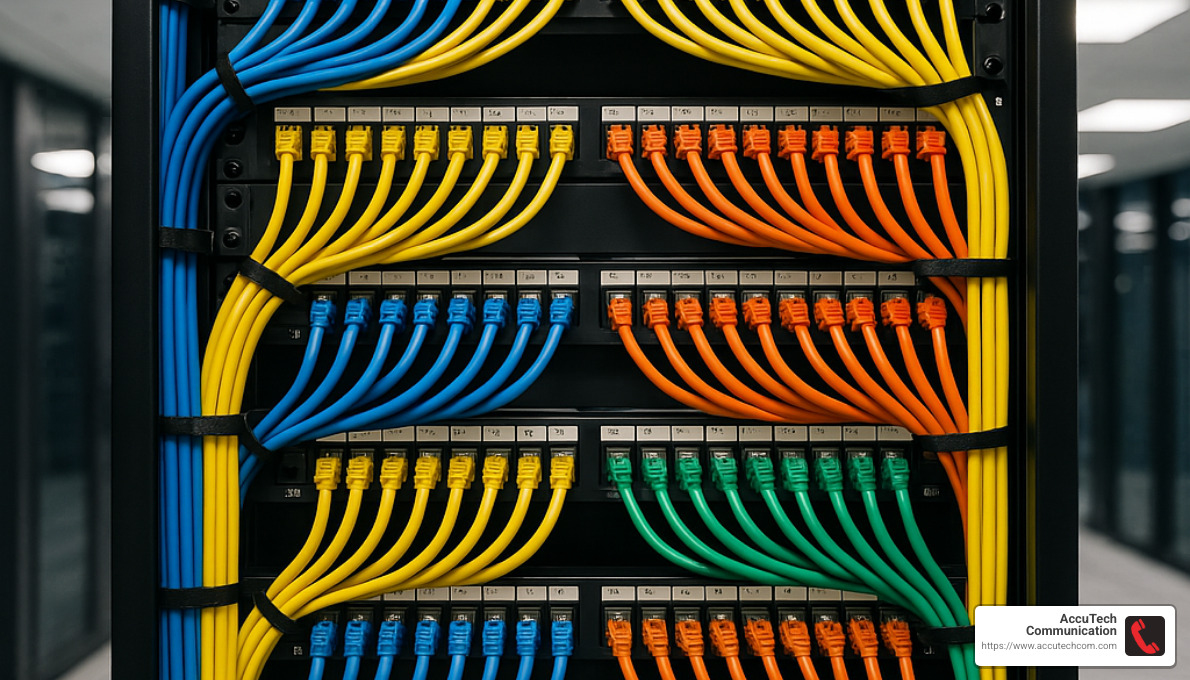
Scalability
One of the best perks of structured network cabling systems is that they’re built to grow with your business. Imagine you’re expanding your team or adding new equipment to keep up with rising customer demand. With structured cabling, adding workstations or new devices is quick and simple—no headaches required!
A facility manager from a manufacturing company in Waltham, MA, shared with us recently, “When we expanded our production floor last year, the structured cabling we installed earlier made the entire transition easy and stress-free. What could have turned into a big mess went smoothly with almost no downtime.”
Reduced Downtime
Did you know structured cabling can reduce network downtime by up to 50%? That’s because structured systems keep everything tidy, organized, and clearly labeled. If something does go wrong, your IT team can quickly pinpoint the issue, meaning fewer disruptions for your team.
Here in New England, we know all too well about unpredictable weather and power issues. Businesses in Massachusetts, New Hampshire, and Rhode Island rely on structured network cabling systems to ensure that storms and other events don’t leave them offline at the worst possible moment.
Improved Performance
A structured cabling system is carefully designed from the start, reducing interference, minimizing bottlenecks, and delivering higher data speeds. That means your employees spend less time waiting for files to transfer or apps to load—and more time doing the work that really matters. It’s like upgrading from a bumpy dirt road to a smooth, fast highway.
Future-Proofing
Technology is always changing, but structured cabling helps your business keep pace effortlessly. By choosing higher-quality cables (like Cat6A) and following industry standards, your infrastructure can easily handle tomorrow’s technologies—without needing a complete overhaul.
In other words, you’re investing in a system that’s built to adapt and thrive, no matter what new innovations come your way.
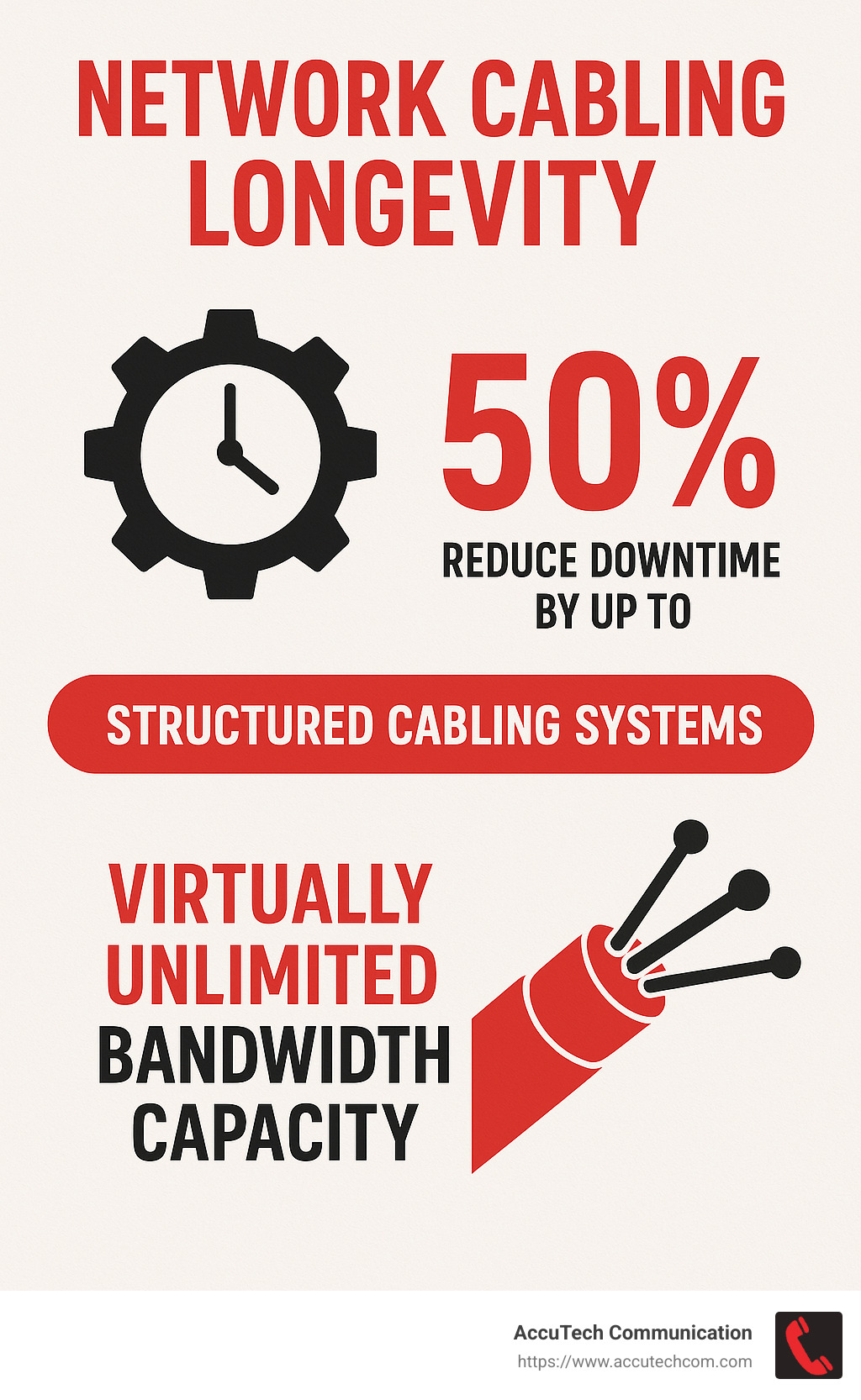
Flexibility
Businesses today move fast and change often. Employees move desks, departments reorganize, and new technologies pop up all the time. Structured network cabling systems handle these shifts with ease, saving you time and money whenever you need to rearrange or adapt your workspace.
We’ve heard from countless businesses around the metro Boston area about how much simpler office reconfigurations become when structured cabling is already in place. Instead of endless cables getting tangled (and making everyone cranky!), adjustments are quick and seamless.
Reduced Clutter
Let’s face it—nobody likes dealing with a mess of cables tangled together like spaghetti. Structured cabling systems keep your workspace clean and organized, making your equipment room or office look professional and well-managed. This tidiness also improves airflow around your equipment, potentially lowering cooling costs.
A hospital IT director in Worcester summed it up perfectly: “Beyond technical performance, the clean, organized cabling transformed our server room. It’s easier to maintain, looks professional, and we’ve even noticed lower cooling bills.”
Improved Security
Believe it or not, structured cabling also makes your business safer. Organized, labeled cables make unauthorized connections obvious, helping quickly identify potential security breaches. And better documentation means your IT team can swiftly spot and address any vulnerabilities.
For businesses in regulatory-heavy industries like healthcare and finance (and we serve plenty of those in Massachusetts and throughout New Hampshire and Rhode Island), structured cabling is essential for staying compliant and secure.
Want to learn even more about how structured cabling can benefit your business? Check out our detailed guide on The Advantages of Structured Cabling for Your Business.
4. Best Practices for Installing Network Cabling Systems
Properly installing network cabling systems isn’t just about neatly running cables from point A to point B—though, let’s admit, neatly run cables are strangely satisfying. It’s about creating a reliable, high-performing, and future-ready foundation for your entire IT infrastructure. Trust me: after spending three decades installing cabling across Massachusetts, New Hampshire, and Rhode Island, we at AccuTech Communications have seen it all—good, bad, and spaghetti-like.
Here are the essential best practices we swear by to ensure your cabling serves you well now and for years to come.
Planning and Design
Great installations start with thorough planning—it’s the step you really can’t skip. It’s tempting to jump right in (we get it, fresh cable reels are exciting!), but trust us: careful planning pays dividends.
First, carefully assess both your current needs and your future requirements (think at least 5-10 years ahead). Are you planning to expand your team, adopt new technologies, or change your office layout? A bit of crystal ball gazing now can save you a lot of headaches later.
Next, create detailed schematics. Clearly map out cable routes, equipment locations, and connection points. Do a careful calculation of cable lengths, adding service loops and extra slack for proper routing. You’ll thank yourself later when you’re not awkwardly pulling cables tighter than guitar strings just to connect devices.
Also, don’t forget about environmental factors. Consider heat, humidity, physical obstructions, electromagnetic interference sources, and physical security requirements. A well-planned installation will save you stress, hassle, and money in the long run.
One IT director at an educational institution in Marlborough summed it up best: “The time we spent in the planning phase saved us countless headaches later. Having AccuTech map out our entire campus network before installation helped us avoid expensive changes down the road.”

Adherence to Standards (Trust Us: Standards Matter!)
We understand. Standards don’t sound very exciting. But when it comes to network cabling systems, following industry standards is a must. Why? Standards ensure compatibility, longevity, and optimum performance of your network.
At AccuTech Communications, our technicians follow key industry guidelines, including:
- ANSI/TIA-568 — the gold standard (literally) for commercial building cabling.
- ISO/IEC 11801 — the international equivalent, ensuring global compatibility.
- BICSI Standards — best practices from industry experts.
- Local building codes — making sure your installation meets all fire safety and regulatory requirements in your area.
We train and certify all our technicians rigorously, so every installation we complete across New England meets or exceeds these requirements.
Proper Cable Management (Neatness Counts!)
Proper cable management isn’t just an aesthetic choice—though, let’s face it, an organized cable system is a thing of beauty. It’s critical for maintenance, troubleshooting, and protecting your investment.
Always use appropriate cable pathways: J-hooks, cable trays, and conduits help protect the cables and maintain proper bend radius. Keep power and data cables separate to prevent interference. Follow bend radius limitations—sharp bends aren’t good news for data signals or cable integrity.
And forget the zip ties! Velcro straps are your cable’s best friend—they provide gentle support without compressing or damaging the cable. Also, leave plenty of room for expansion; your future self (or future IT team) will thank you.
As a wise technician once told us:
“A well-organized cabling system reduces the risk of connectivity issues, which are a common cause of network downtime.”
Labeling and Documentation (The Gift That Keeps On Giving)
Detailed labeling and documentation aren’t optional—they’re essential tools to help maintain and troubleshoot your system over time.
Label both ends of every cable clearly, including location, purpose, and connection points. Keep detailed cable schedules in an easily accessible central database or spreadsheet. And don’t just tell—show. Maintain up-to-date diagrams and even take photographs of critical installation points. Future troubleshooting becomes infinitely easier when you can quickly pinpoint exactly where each cable goes.
A healthcare IT manager in Boston told us: “When we had an urgent issue at 2 AM, the detailed labeling and documentation provided by AccuTech allowed us to quickly identify and resolve the problem without disrupting patient care.” Yep—we really mean it when we say documentation saves the day.
Testing and Certification (Proof is in the Performance)
A great-looking installation isn’t enough—it also has to perform reliably. Every single cable run should be rigorously tested to confirm it meets or exceeds expected performance parameters: length, attenuation, NEXT (Near-End Crosstalk), and return loss.
At AccuTech Communications, we use advanced testing equipment like Level IV NEXT/FEXT PairScanners for copper cabling and OTDR (Optical Time Domain Reflectometer) for fiber optic cables. We don’t stop testing until everything meets or surpasses the required standards. And, of course, we provide detailed test reports, so you have full confidence in your network cabling system.
Environmental Considerations (Mother Nature Has a Say)
Your cables need TLC, especially when it comes to environmental considerations. Keep cables away from heat sources (heating vents, radiators, or areas with direct sunlight). Moisture-prone areas require appropriate cable types and added protection. Steer clear of areas with high electromagnetic interference (think fluorescent lights and motors).
It’s also wise to install cables in protected areas where they won’t accidentally be damaged by foot traffic, furniture, or equipment. After decades of working across New England—from historic Boston buildings to busy manufacturing plants in Worcester—we’ve learned that thoughtful cable placement is key to longevity.
Want more detailed info on installation best practices? Check out our dedicated page on Network Cable Installations.
Or dive deeper into industry guidelines with this handy Guide to Network Cabling Standards.
At AccuTech Communications, we’ve seen how following these best practices makes a dramatic difference. A properly installed, tested, and documented network cabling system is a reliable, future-proof investment in your business’s connectivity and productivity.
5. The Future of Network Cabling Systems
Technology never sits still—and neither do network cabling systems. As businesses continue to adopt new tech like cloud computing, virtual reality (VR), artificial intelligence (AI), and a myriad of IoT devices, the demands placed on cabling infrastructure continue to grow. Here’s a friendly peek at what’s coming down the pipeline (no pun intended).
High-Speed Data Transmission
Today’s businesses crave speed. Whether it’s streaming high-definition video conferences, crunching big data analytics, or leveraging real-time AI applications, faster data transfer rates are becoming essential.
Many companies now see 10 Gigabit Ethernet as standard, especially for high-performance office networks. In data centers, the bar is set even higher—40 and 100 Gigabit Ethernet are quickly becoming the norm. And believe it or not, we’re already seeing the emergence of 400 Gigabit Ethernet for ultra-fast backbone applications.
At AccuTech Communications, we’ve seen how upgrading to high-speed cabling systems gives our clients across Massachusetts, New Hampshire, and Rhode Island a competitive edge—improving both productivity and operational efficiency.
CAT6A and Beyond
CAT6A is currently the go-to copper cabling choice for modern network cabling systems, offering outstanding performance and reliability. But tech always moves forward, and newer standards are already appearing on the horizon.
For example, CAT7 cabling supports frequencies up to 600 MHz, providing even better shielding from interference (though be aware it uses a different type of connector, not the typical RJ45). Meanwhile, CAT8 cables are specifically designed for data centers, capable of delivering speeds up to 40 Gbps at frequencies as high as 2000 MHz—though these cables have a shorter maximum distance (around 30 meters).
The variations CAT8.1 and CAT8.2 offer different shielding options and connector compatibility, helping companies tailor their cabling to specific environments. Our team at AccuTech regularly advises businesses in the Metro-west Boston area on when these new standards make sense to adopt—ensuring they’re well-prepared for the future without unnecessarily breaking the bank today.
PoE Advancements
PoE (Power over Ethernet) technology is revolutionizing how we design and use networks. Traditionally, Ethernet cables just transferred data. Now, with PoE, the same cable can also deliver electrical power to connected devices, eliminating the need for separate power sources.
Modern PoE systems have come a long way. Early versions provided only around 12.4 watts per device, but today’s standards can deliver up to 90 watts! This additional power opens doors for connecting many more kinds of equipment—like high-performance wireless access points, sophisticated pan-tilt-zoom security cameras, vibrant digital signage displays, and even entire lighting systems.
One facility manager we worked with in Waltham recently installed PoE lighting throughout their office building. He told us, “We cut our installation costs by 30%, and now we have much greater flexibility to control lighting compared to traditional electrical wiring. It’s been a real game-changer.”
IoT Integration
Have you noticed how everything—from thermostats and security cameras to coffee machines and door locks—seems to be connected these days? Welcome to the Internet of Things (IoT). As more businesses accept IoT, the demands on network cabling systems grow fast.
With so many additional devices connected to the network, businesses need more connection points, higher bandwidth, improved security, and reliable power delivery to remote sensors and devices. Structured cabling provides the stable foundation that IoT deployments require, keeping all those smart devices running smoothly and securely.
Smart Buildings
Speaking of connected devices, modern buildings are becoming “smart,” bringing together multiple systems into one unified network cabling infrastructure. Building automation, security and access control, energy management, environmental monitoring, and even occupancy tracking all now rely on advanced structured cabling.
In Boston and throughout Massachusetts, we’ve seen customers eagerly adopt smart building technology in new construction and renovations. Having a future-proofed, robust cabling strategy from the start helps ensure these integrated systems are reliable, secure, and easy to maintain.
Future-Proof Infrastructure
With all these exciting advancements, how do you make sure your cabling investment stays relevant for years to come? The key is planning ahead. A truly future-proof network cabling system typically includes a few smart strategies:
- Over-Provisioning Capacity: Install higher-grade cabling and additional cable runs than you currently need.
- Robust Pathways: Make sure cables have ample space and clear pathways for future expansions.
- Flexible Design: Use modular components and structured designs that can easily adapt as your needs evolve.
- Comprehensive Documentation: Maintain clear and detailed records, diagrams, and labeling to simplify future updates.
- Standards-Based Approach: Follow established industry standards designed to anticipate and support future technological advances.
A CIO from a growing technology company in Sudbury recently told us, “Working with AccuTech on our cabling infrastructure was one of the best tech investments we’ve ever made. Three years later, we’re still ready to handle new tech without needing costly infrastructure overhauls.”
Technology certainly won’t slow down—but with smart planning and the right partner, neither will your business. At AccuTech Communications, we’re here to help you build a cabling infrastructure that’s ready for whatever the future holds.

Learn more about cabling types and categories on our page about Network Cable Categories.
Conclusion
Throughout this guide, we’ve explored the foundational role network cabling systems play in creating reliable, efficient, and adaptable business infrastructures. From learning the ins-and-outs of structured cabling to understanding different cable types and installation best practices, it’s clear that your network’s physical infrastructure is much more than just a collection of wires and connectors—it’s the backbone of your daily operations.
Structured cabling isn’t just an IT buzzword—it’s a carefully planned approach that ensures your network is scalable, flexible, and ready for the challenges of tomorrow. Whether you choose twisted pair cabling for your office spaces, coaxial cables for specialized broadband applications, or fiber optics for unparalleled speed and reliability, the cables you select today directly impact your business performance for years to come.
Proper installation, clear labeling, detailed documentation—these may sound dull, but trust me, they’re your network’s best friends. Investing time and care during the installation process reduces downtime, simplifies troubleshooting, and ensures everything runs smoothly. Plus, there’s nothing like a neatly organized server room to impress visiting clients, right?
Looking ahead, new advancements are already shaping the future of network cabling systems. High-speed data transmission, powerful Power over Ethernet (PoE) capabilities, and the rapid expansion of IoT devices and smart buildings—all these trends highlight the importance of future-proofing your infrastructure. Planning ahead now means less headache—and fewer surprise expenses—down the road.
At AccuTech Communications, we’ve proudly helped businesses across Massachusetts, New Hampshire, and Rhode Island build solid, reliable networks since 1993. Our team of certified technicians brings decades of hands-on experience to every installation, ensuring your network meets today’s demands while staying adaptable for tomorrow. Whether you’re expanding to a new location in Boston, upgrading your facility in Worcester, or just tired of the tangled mess in your Marlborough office, we’ve got you covered.
In short, your network cabling system is the nervous system of your business. It connects your people, powers your communications, and helps you deliver the service your customers expect. Choosing the right partner to design, install, and maintain this critical infrastructure isn’t just smart—it’s essential.
If you’re ready to take your network to the next level, contact AccuTech Communications today. We’ve been doing this for over 30 years, and we’d love to put our expertise to work for your business.
Frequently Asked Questions about Network Cabling Systems
What are the main components of a network cabling system?
A complete network cabling system is like a well-organized highway system—it has multiple parts working together to keep your data flowing smoothly. Here’s how it breaks down:
It all starts with Entrance Facilities, the point where outside telecom services—think internet providers—connect into your building.
From there, the cables run to Equipment Rooms, which are basically the control centers housing all your important telecom gear and network servers.
Connecting these critical spaces is Backbone Cabling, the high-capacity and typically vertical wiring that carries data between floors or buildings.
Next, you have Telecommunications Rooms, smaller areas that link backbone cabling to the cables serving individual workstations.
From telecommunications rooms, Horizontal Cabling runs directly to your employees’ desks and workstations, delivering connectivity right where it’s needed.
Lastly, we have Work-Area Components, which include the cables, adapters, and connectors that plug into computers, phones, printers, and other devices at the user’s end.
Each of these components plays a vital role in making sure your network cabling system is reliable, flexible, and able to keep up with your business needs—today and in the future.
How do network cabling systems support future growth?
Structured network cabling systems are specifically designed to grow with your business. The secret ingredient? Smart planning.
By following industry standards (like ANSI/TIA-568 and ISO/IEC 11801), your cabling infrastructure can easily handle new technologies as they come along. Installing higher-grade cabling (like Cat6A instead of Cat6) gives you extra bandwidth to handle increased data demands down the road.
Building in a bit of extra capacity, such as installing additional connections and cable runs during the initial installation, ensures you’ll have room for future expansion without a costly overhaul later on.
And because structured cabling uses modular components like patch panels and equipment racks, it’s easy to add, move, or upgrade components when needed.
Finally, keeping detailed, clear documentation about your network setup means any future changes or expansions can be done quickly and efficiently. At AccuTech Communications, we’ve helped countless businesses across Massachusetts, New Hampshire, and Rhode Island plan ahead so they’re ready for whatever comes next.
Why is proper documentation important in network cabling installations?
Imagine trying to find your way around Boston without a GPS or map—it’s frustrating, right? The same goes for managing your network cabling systems without proper documentation. Good documentation is like the GPS for your network infrastructure.
When there’s a problem (and let’s face it, sooner or later, there usually is), accurate and clear documentation allows technicians to quickly pinpoint and fix the issue. This means your business experiences less downtime, fewer headaches, and a lot fewer frantic phone calls to IT at 2 AM.
Routine maintenance also becomes much simpler. Technicians know exactly where every cable starts and ends, which saves a ton of time when making repairs or upgrades. Changes—like moving desks around or adding new technology—also become faster and easier because your documentation clearly shows where everything should go.
Proper documentation even helps in disaster recovery situations. If the unexpected happens and your system is damaged, detailed records allow rapid restoration of your network, minimizing disruption to your business.
And let’s not forget employee turnover. When your favorite network administrator decides to retire to a beach somewhere sunny (lucky them!), thorough documentation ensures that crucial knowledge doesn’t walk out the door with them.
A hospital IT manager in Boston once told us, “When we experienced a partial network outage at 2 AM, the detailed documentation provided by AccuTech allowed our on-call technician to identify and resolve the issue within minutes—even though he’d never worked on that specific system before!”
After three decades installing and maintaining network cabling systems across Massachusetts, Rhode Island, and New Hampshire, we’ve found that taking the time to document everything thoroughly pays off again and again.
