
Ethernet Cable Types: 6 Essential Choices for 2025 Success
When it comes to ethernet cable types, they remain a cornerstone of reliable network connectivity. Wired connections, such as those supported by Ethernet cables, offer best reliability, speed, and stability compared to wireless connections. If your business operations require consistent high-speed internet, reducing downtime, or maintaining data safety, understanding ethernet cable types is essential. Here’s a quick look at the most common categories:
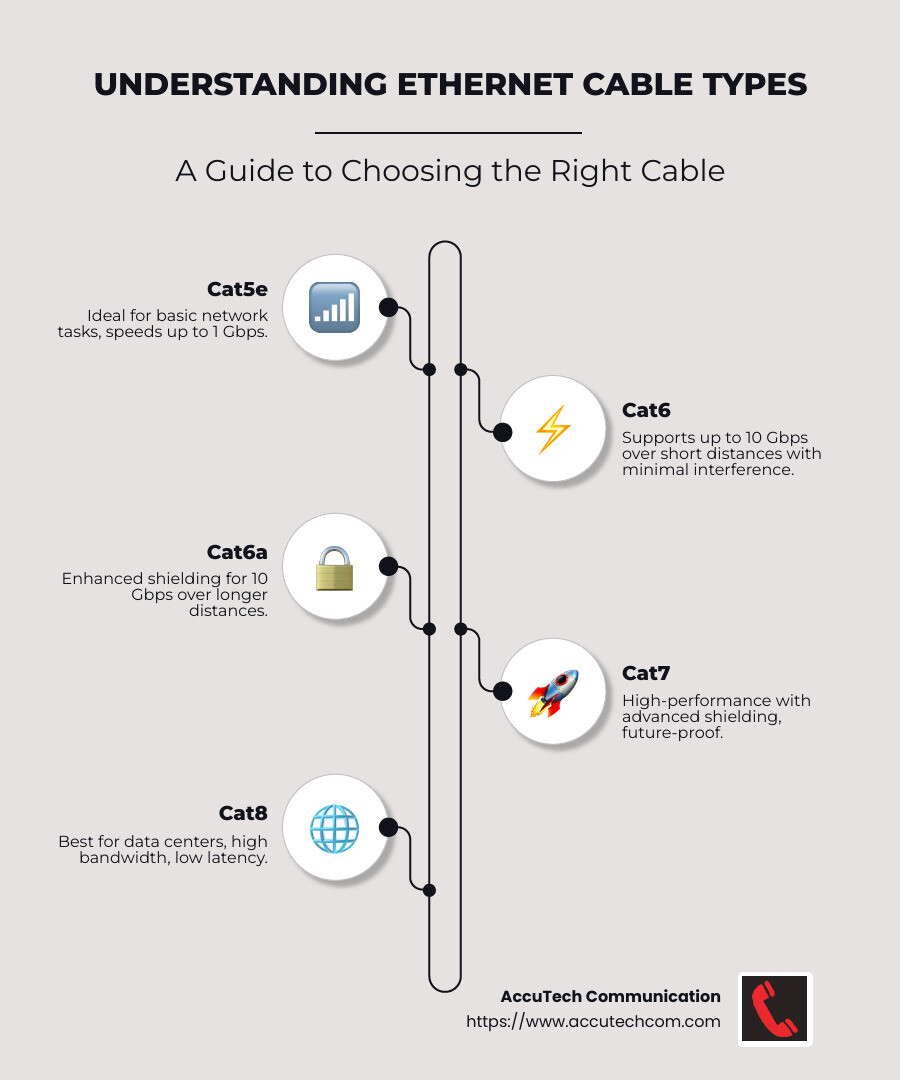
- Cat5e: Good for most basic network tasks, offering speeds up to 1 Gbps.
- Cat6: Supports higher speeds, up to 10 Gbps over short distances.
- Cat6a: Improved shielding for less interference, ideal for maintaining 10 Gbps over longer distances.
- Cat7: High-performance with advanced shielding for future-proofing.
- Cat8: Best for data centers or environments demanding high bandwidth and low latency.
I’m Corin Dolan, and with over two decades of experience in telecommunications, I am well-versed in ethernet cable types and their applications. My expertise stems from years of practical involvement in optimizing network infrastructures for businesses of all sizes. Transitioning from introductory insights into detailed discussions about ethernet cable types, the next section digs deeper into each category’s specifics.
Handy ethernet cable types terms:
– network cable categories
– network cable speeds
– rj45 network cable
Ethernet Cable Types Overview
Understanding the different ethernet cable types is crucial for setting up a reliable network. Let’s break down the categories from Cat5 to Cat8, highlighting their key features and uses:
Cat5 and Cat5e
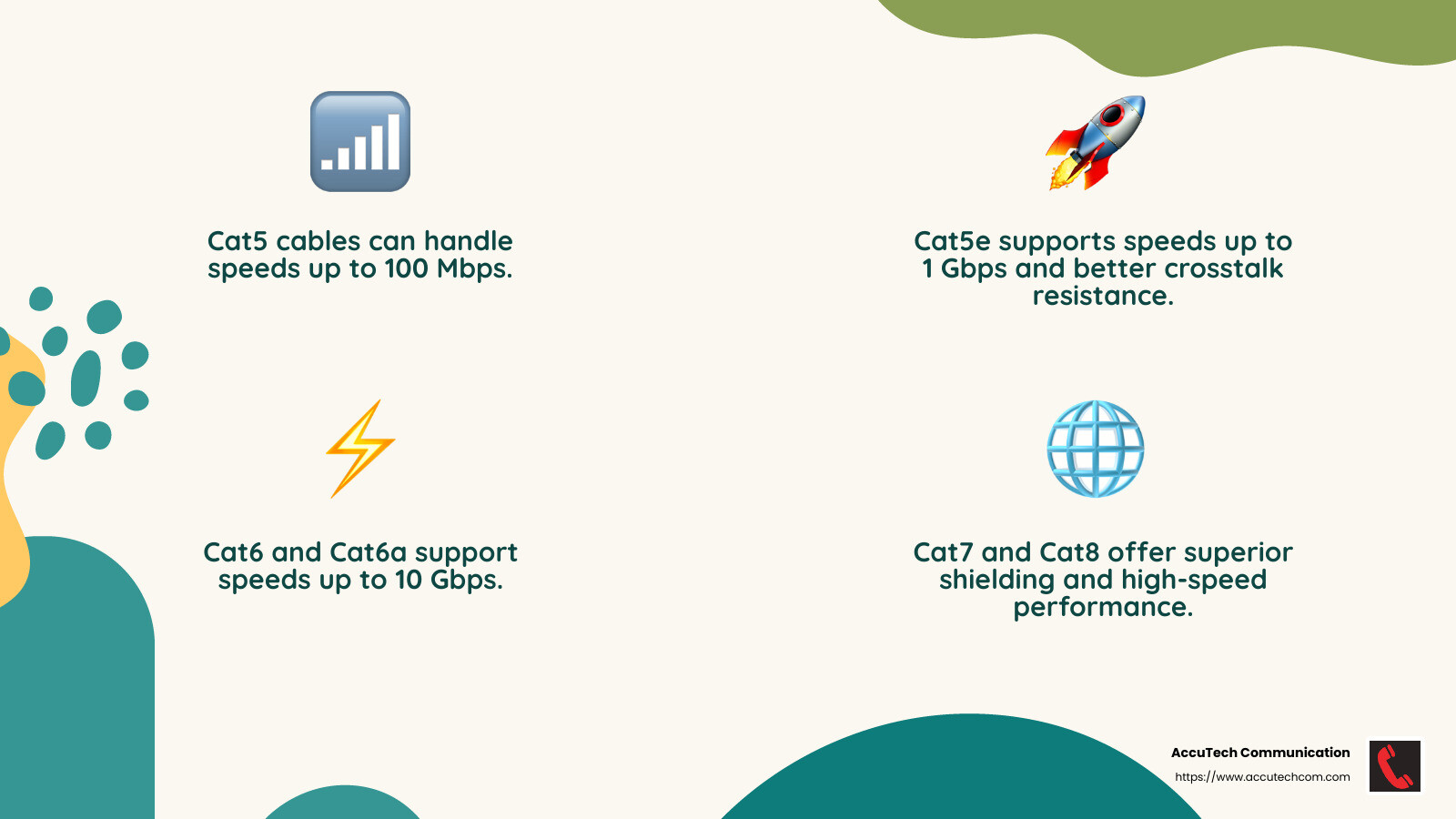
- Cat5: Once the standard for Ethernet networks, Cat5 cables can handle speeds up to 100 Mbps. They’re suitable for basic tasks like connecting a desktop to a router in a small home network.
- Cat5e: An improved version of Cat5, Cat5e cables support speeds up to 1 Gbps. They offer better resistance to crosstalk, making them more reliable for faster data transfer. Ideal for small to medium-sized networks that need a cost-effective solution.
Cat6 and Cat6a
- Cat6: These cables support speeds up to 10 Gbps over short distances (up to 55 meters). They are a popular choice for home networks where higher speeds are needed. Cat6 cables also offer better shielding against interference compared to Cat5e.
- Cat6a: An upgrade from Cat6, Cat6a cables maintain 10 Gbps speeds over longer distances (up to 100 meters) thanks to improved shielding. They are perfect for environments with more network traffic or electronic interference, like busy office spaces.
Cat7 and Cat8
- Cat7: Designed for high-performance networking, Cat7 cables support speeds up to 10 Gbps and offer superior shielding to reduce interference. They are often used in data centers and enterprise networks where performance and reliability are critical.
- Cat8: The latest in Ethernet technology, Cat8 cables support speeds up to 25-40 Gbps. These cables are ideal for data centers or environments that require high bandwidth and low latency, such as server rooms. However, their maximum length is limited to 30 meters.
Each ethernet cable type serves different needs, from simple home setups to complex data centers. Choosing the right one depends on factors like speed requirements, distance, and potential interference. We’ll dig deeper into the specifics of each category, helping you make the best choice for your network needs.
Detailed Comparison of Ethernet Cable Types
Cat5 and Cat5e
Cat5 and Cat5e cables are the veterans of the Ethernet world. Cat5 cables, while mostly phased out now, were once the go-to choice for basic networking needs. They support 100BASE-T networks, handling speeds up to 100 Mbps. This makes them suitable for simple tasks like connecting a desktop to a router in small home networks.
Cat5e, or “improved” Cat5, is still widely used due to its cost-effectiveness. It supports Gigabit Ethernet, allowing speeds up to 1 Gbps. This makes it a practical choice for small to medium-sized networks that need a reliable yet affordable solution. The improved design of Cat5e reduces crosstalk, ensuring more stable data transfers compared to its predecessor.
Cat6 and Cat6a
Cat6 cables bring a significant leap in performance, supporting speeds up to 10 Gbps over short distances (up to 55 meters). This makes them a popular choice for home networks where faster speeds are needed. The cables also offer better shielding options to minimize interference, making them more reliable than Cat5e in environments with more electronic noise.
Cat6a takes it a step further by maintaining 10 Gbps speeds over longer distances (up to 100 meters). Thanks to its improved shielding, Cat6a is ideal for high-traffic environments like busy offices or commercial spaces. These cables are bulkier and less flexible, but they offer superior performance in reducing crosstalk and external interference.
Cat7 and Cat8
Cat7 cables are designed for high-speed networking, supporting speeds up to 10 Gbps with even more advanced shielding than Cat6a. This makes them suitable for data centers and enterprise networks where performance and reliability are non-negotiable. Cat7 cables use a modified connector (GG45), which is backward compatible with standard RJ45 ports, ensuring flexibility in various setups.
Cat8 is the cutting-edge of Ethernet technology. These cables support astonishing speeds of 25-40 Gbps, making them perfect for data centers or environments demanding high bandwidth and low latency, such as server rooms. However, Cat8 cables have a maximum length of 30 meters, so they are best suited for short-distance, high-performance applications. With their advanced shielding, Cat8 cables ensure minimal interference, offering a future-proofing solution for networks anticipating heavy data loads.
Each of these ethernet cable types is custom to specific needs, from basic home networks to sophisticated data centers. Choosing the right cable depends on factors like required speed, distance, and the potential for interference. We’ll explore how to choose the right Ethernet cable for your unique needs.
Choosing the Right Ethernet Cable for Your Needs
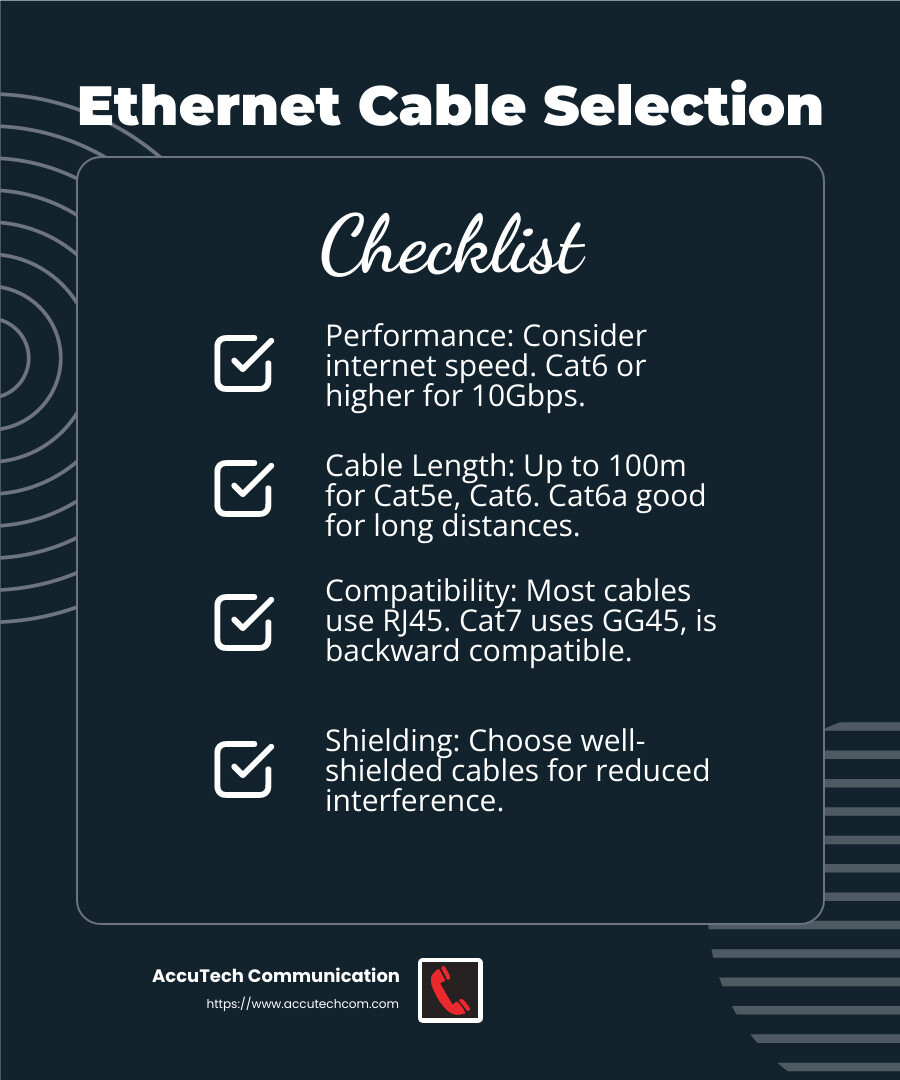
Selecting the right Ethernet cable can feel overwhelming, but it doesn’t have to be. By focusing on performance, cable length, compatibility, and shielding, you can easily find the best fit for your setup.
Performance
Start with your internet speed. If you have a high-speed connection, like gigabit internet, a Cat5e cable might be the minimum you need. For even faster speeds, consider Cat6 or higher. These cables can support up to 10Gbps, which is great for streaming, gaming, or transferring large files.
If you’re planning for the future, Cat7 or Cat8 cables offer the best performance. They support speeds up to 40Gbps and are ideal for data-intensive environments like data centers or server rooms.
Cable Length
Cable length can impact performance. Most Ethernet cables, like Cat5e and Cat6, work well up to 100 meters. Beyond this, you might experience signal degradation. Cat6a maintains high speeds over long distances, making it a good choice for larger spaces.
However, Cat8 cables are limited to 30 meters. They’re perfect for short runs in high-performance settings but not suitable for long distances.
Compatibility
Compatibility is key. Most Ethernet cables use the standard RJ45 connector, making them easy to plug into routers, switches, and computers. However, Cat7 cables use a GG45 connector, which is backward compatible with RJ45, providing flexibility.
While newer cables can connect to older devices, they won’t improve the device’s maximum speed. Ensure your equipment can take full advantage of the cable’s capabilities.
Shielding
Shielding protects against interference. If your cable runs near other electronic devices, choose a cable with good shielding. Cat6 and above often come with shielding options to reduce crosstalk and external noise, making them more reliable in busy environments.
For areas with high interference, like industrial settings, Cat7 and Cat8 offer superior shielding, ensuring stable connections.
Choosing the right Ethernet cable involves balancing these factors to meet your specific needs. Whether you’re setting up a home network or managing a data center, understanding these elements will guide you to the best choice.
Applications and Use Cases
Home Networking
When it comes to setting up a home network, Cat6 and Cat6a cables are often the go-to choices. They offer impressive speeds up to 10Gbps, which is more than enough for streaming your favorite shows, gaming, or working from home. These cables are perfect for shorter distances typically found in residential settings. Plus, if you live in a busy apartment complex, you can opt for shielded versions to minimize interference from neighboring devices and cables.
Commercial Applications
In commercial settings, where data sanctity and speed are paramount, Cat8 cables stand out. They provide the best performance and shielding options, making them ideal for environments where sensitive information is exchanged. However, keep in mind that Cat8 cables are limited to 30 meters, so using a booster might be necessary for longer runs.
For businesses looking for a balance between cost and performance, Cat6a offers a robust solution with better shielding than Cat6, making it suitable for office environments with moderate interference.
Data Centers
Data centers require high-speed, reliable connections to manage vast amounts of data. Here, fiber optic cables are the stars. They outperform traditional twisted copper pair cables, offering bandwidths that can exceed 400 Gbps. Fiber optics are also length-friendly, supporting multi-mile connections, which is crucial in large-scale data centers. Their superior shielding and weatherproofing options make them resilient to environmental factors, ensuring a stable and fast network.
IoT Devices
For IoT edge devices that are hard to reach with traditional power cables, Power over Ethernet (PoE) connections are a game-changer. PoE simplifies wiring by allowing both power and data to be transmitted over a single Ethernet cable. This is particularly useful for deploying IoT devices in remote or hard-to-access locations, enabling smart homes and businesses to thrive without the clutter of multiple cables.
Understanding the various applications and use cases for different Ethernet cable types helps in choosing the right cable for your specific needs, whether it’s for a cozy home setup, a busy office, or a high-demand data center.
Frequently Asked Questions about Ethernet Cable Types
What are the different types of Ethernet cables?
When diving into Ethernet cable types, you’ll come across several options: Cat5, Cat5e, Cat6, Cat6a, Cat7, and Cat8. Each of these categories offers different levels of performance, speed, and shielding.
- Cat5: This is an older standard, supporting speeds up to 100 Mbps. It’s mostly phased out but still found in some older installations.
- Cat5e: An improved version of Cat5, it supports Gigabit Ethernet (1 Gbps) and is more adept at reducing crosstalk, making it a cost-effective choice for many.
- Cat6: Offers speeds up to 10 Gbps over short distances (up to 55 meters) and has better shielding options, making it ideal for home networks.
- Cat6a: An improvement over Cat6, it supports 10 Gbps up to 100 meters and provides improved shielding to reduce interference.
- Cat7: Boasts even better shielding for interference reduction and supports speeds up to 10 Gbps, often used in data-heavy environments.
- Cat8: The latest in Ethernet cabling, Cat8 supports speeds up to 25 or 40 Gbps and features advanced shielding, making it perfect for data centers and future-proofing.
Is Cat5 or Cat6 better for Ethernet?
When comparing Cat5 and Cat6, the choice largely depends on your needs. Cat6 is generally better for Ethernet due to its support for higher speeds (up to 10 Gbps) and improved ability to reduce crosstalk. This makes Cat6 a better choice for modern networks, especially in environments where data transfer speed and reliability are crucial. On the other hand, Cat5 might still suffice for less demanding applications or legacy systems.
What is the difference between Cat6 and Cat7 Ethernet cables?
The primary differences between Cat6 and Cat7 cables lie in their shielding and performance capabilities. Cat7 cables offer superior shielding, which significantly reduces electromagnetic interference, ensuring a cleaner and more reliable signal. This makes Cat7 suitable for environments with high interference or where maintaining signal integrity is critical.
Additionally, while both support speeds up to 10 Gbps, Cat7 is often more robust over longer distances, maintaining performance better than Cat6. However, it’s worth noting that Cat7 cables can be more expensive and may require specific connectors, so they are best used in settings where their advanced features are needed.
Conclusion
At AccuTech Communications, we understand that the backbone of any successful network lies in choosing the right Ethernet cable types. Whether you’re setting up a home network or equipping a large data center, the quality of your network cabling can make all the difference.
Our commitment to delivering top-notch service has been unwavering since 1993. We pride ourselves on offering certified and reliable network cabling solutions custom to the unique needs of businesses across Massachusetts, New Hampshire, and Rhode Island. Our expertise ensures that your network infrastructure is not only robust but also future-proofed against the demands of tomorrow.
We offer a comprehensive range of services, from consultation and design to installation and maintenance. Our team of skilled technicians is dedicated to optimizing your network for peak performance. With AccuTech, you can expect competitive pricing and a steadfast commitment to quality, ensuring that your business stays connected without a hitch.
Choose AccuTech Communications for your network cabling needs and experience the difference that quality service can make. Let us be your trusted partner in building a network wired for success.
Explore our network cable services and see how we can help lift your business connectivity today.
