
Fiber Optics Technician Jobs: Unlock Your 2025 Future
Why Fiber Optics Technician Jobs Are Booming
Fiber optics technician jobs are booming as the demand for faster, more reliable internet grows. The telecommunications industry is expanding its fiber optic infrastructure, creating thousands of new opportunities for skilled technicians to install, maintain, and repair the backbone of our digital world.
Top Fiber Optics Technician Job Opportunities:
- Installation Technician – Install new fiber optic cables and equipment
- Maintenance Technician – Perform regular system maintenance and repairs
- Splicing Technician – Join fiber optic cables using fusion or mechanical splicing
- Testing Technician – Use OTDR and power meters to verify system performance
- Outside Plant (OSP) Technician – Work on outdoor cable installations
- Inside Plant (ISP) Technician – Handle indoor data center and building connections
Key technical skills include working with fiber optic cables, power meters, OTDR systems, and various connector types. As one industry expert noted, “Everyone deserves access to fast, reliable, fairly priced internet. Help us bring it to them.”
Salary ranges vary by location and experience:
- Entry-level positions: $32,500 – $45,000 annually
- Experienced technicians: $57,300 – $72,400 annually
- Specialized roles can exceed $77,000 annually
I’m Corin Dolan, owner of AccuTech Communications. With over 30 years in telecommunications, I’ve helped businesses across Massachusetts, New Hampshire, and Rhode Island build robust network infrastructures. I’ve seen fiber optics technician jobs evolve from niche positions to essential roles that keep our world connected.

Fiber optics technician jobs terms simplified:
What is a Fiber Optic Technician and What Do They Do?

A fiber optic technician is a skilled professional who works with the thin glass fibers that carry light signals for high-speed internet and data networks. Think of us as the construction crew, maintenance team, and emergency repair service for the internet’s superhighways.
Our core responsibilities include:
- Installation: We run new fiber optic cables through buildings, underground conduits, or on utility poles. This involves reading blueprints, planning cable routes, and ensuring every installation meets strict specifications.
- Splicing: This is a delicate and critical skill. Using a fusion splicer, we melt and fuse tiny glass fibers to join cables, creating a seamless connection for light to pass through.
- Maintenance: We perform regular inspections to check signal strength and identify potential problems before they cause outages, keeping networks running smoothly.
- Testing: Using equipment like Optical Time Domain Reflectometers (OTDRs) and power meters, we measure signal quality, locate faults, and verify network performance after any work is completed.
- Troubleshooting & Repair: When a cable is damaged, we act as detectives to find the exact location of the problem and perform the necessary repairs to restore service.
- Termination: We attach connectors to the ends of fiber optic cables, carefully polishing each one to minimize signal loss so they can plug into network equipment.
Our work environment varies dramatically, from climate-controlled data centers (Inside Plant or ISP) to outdoor aerial installations (Outside Plant or OSP). Every video call, streaming movie, and online transaction depends on the fiber optic networks we build and maintain.
More info about fiber optic cable
What is Fiber Optic Cable Used For?
The Path to Becoming a Technician: Skills and Certifications
Entering the field of fiber optics technician jobs doesn’t require a four-year degree, but it does demand a commitment to learning specific technical and practical skills.
Essential Skills for the Job
Success as a technician relies on a blend of technical knowledge and practical abilities.
- Technical Knowledge: A fundamental understanding of fiber optic cables (single-mode vs. multi-mode), how they transmit light, and proper handling techniques is essential.
- Hands-On Skills: Proficiency with specialized tools is critical. This includes using OTDRs for testing, power meters for verifying signal strength, and fusion splicers for joining cables.
- Physical & Safety Skills: Much of the work involves physical activity, including safely using ladders and bucket trucks for aerial installations.
- Soft Skills: Strong problem-solving is needed to diagnose complex network issues. Attention to detail is crucial for precise work like splicing and termination. Good communication skills are important for interacting with customers and team members.
Here are the essential tools you’ll master:
- OTDR (Optical Time Domain Reflectometer)
- Power Meters
- Fusion Splicer
- Ladders (usually 18 feet minimum)
- Bucket Truck
- Fiber inspection scopes and cleaning equipment
Fiber Optic Technician skills for your resume and career
Qualifications and How to Get Certified
The path to becoming a technician is straightforward. A high school diploma or GED is the typical starting point. From there, you can pursue:
- Technical Training: Vocational schools and training programs offer focused courses on fiber theory, installation, and hands-on splicing practice.
- Certifications: These are key to proving your expertise. The Certified Fiber Optic Technician (CFOT) from the Fiber Optic Association (FOA) is the industry gold standard. The FOA also offers specialized credentials for splicing (CFOS/S) and outside plant work (CFOS/OSP). The Electronics Technicians Association International also provides respected certifications.
Continuous learning is vital as technology evolves. Quality companies like AccuTech Communications often invest in their technicians’ training to ensure reliable service. Hands-on experience from entry-level positions is also invaluable for building real-world skills.
Electronics Technicians Association International
Fiber Optic Cable Contractor License
A Day in the Life: Responsibilities, Benefits, and Challenges
What’s it really like to work in fiber optics technician jobs? A career in this field is dynamic, with no two days being exactly the same. One day might involve precise work in a quiet data center, while the next could be an urgent repair atop a utility pole.
Daily Tasks and Work Environment
Our work splits between two main environments:
- Inside Plant (ISP): This involves installing and connecting fiber optic cables within buildings, data centers, and telecom rooms. The work is precise, often in clean, climate-controlled settings.
- Outside Plant (OSP): This is outdoor work, such as installing underground cables, splicing fibers in splice trailers, or working on utility poles in various weather conditions.
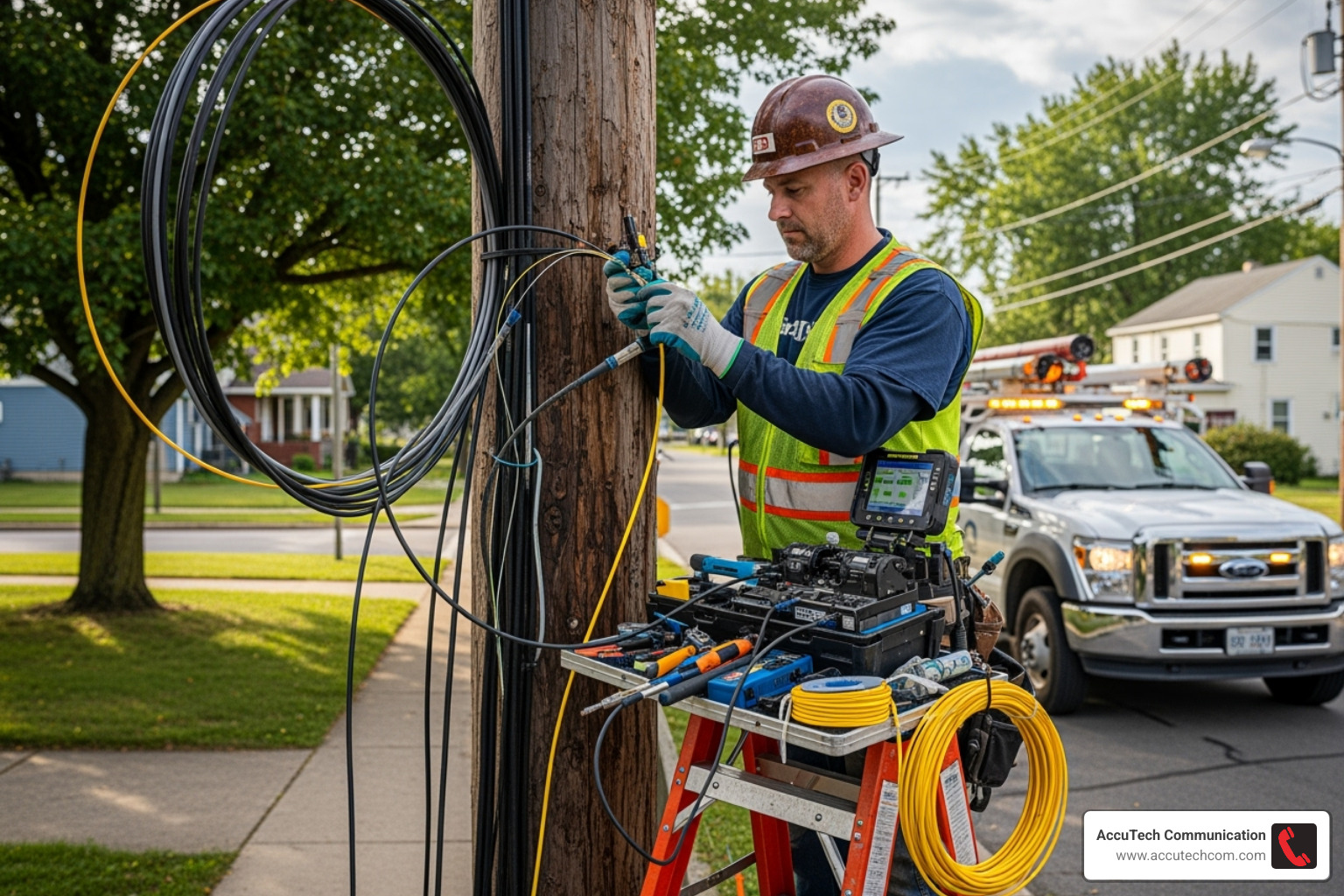
Common daily tasks, regardless of location, include reading blueprints, carefully running and routing cables, performing tests with OTDRs and power meters to ensure network health, and documenting all work for future reference. Safety is a constant priority, especially when working near electrical hazards or at heights.
How Many Hours Does a Fiber Optic Technician Work?
The Perks and Pains of the Profession
Like any job, this career has its rewards and challenges.
The Rewards:
- Job Security & Competitive Pay: High demand for skilled technicians ensures stability and strong earning potential.
- Hands-On Satisfaction: There’s a tangible sense of accomplishment in building essential infrastructure and restoring critical services.
- Career Advancement: Clear paths exist to move into senior, supervisory, or specialized roles.
- Cutting-Edge Technology: The field is constantly evolving, providing continuous learning opportunities.
The Challenges:
- Physically Demanding: The job requires lifting, climbing, and working in awkward positions, tight spaces, or at heights.
- On-Call and Irregular Hours: Network emergencies can happen anytime, requiring work on evenings, weekends, or holidays.
- Complex Troubleshooting: Diagnosing network problems can be a frustrating puzzle that requires patience and persistence.
- Working Conditions: OSP work means exposure to the elements, including heat, cold, rain, and snow.
The Market for Fiber Optics Technician Jobs: Salary and Career Outlook
The market for fiber optics technician jobs is robust, driven by the world’s reliance on high-speed data. Understanding the salary and career outlook is key for anyone considering this field.
Salary Expectations for Fiber Optics Technician Jobs
Technician salaries vary based on experience, location, certifications, and specialization.

- Average Salary Range: Entry-level roles typically start between $32,500 – $45,000 annually. Experienced technicians can earn $57,300 – $72,400 annually, with specialized or lead positions exceeding $77,000 annually.
- Key Factors: Higher salaries are common in urban areas with more data centers and telecom companies. Experience and industry certifications like the FOA CFOT significantly boost earning potential. Specializing in high-demand areas like OSP projects or data center work also commands higher pay.
Career Growth and Specializations
This career offers numerous opportunities for advancement. A typical path might look like this:
- Entry-Level: Start as a Technician Assistant or Installer, learning the basics on the job.
- Technician: With experience, advance to a full technician role with more complex responsibilities.
- Senior & Lead Roles: Become a Lead Technician or Supervisor, overseeing projects and teams.
- Specializations: Focus your skills to become a Splicing Technician, OSP Technician, Data Center Technician, or Test & Turn-Up Technician.
- Advanced Paths: With further education and experience, you can transition into roles like Project Manager or Network Engineer.
Continuous learning and advanced certifications are the keys to open uping these higher-level opportunities.
Fiber Optic Splicing Technician
Fiber Optic Network Design
Job Outlook and Industry Demand for Fiber Optics Technician Jobs
The future for fiber optics technician jobs is exceptionally bright, with approximately 6,300 projected job openings annually through 2033. This surge is driven by several major trends:
- 5G Rollout: 5G wireless networks require a dense fiber optic backhaul, creating massive installation demand.
- Rural Broadband Expansion: Government and private initiatives to connect underserved areas require extensive new fiber deployments.
- Data Consumption & Data Centers: The growth of streaming, cloud computing, and remote work fuels the expansion of data centers, all of which are built on fiber.
- Smart Cities & Enterprise Upgrades: The development of smart city infrastructure and business network upgrades further increases the need for skilled technicians.
The heavy investment in fiber optic infrastructure makes this a secure and in-demand career choice for the foreseeable future.
2023-2033 employment projections Source: Bureau of Labor Statistics
Frequently Asked Questions about Fiber Optic Technician Careers
Here are answers to some of the most common questions about pursuing a career as a fiber optic technician.
Is being a fiber optic technician a good career?
Absolutely. Fiber optics technician jobs offer a fantastic career path due to a combination of high demand, strong salary potential, and long-term career stability. Because fiber is the essential infrastructure of our digital world, the skills you learn will remain valuable for decades. It’s a hands-on, engaging career where you can see the direct impact of your work in keeping communities and businesses connected.
How long does it take to become a fiber optic technician?
You can enter this field relatively quickly. With a high school diploma or GED, you can find entry-level roles that provide on-the-job training. To fast-track your career, you can complete a certification program, like the FOA’s CFOT, in as little as a few days to a week. The key is that you can start earning while you learn, without the need for a multi-year degree program. Continuous learning will be part of the job as technology evolves.
What is the difference between a fiber optic technician and an engineer?
Think of it as the difference between an architect and a master craftsman.
- A Fiber Optic Technician is the hands-on expert who physically installs, splices, tests, maintains, and repairs the fiber optic network. We work in the field, using specialized tools to build and fix the infrastructure.
- A Fiber Optic Engineer is the planner who focuses on network design, architecture, and high-level strategy. They create the blueprints that technicians follow.
Both roles are critical and work together. A technician’s practical field experience is invaluable, and there are pathways for technicians to move into engineering roles with additional education.
Conclusion: Start Your Career in Fiber Optics
The world runs on connections, and fiber optics technician jobs are at the heart of our digital society. This career offers a unique blend of hands-on work, cutting-edge technology, and the satisfaction of building essential infrastructure.
The demand for skilled technicians is surging, with 6,300 job openings projected annually and salaries for experienced professionals reaching over $70,000. This field provides both job security and significant growth potential. Best of all, it’s an accessible career. You can start with a high school diploma and focused certifications like the FOA CFOT, building a stable, well-paying career in months, not years.
While the work can be physically demanding, the reward of connecting communities is immense. There’s a place for you in this field whether you’re drawn to the precision of splicing or the challenge of troubleshooting.
For businesses in Massachusetts, New Hampshire, and Rhode Island, AccuTech Communications has been a trusted partner for network infrastructure since 1993. We know that skilled technicians are the key to the certified, reliable service we provide.
If you’re ready to build a career that matters, fiber optics technician jobs could be your calling. The future is bright, and it’s traveling at the speed of light.
Learn more about becoming a Fiber Optic Technician
