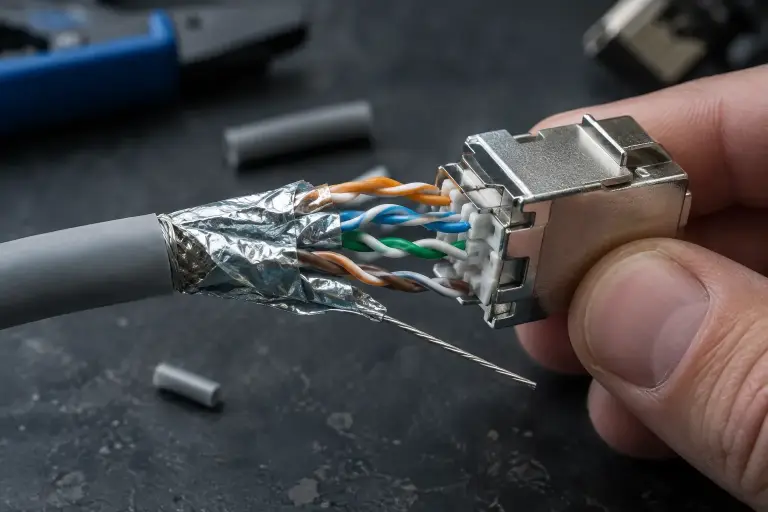
Planning Network Cabling for New Wireless Access Points in an Existing Office
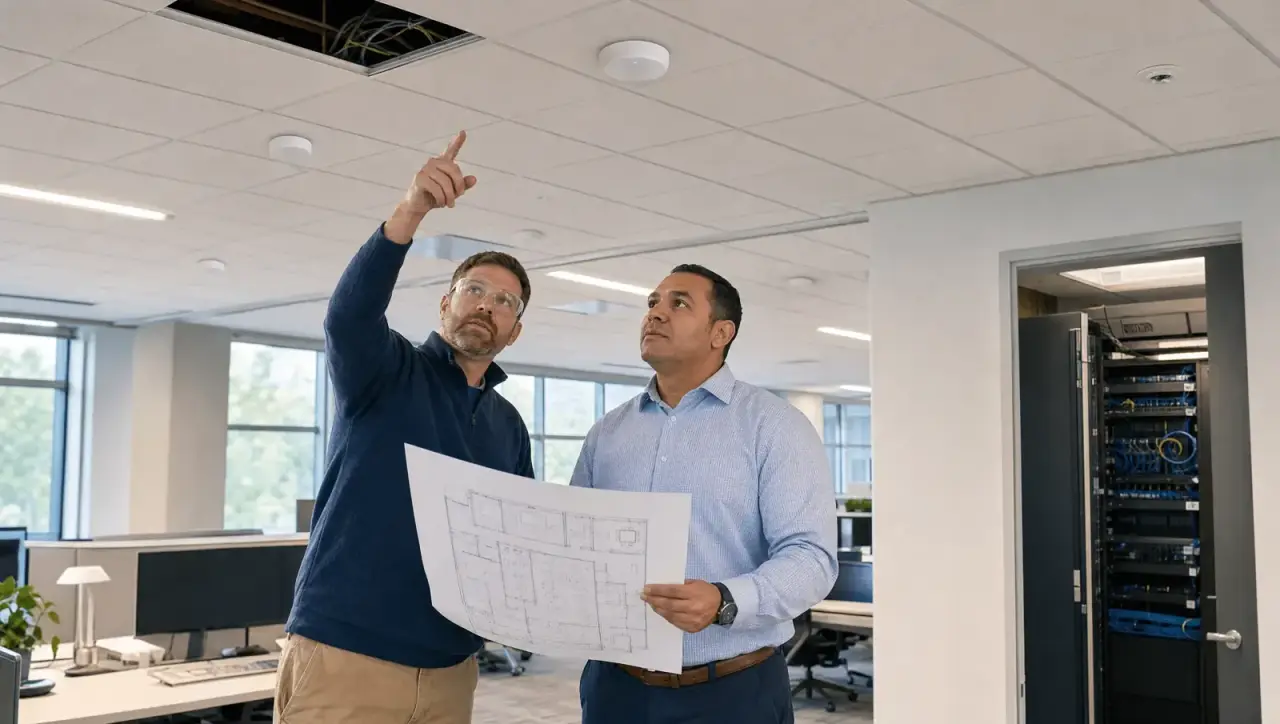
Wireless access points still depend on a well-planned wired network. Before cable is pulled, the IT team and cabling contractor should agree on validated AP locations, cable category and pathway, Power over Ethernet requirements, switch capacity, ceiling access, labeling, firestopping responsibilities, and the test records required at handoff.
Do not choose cable locations from a floor plan alone
A predictive design can establish a starting point, but walls, glass, shelving, neighboring networks, ceiling construction, client devices, and intended applications all affect RF performance. Cisco’s WLAN site-survey guidance distinguishes predictive, passive, and active surveys and recommends post-installation validation. The practical sequence is RF requirements first, preliminary locations second, cable installation third, and validation after the office is operating in its normal condition.
Coordinate the wired and wireless decisions
| Decision | Owner | What the installer needs |
|---|---|---|
| Coverage and capacity | Wireless designer / IT | AP model, final marked locations, mounting orientation, and any spare locations |
| Power budget | Network engineer | Required PoE class, switch-port plan, UPS expectations, and cable-length constraints |
| Pathway and code conditions | Cabling contractor / facility | Ceiling type, rated assemblies, sleeves, supports, access hours, and restoration scope |
| Acceptance | IT and facility together | Labeling standard, copper test result, as-built drawing, patching, and RF validation |
Survey the pathway, not just the destination
Walk from the telecommunications room to every proposed AP. Record tray or J-hook availability, penetrations, inaccessible ceilings, occupied areas, lifts or ladders required, and any spaces where work must be performed after hours. Confirm that cable will be independently supported and that penetrations through rated assemblies will be restored with an approved system. Do not use ceiling grid, sprinkler pipe, or unrelated building systems as cable support.
Existing offices often hide the costliest surprises above the ceiling: congested sleeves, abandoned cable, hard ceilings, locked tenant spaces, and routes that cross construction zones. A pathway survey converts those surprises into plan decisions.
Check the telecommunications room before adding drops
- Available rack, patch-panel, switch-port, and UPS capacity
- PoE budget for the selected AP model under expected load
- Patch-cord standard and port-assignment convention
- Grounding, bonding, cooling, and service-clearance conditions
- Whether the existing backbone can support the planned traffic and uplink design
- A growth allowance for AP relocation, added density, or future technologies
Do not assume that an open switch port has adequate power or that the existing cable category is appropriate for a new AP. Those are model- and design-specific decisions for the network engineer and installer to confirm.
Specify a handoff that can be audited later
Each run should have a unique identifier at both ends that matches the patch panel and as-built drawing. Request standards-based permanent-link test results rather than a simple continuity check. Record the AP outlet location, cable route changes, firestop locations, and any unused service loop. Then perform the post-installation RF validation with representative client devices and normal interference sources operating.
Questions to settle before work starts
Should two cables be installed at each AP?
Some designs benefit from a second run for redundancy, aggregation, sensing, or future use; others do not. Decide from the AP model, network architecture, and growth plan, not from a universal rule.
Can existing cable be reused?
Only after its category, route, length, condition, labeling, and certification results are verified for the intended application and PoE load.
When should the final AP location be locked?
After the wireless design establishes a viable location and the pathway survey confirms it can be safely cabled and mounted. If construction conditions force a move, the RF designer should review it before installation.
Accutech can coordinate the physical layer through its structured cabling services and broader network cabling installation capabilities across Massachusetts, Rhode Island, and New Hampshire.