
Why Internet Fiber Optic Infrastructure Matters for Your Business
Choosing a premium internet fiber optic connection is the single most important infrastructure decision your business can make today.
If you want a quick summary of why fiber-optic technology beats traditional business broadband, here is what you need to know:
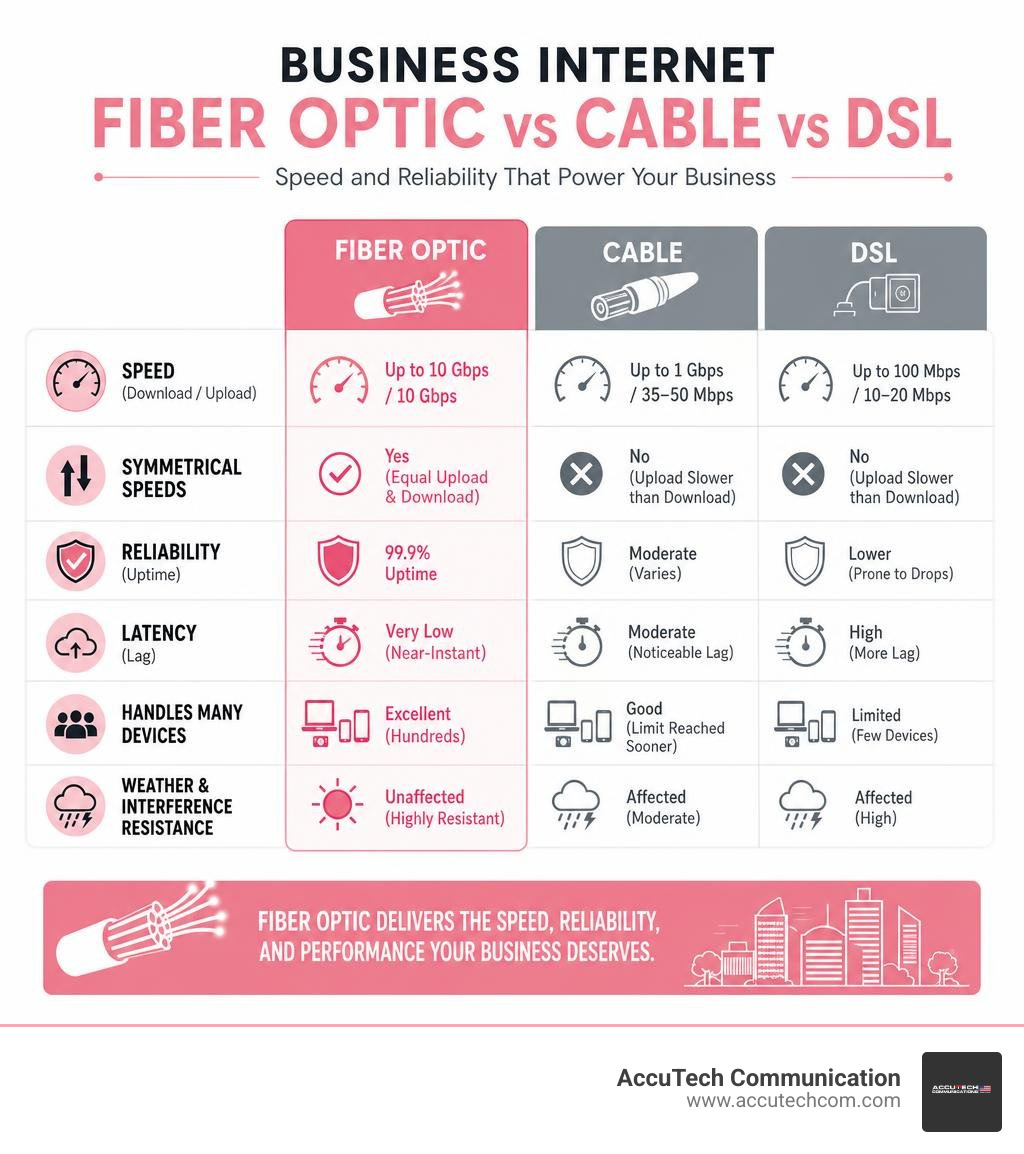
- Symmetrical Speeds: Unlike cable, fiber offers identical upload and download speeds up to 10 Gbps.
- Rock-Solid Reliability: It is virtually immune to bad weather and electrical interference, boasting 99.9% uptime.
- Zero Lag: Light-based transmission means near-instant data transfer for smooth cloud backups and video conferencing.
- Future-Proof Bandwidth: It easily handles hundreds of connected devices simultaneously without slowing down your operations.
In today’s fast-moving business world, slow internet is more than an annoyance. It is a massive drain on your bottom line. Traditional copper lines simply cannot keep up with cloud-based software, constant video meetings, and heavy daily data transfers.
Fiber-optic technology sends data using light pulses through ultra-thin glass strands. This means your business gets unmatched speed and reliability, keeping your team productive and your operations seamless.
I am Corin Dolan, owner of AccuTech Communications, and we have spent over three decades designing and installing high-performance network systems. My team and I specialize in deploying enterprise-grade internet fiber optic infrastructure to keep commercial operations in Massachusetts, New Hampshire, and Rhode Island running at peak efficiency.
Handy internet fiber optic terms:
Understanding Internet Fiber Optic Technology for Businesses
To appreciate why an internet fiber optic network is so for modern commercial enterprises, we have to look at the physics of how it operates. Traditional networks rely on copper cables, which transmit data using electrical signals. These signals degrade over distance, are highly susceptible to electromagnetic interference, and struggle to support high-bandwidth demands.
By contrast, fiber-optic technology relies on sending light pulses through flexible, ultra-pure glass strands. If you want to dive deeper into the core mechanics of this technology, you can read our detailed guide on How Do Fiber Optic Cables Work?.
Structurally, a Fiber-optic cable – Wikipedia consists of a central glass core surrounded by a reflective layer called cladding. Because of a phenomenon known as total internal reflection, light pulses bounce along the inside of the core without escaping.
These light pulses transmit data at about 70% the speed of light, enabling near-instantaneous communication across vast distances. This incredible speed makes fiber the gold standard for modern business networking.
How Symmetrical Speeds Power Commercial Operations
For businesses operating in June 2026, upload speeds are just as important as download speeds. Traditional broadband connections like cable and DSL are asymmetrical, meaning they prioritize fast downloads while offering painfully slow upload rates. This setup might work for a residential user streaming a movie, but it is a major bottleneck for commercial operations.
Symmetrical speeds mean your upload and download rates are identical. If your business has a 1 Gbps fiber connection, you get 1 Gbps down and 1 Gbps up. This symmetrical performance is crucial for:
- Cloud Applications: Running cloud-based ERP, CRM, and productivity software without latency or lag.
- Data Backups: Executing massive, automated off-site backups in minutes rather than hours.
- Video Conferencing: Hosting multi-party Zoom or Microsoft Teams meetings in crystal-clear 4K resolution without dropped calls.
- Collaborative Workflows: Allowing remote and on-premise teams to seamlessly share, edit, and upload massive media files or engineering schematics.
Comparing Fiber to Cable and DSL
When evaluating network infrastructure, it helps to see how fiber stacks up against older copper-based alternatives.
| Feature | Fiber Optic | Cable Internet | DSL Internet |
|---|---|---|---|
| Transmission Medium | Glass Strands (Light) | Coaxial Copper (Electricity) | Telephone Lines (Electricity) |
| Symmetrical Speeds | Yes (Identical Up/Down) | No (Slow Uploads) | No (Very Slow Uploads) |
| Maximum Potential Speed | Up to 10 Gbps+ (Commercial) | Up to 1 Gbps | Up to 100 Mbps |
| Latency (Ping) | Extremely Low (1-5 ms) | Moderate (20-50 ms) | High (50-100+ ms) |
| Weather/EMI Resistance | Immune | Susceptible | Highly Susceptible |
Unlike copper, which degrades over long distances, fiber can transmit data for miles without experiencing signal loss. This means your office in Boston, MA, or Concord, NH, gets the exact speed you pay for, regardless of how far you are from the telecom hub.
Selecting the Right Commercial Infrastructure
When deploying an internet fiber optic system, businesses must choose between different cable types and network configurations to support their specific workloads. Understanding these options helps ensure your infrastructure is scalable and ready for future technology upgrades.
To explore the physical differences between various cables, read our overview of the different Types of Fiber Optic Cable. For businesses, the choice often comes down to single-mode fiber (best for long-distance runs) and multi-mode fiber (ideal for high-bandwidth data center applications over shorter distances).
Additionally, as highlighted in the industry piece Unveiling the Hidden Material That Weaves Together Our Digital Lives – Interconnections – The Equinix Blog, physical fiber infrastructure is the literal backbone of our digital world, connecting local offices directly to global data centers.
Dedicated Internet Access (DIA) vs. Shared Business Fiber
Many businesses do not realize that not all business fiber connections are the same. When shopping for a plan, you will encounter two primary options: Dedicated Internet Access (DIA) and Shared Business Fiber.
- Shared Business Fiber: This architecture (often deployed as GPON) shares a single fiber line among multiple businesses in an office park or neighborhood. While it is highly cost-effective, your speeds can fluctuate during peak business hours when your neighbors are active.
- Dedicated Internet Access (DIA): With DIA, your business has a private, direct connection to the provider’s network. The bandwidth is 100% yours, 100% of the time. DIA plans come with robust Service Level Agreements (SLAs) that guarantee 99.9% uptime, strict latency limits, and rapid repair times if an issue ever occurs.
Key Hardware for Enterprise Internet Fiber Optic Connections
To get the most out of your fiber connection, your building’s internal cabling must match the speed of the incoming utility line. To understand the complete ecosystem, check out Everything You Need to Know About Fiber Optic Systems.
A complete enterprise fiber setup requires several vital components:
- Optical Network Terminal (ONT): This device converts the incoming light signals from the fiber cable into electrical signals that your network hardware can understand.
- Enterprise Router/Firewall: A high-throughput gateway capable of routing multi-gigabit traffic and applying advanced security protocols without bottlenecking your speed.
- Structured Cabling: High-quality Ethernet (Cat6a or Cat7) or internal multi-mode fiber runs that connect your server room to individual workstations and wireless access points.
Evaluating Commercial Fiber Providers and Installation Costs
If you are looking to upgrade your office network, checking regional availability is the first step. For businesses in our service area, resources like Internet Service Providers in Massachusetts | HighSpeedInternet.com can help identify which major carriers have lines running near your facility. You can also read our guide on how to Supercharge Your Business: Top Fiber Internet Providers to compare your options.
Once you select a carrier, the physical installation must be carefully planned. This is where professional structured cabling installers design the physical path the cables will take through your building.
Selecting the Right Commercial Internet Fiber Optic Architecture
Every business facility is unique, which is why we design custom cabling architectures to fit specific physical layouts:
- Point-to-Point Topology: A direct, dedicated link between two buildings or endpoints. It offers maximum security and speed, making it perfect for connecting adjacent corporate offices.
- Star Network Configuration: All workstations and local switches connect back to a central main distribution frame (MDF). This is the most common layout for modern commercial offices.
- Redundant Path Rings: A highly resilient configuration where fiber runs in a closed loop. If one side of the ring is accidentally cut, data instantly reroutes in the opposite direction to prevent downtime.
- Hybrid Architectures: Combining different topologies to balance cost, performance, and redundancy across complex corporate campuses.
Understanding Commercial Installation and Pricing Ranges
When planning a commercial fiber rollout, businesses need to budget for both the monthly carrier service and the physical installation of the internal structured cabling.
To help you understand the long-term ROI of this investment, read our analysis on Beyond Broadband: Why Fiber Optics is Your Business’s Future.
Disclaimer: The pricing ranges below represent average industry costs sourced from publicly available internet data. They do not represent the actual pricing of AccuTech Communications, as commercial projects vary significantly based on building size, materials, and complexity.
To give you a realistic idea of industry pricing, commercial structured cabling installations typically range from $1,500 to $45,000+ depending on several variables:
- Low-End Range ($1,500 – $4,500): Typical for small office suites requiring standard internal drops, structured patch panels, and minimal pathway construction.
- Mid-Range ($4,500 – $15,000): Common for medium-sized office buildings or multi-floor facilities requiring backbone cabling, intermediate distribution frames (IDFs), and multiple outdoor runs.
- High-End Range ($15,000 – $45,000+): Applies to large corporate campuses, industrial warehouses, or high-density data centers requiring extensive fiber splicing, redundant path rings, underground trenching, and comprehensive certification testing.
Frequently Asked Questions About Business Fiber
How do I check if commercial fiber is available at my business address?
Because fiber requires dedicated physical infrastructure, availability is highly location-dependent. You can check regional maps or use tools like Top 9 Internet Providers in Acton, MA (Jun 2026) – BroadbandNow to see which carriers service specific zip codes in our region.
If a provider’s main line runs down your street, they can typically run a “drop” directly into your building. If the nearest line is blocks away, you may face construction fees to bring the fiber to your property.
What is the difference between dark fiber and lit fiber?
- Lit Fiber: This is active fiber service managed by an internet service provider. The ISP owns and maintains the equipment on both ends, and you pay a monthly fee for a set bandwidth limit.
- Dark Fiber: These are physical fiber optic strands that have been installed but are not currently connected to active transmission equipment. Large enterprises can lease these “dark” strands and install their own hardware on both ends. This gives them complete control over their network protocols, security, and bandwidth scaling.
Why is professional installation critical for enterprise fiber networks?
Unlike copper wires, which can tolerate rough handling, fiber optic cables are made of glass and are incredibly delicate. They have strict bend-radius limits, and even a tiny speck of dust on a fiber connector can completely block the light signal.
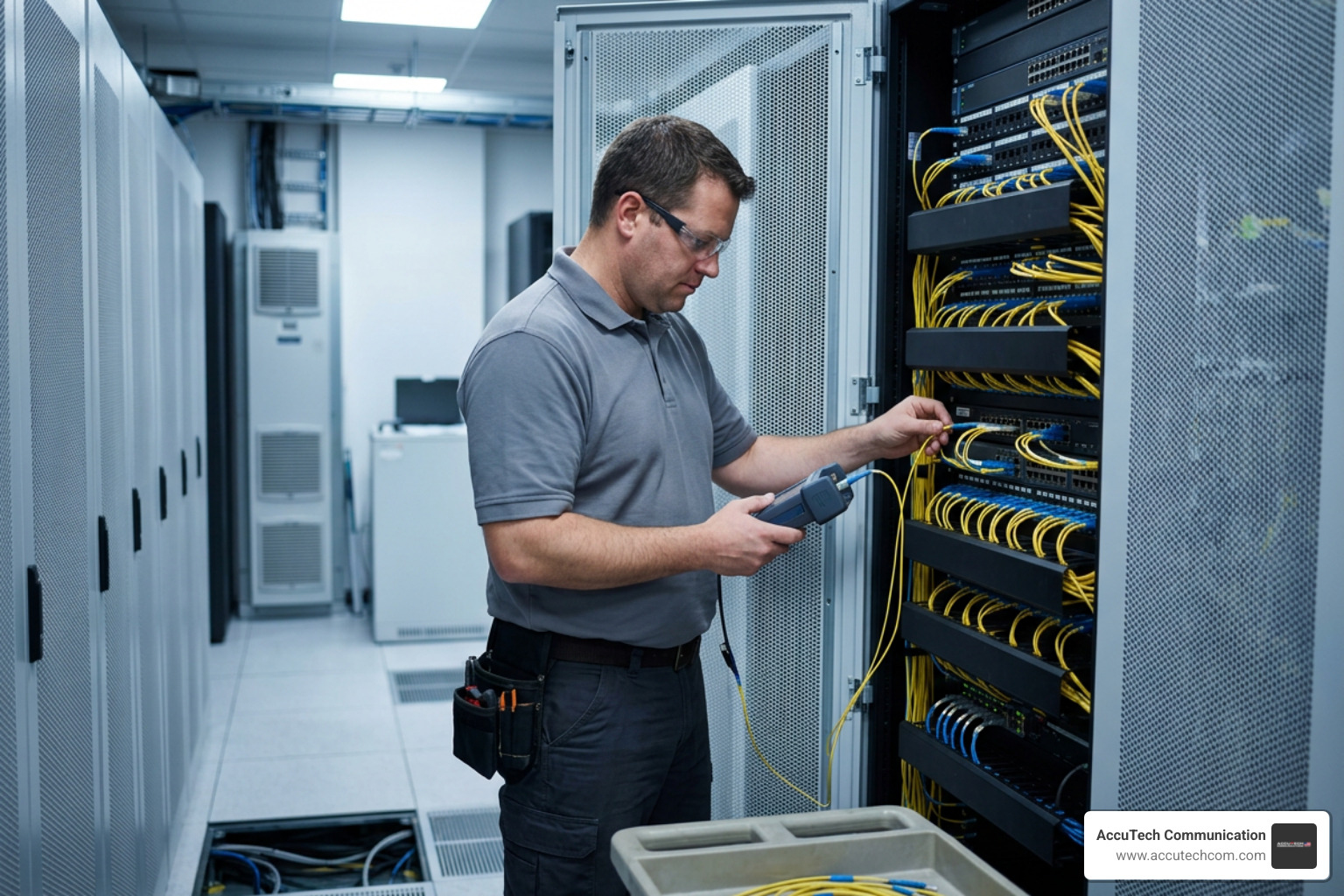
Professional Fiber Optic Installation requires specialized tools, certified technicians, and advanced testing equipment. A professional team uses fusion splicing to join glass strands with electric arcs, ensuring minimal signal loss.
Once installed, they use Optical Time-Domain Reflectometers (OTDRs) to test and certify every single run, giving you documented proof that your network is operating at peak performance.
Conclusion
Upgrading to a high-speed internet fiber optic system is one of the smartest investments your business can make to ensure long-term productivity, scalability, and operational reliability. However, even the fastest internet connection from a carrier is only as good as the physical cabling inside your building.
At AccuTech Communications, we have been helping businesses in Massachusetts, New Hampshire, and Rhode Island build reliable, future-proof networks since 1993. Whether you are based in Boston, MA, Nashua, NH, or Providence, RI, our team of certified technicians is ready to deliver top-tier structured cabling, fiber installation, and data center technologies tailored to your business needs.
Ready to future-proof your office with high-performance cabling? Request an Estimate from AccuTech Communications today, and let us design a custom solution that keeps your business moving at the speed of light.
