
Cat 6 Cable Tester: Top 3 Pro Picks
Why Reliable Network Testing is Critical for Your Business
A cat 6 cable tester verifies the integrity and performance of your cabling so your business can depend on fast, error-free data. Whether you’re troubleshooting or certifying new links, the right tester is inexpensive insurance against costly downtime.
Quick Cat 6 Cable Tester Comparison
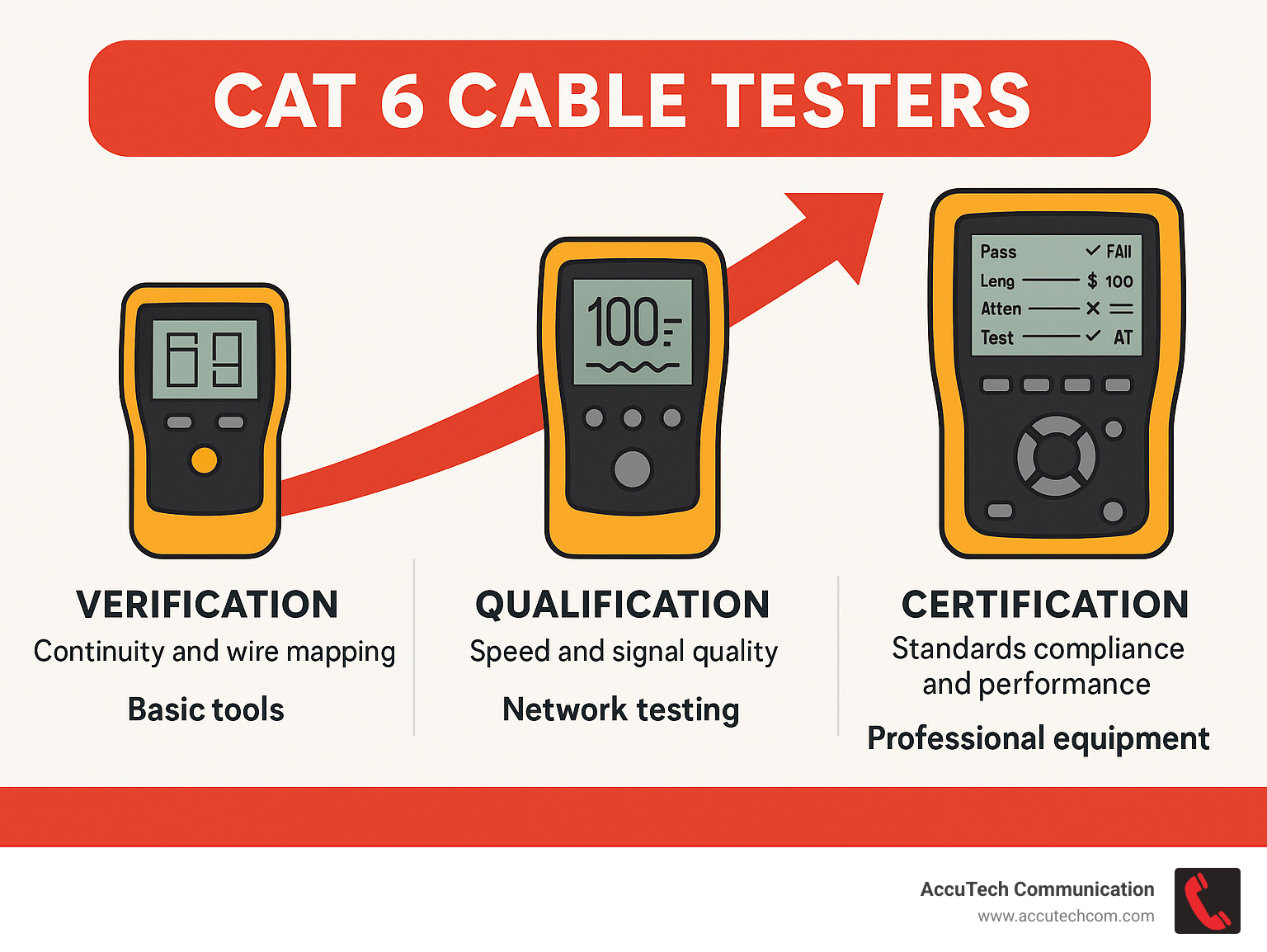
- Verification Testers – Continuity & wire map ($30-100)
- Qualification Testers – Speed capability & signal quality ($200-800)
- Certification Testers – Full standards compliance ($2,000-15,000+)
These tools measure key parameters such as continuity, attenuation, crosstalk, and overall compliance with TIA/EIA standards. Every extra connection in a channel introduces potential signal loss, so professional testing isn’t optional—it’s how you protect network reliability.
I’m Corin Dolan, owner of AccuTech Communications. Three decades of field work across Massachusetts, New Hampshire, and Rhode Island have shown me that rigorous testing up-front prevents the mysterious, revenue-draining outages that appear months—or years—later.
Introduction: Ensuring Your Network’s Backbone is Flawless

Your network cables are the highways for every file, call, and video in your office. A reliable cat 6 cable tester confirms those highways are clear before problems surface. If a cable fault slips through installation, it can trigger intermittent slowdowns that steal hours of productivity.
Think of testing as proof, not hope. When AccuTech completes a network cabling installation, we document that each permanent link meets Cat6 performance—so it will keep delivering gigabit speeds long after the installers leave.

What Do Cable Testers Actually Test? Understanding Key Parameters and Faults
A cat 6 cable tester performs a rapid, comprehensive health check of your network’s nervous system, going far beyond a simple connectivity check. Here are the critical parameters and faults it identifies:
- Wire map & continuity – This is the most basic test, verifying that all eight conductors in the cable are connected to the correct pins at both ends (e.g., following the T568A or T568B wiring standard). It also confirms there are no breaks, ensuring electrical current can flow from end to end.
- Opens / Shorts – An ‘open’ signifies a broken wire, while a ‘short’ means two or more conductors are touching, creating an unintended connection. This can be caused by a staple piercing the jacket or a poorly terminated connector.
- Split or reversed pairs – This is a common and tricky wiring error where pairs are mixed between connectors. A simple continuity tester might show a ‘pass’ because all wires connect, but the mismatched pairing will severely degrade performance by disrupting noise cancellation, leading to high error rates that cripple gigabit speeds.
- Crosstalk (NEXT) – Near-End Crosstalk (NEXT) measures the signal interference bleeding from one twisted pair to an adjacent one. Excessive crosstalk is a primary cause of transmission errors and is a key performance metric that separates a reliable gigabit link from an unstable one.
- Attenuation & Return Loss – Attenuation is the natural weakening of a signal as it travels down the cable. Return Loss measures the amount of signal that is reflected back toward the source due to impedance mismatches, often caused by poor connectors or cable damage. Both must be within strict limits for the signal to be intelligible at the far end.
- Cable length / TDR – The tester confirms that the cable run does not exceed the 100-meter (328-foot) maximum for Ethernet standards. Advanced testers use Time-Domain Reflectometry (TDR) to send a pulse down the cable and measure the time it takes for reflections to return, accurately calculating the length and pinpointing the exact distance to faults like opens or shorts.
Understanding these metrics explains why a simple continuity beep isn’t enough for high-speed RJ45 Network Cable. Most unexplained network issues trace back to one of these physical layer faults—caught instantly and precisely with the proper tester.
A Guide to the Different Tiers of Network Testers
This overview shows how each tester level adds capability.
Verification Testers: The First Line of Defense
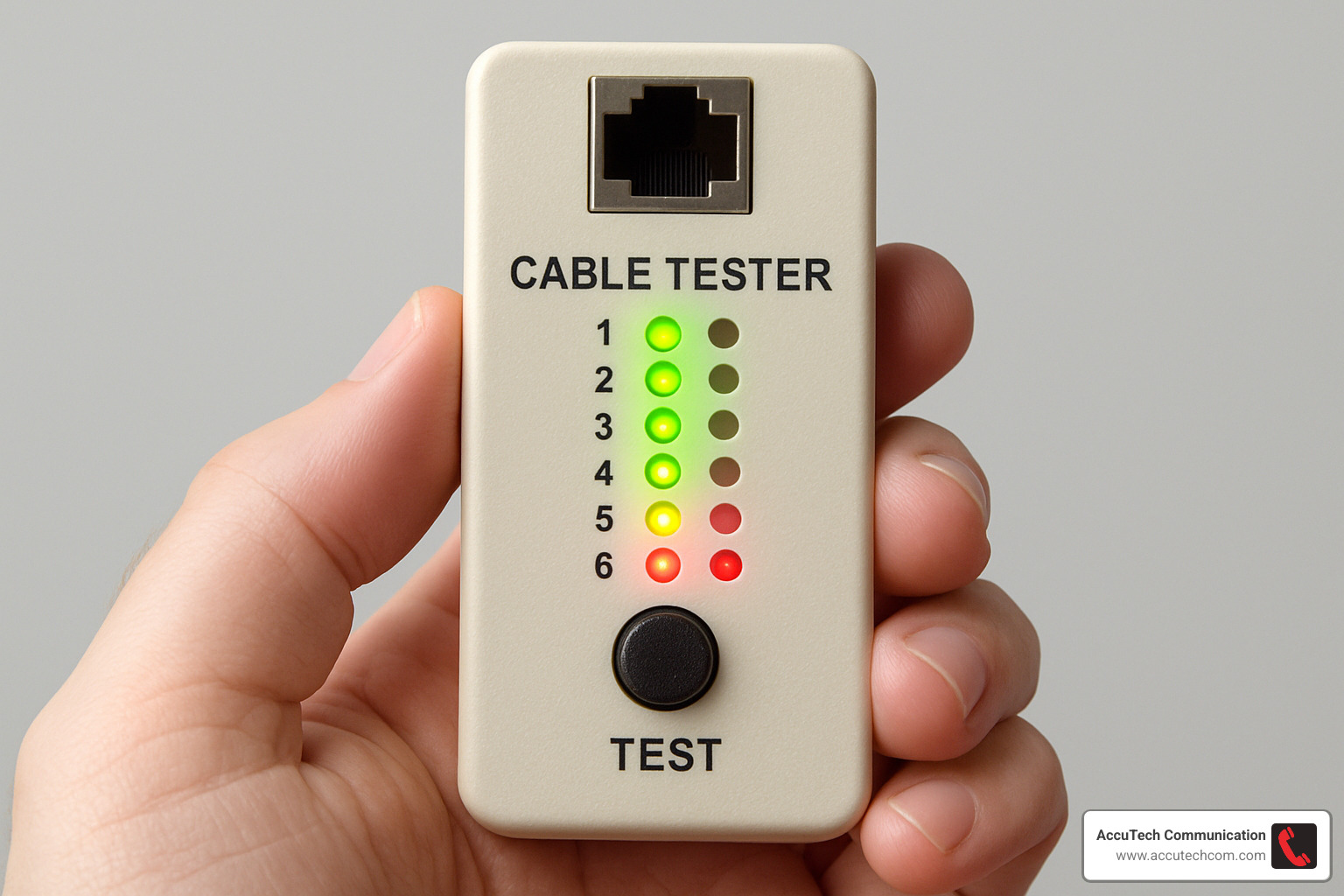
Fast go/no-go tools that fit in your pocket. They show continuity, wire map, opens, and shorts—perfect for quick checks or small offices.
Qualification Testers: Beyond Basic Connectivity

Adds bandwidth and noise testing to see if an installed link can truly support 100 Mbps or gigabit speeds—ideal during upgrades when you’re re-using existing cabling and need to find the weak links.
Certification Testers: The Professional Standard
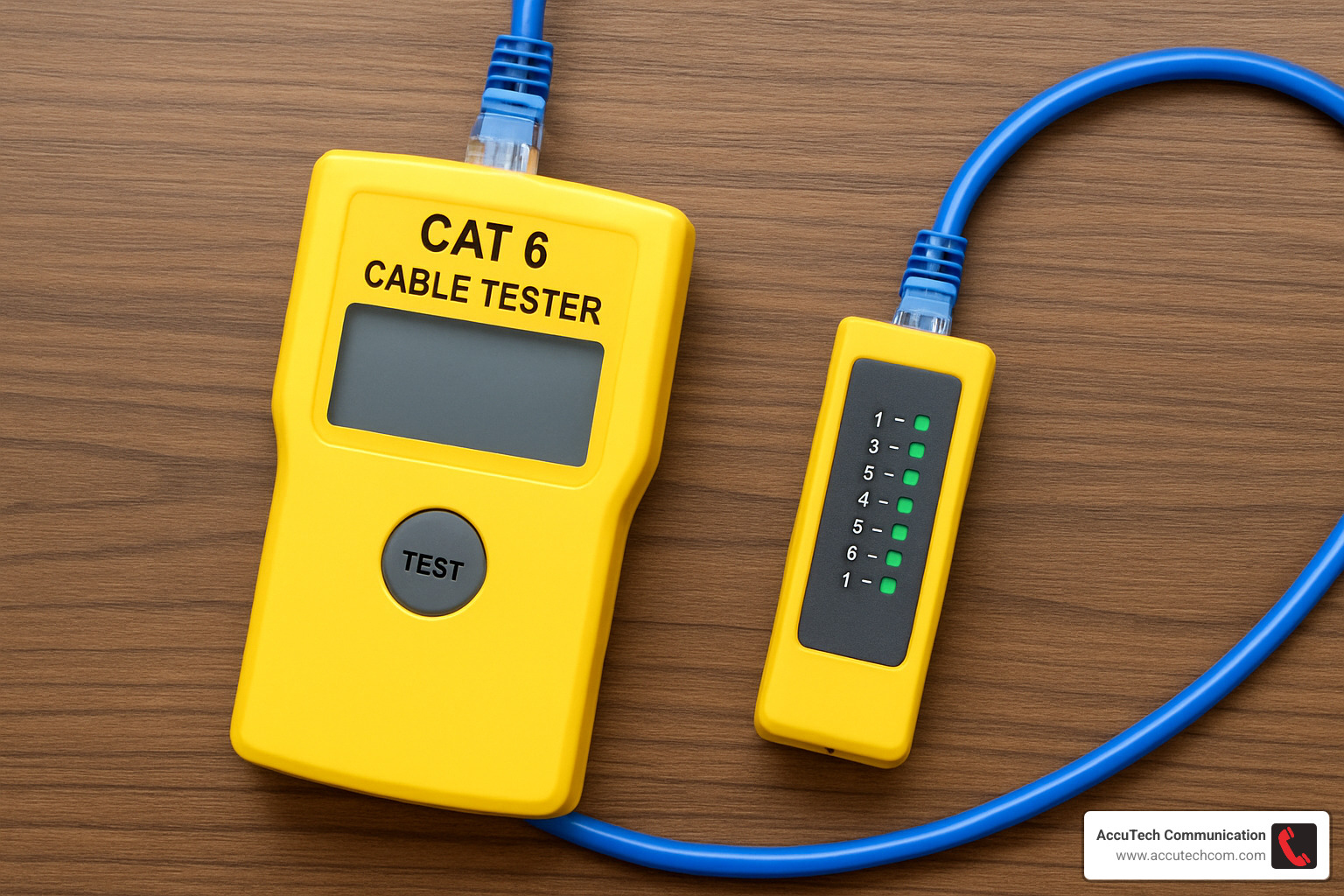
Lab-grade instruments that prove compliance with TIA/ISO standards. They record NEXT, ACR-F, Return Loss, and dozens of other parameters, then generate PDF reports accepted by manufacturers and building owners.
Why Certification is Crucial for Your Cat 6 Cable Tester and Network
The Importance of Standards-Compliant Testing
TIA/EIA-568 specifications are the common language of networking. Manufacturer warranties and performance guarantees hinge on passing those tests. Without a certification report, you may find too late that a cabling fault voids your warranty—or throttles future 10-gig upgrades.
Learn more at the official TIA standards organization. Peace of mind is the real payoff: certified links let you focus on business, not bandwidth.
Channel vs. Permanent Link Testing Explained
- Permanent Link – patch panel to wall plate; excludes patch cords, proving the fixed infrastructure is solid.
- Channel – switch to device; includes patch cords, mirroring real-world performance.
AccuTech runs both tests on every Data Network Cabling project so you know the foundation—and the day-to-day connection—are ready for prime time.
Choosing and Using Your Ideal Cat 6 Cable Tester
How to Effectively Diagnose Network Issues
- Prepare – verify batteries and, for certification tools, current calibration.
- Connect – seat both ends firmly; a loose plug causes false fails.
- Test – allow the full cycle to finish.
- Interpret – opens = breaks; shorts = unwanted contact; miswires = wrong pins.
- Isolate – start with patch cords, then terminations, then cable runs.
Avoid common pitfalls such as testing live circuits or skipping documentation. See our guide to 5 Common Mistakes to Avoid When Installing Network Cabling.
Key Features to Consider in a Cat 6 Cable Tester
- Display – LEDs for quick pass/fail, LCD for detail.
- Cable support – Cat6/6a today, maybe coax or fiber tomorrow.
- Fault coverage – opens, shorts, split pairs, crosstalk.
- Speed verification – confirm gigabit capability.
- Reporting – store and print results for warranties.
- Power & durability – long battery life and a rugged shell.
Working with an experienced Network Cable Installer ensures the right tool—and the expertise—to turn readings into rock-solid performance.
Conclusion: Invest in Confidence with Professional Testing
Choosing the right Network Cable Tester is fundamental to building and maintaining a high-performance network. From simple verification tools for quick checks to advanced certification testers for guaranteeing enterprise-grade reliability, the right device ensures your Cabling and Networking infrastructure won’t let you down when it matters most.
The investment in proper testing equipment pays dividends in ways that extend far beyond the initial purchase price. Reduced downtime means your team stays productive. Improved network performance keeps your business running smoothly. And the peace of mind that comes from knowing your infrastructure is solid? That’s priceless.
Whether you’re a small business owner checking a few cables or a network administrator managing enterprise infrastructure, understanding the capabilities and limitations of different cat 6 cable tester types helps you make informed decisions. A simple verification tester might be perfect for basic troubleshooting, while a certification tester becomes essential when you need to guarantee performance for years to come.
Here’s the thing about testing – it’s only as good as the person interpreting the results. Professional certification testers can provide incredibly detailed information, but that information is only valuable if you understand what it means and how to act on it. This is why many organizations choose to work with professional installers who have both the expertise and equipment to ensure optimal results.
For businesses in Massachusetts, New Hampshire, and Rhode Island, ensuring your network is installed and certified to the highest standards is the best way to protect your investment. Network infrastructure is too important to leave to chance, and proper testing is the foundation of reliable performance.
At AccuTech Communications, we’ve been providing expert installation and testing services since 1993. Our certified technicians use professional-grade certification testers to guarantee your network’s performance, and we stand behind our work with comprehensive warranties and ongoing support. We’ve seen how proper testing prevents problems before they start.
The technology landscape continues to evolve rapidly, with new applications demanding ever-higher performance from network infrastructure. Video conferencing, cloud computing, and emerging technologies all depend on reliable, high-speed connectivity. By investing in proper testing today, you’re preparing your organization for tomorrow’s challenges while ensuring reliable operation of today’s critical systems.
For a professionally certified network you can depend on, explore our Structured Cabling Services. We’ll ensure your network infrastructure is installed, tested, and documented to the highest industry standards, giving you the confidence that comes from knowing your network will perform when you need it most.
