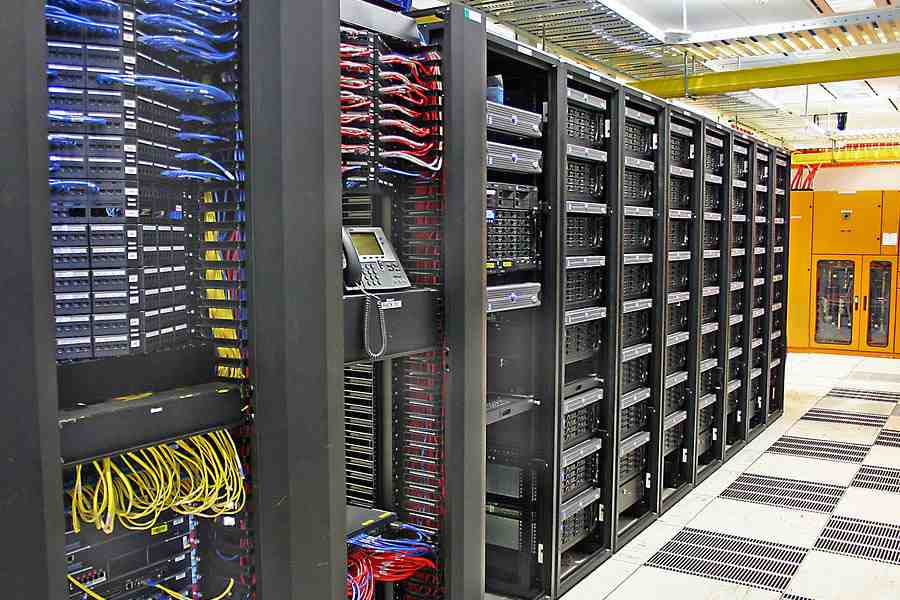
The Digital Lifeline of Boston’s Businesses
Boston data cabling services provide professional design, installation, testing, and certification of structured network infrastructure for commercial buildings throughout Massachusetts. Companies in the Greater Boston area rely on these services to support mission-critical applications, ensure reliable connectivity, and maintain compliance with industry standards like TIA/EIA-568.
Quick Overview: Boston Data Cabling Services
- Types of Cabling: Cat5e, Cat6, Cat6a, and fiber optic (single-mode and multi-mode)
- Core Services: Structured cabling design, installation, testing, certification, and ongoing maintenance
- Service Areas: Boston, Cambridge, Somerville, and surrounding Massachusetts communities
- Key Benefits: Improved network speed, reduced downtime, scalability for business growth
- Standards: TIA/EIA-568 compliant installations with full documentation
- Typical Providers: BICSI-certified technicians with manufacturer-specific training
Is your network too slow? Are you experiencing signal loss or frequent connectivity issues? These symptoms often point to outdated or poorly installed cabling infrastructure. For 25% of businesses, just one hour of network downtime can cost as much as $400,000. Structured cabling can account for upwards of 80% of a network’s overall efficiency, making professional installation a critical business investment rather than an IT expense.
Modern Boston businesses face unique infrastructure challenges. Historic brownstones require careful retrofitting that preserves architectural integrity. High-rise buildings demand backbone cabling that spans multiple floors without signal degradation. Healthcare facilities need installations that meet strict compliance standards. Manufacturing operations require systems that minimize downtime and support industrial environments.
The right cabling infrastructure does more than connect devices. It enables VoIP phone systems, supports high-definition video conferencing, powers wireless access points through Power over Ethernet, and provides the foundation for security cameras and access control systems. A properly designed structured cabling system becomes the longest life-cycle component of your technology setup, often outlasting the computers, switches, and servers connected to it.
I’m Corin Dolan, owner of AccuTech Communications, and I’ve been designing and installing Boston data cabling systems for commercial clients across Massachusetts, New Hampshire, and Rhode Island since 1993. Our team specializes in healthcare, manufacturing, education, and commercial office environments where network reliability directly impacts business operations.
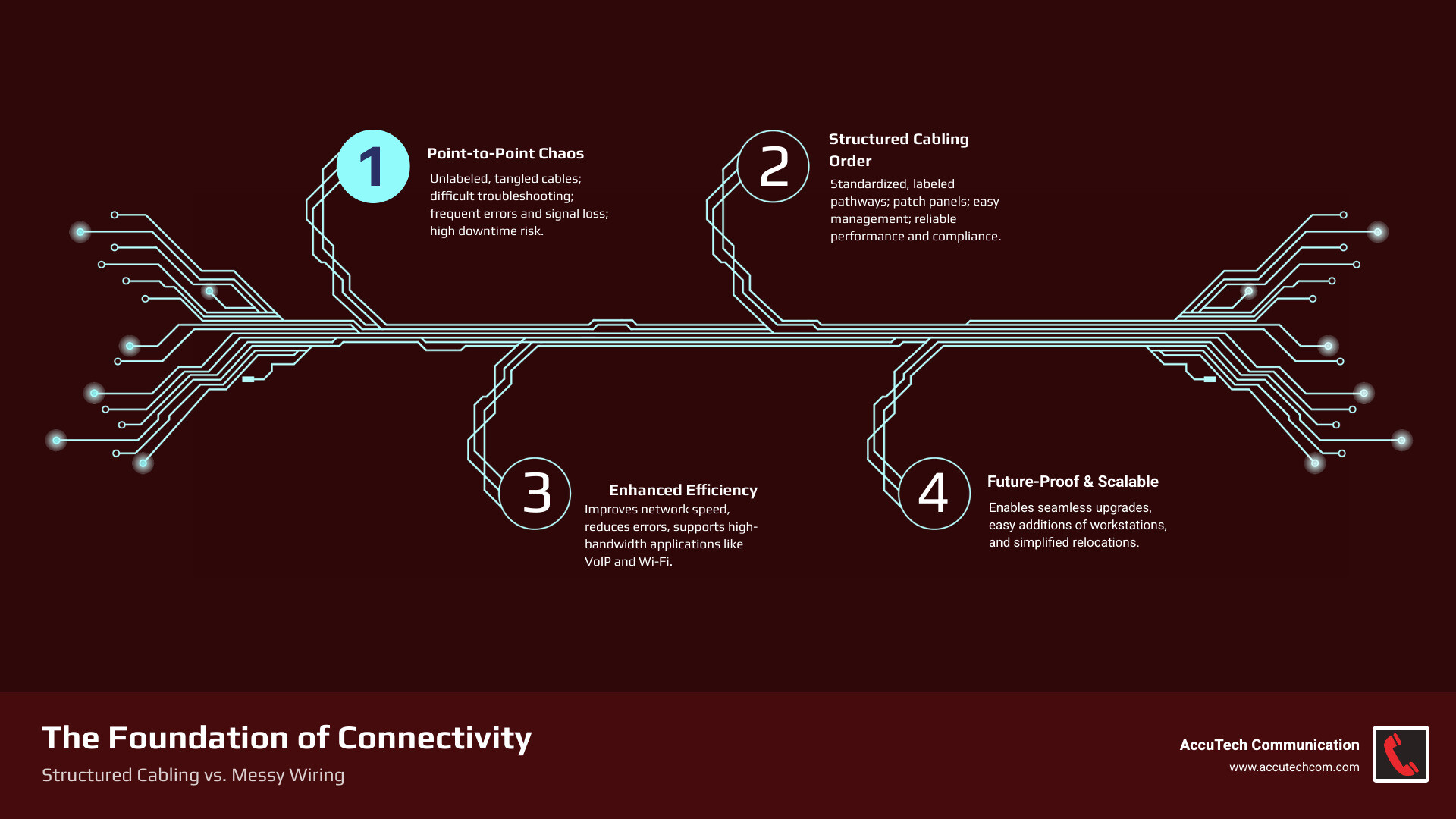
Quick Boston data cabling definitions:
Why Professional Structured Cabling is Your Business’s Competitive Edge
In today’s digital world, your network isn’t just a convenience; it’s the beating heart of your business operations. Whether you’re a startup in Cambridge or an established firm in downtown Boston, the quality of your data cabling directly impacts your productivity, profitability, and ability to innovate. Professional structured cabling isn’t merely about running wires; it’s about building a robust, reliable, and scalable foundation for your entire IT infrastructure.
We’ve seen how a well-designed cabling system can transform a business. It provides network reliability that prevents costly interruptions, supports your growth initiatives, and future-proofs your investment against rapidly evolving technology. As we mentioned, for 25% of businesses, a single hour of network downtime can cost as much as $400,000. That’s a staggering figure, highlighting why investing in quality Boston data cabling is a strategic decision, not just an IT expense. Our commitment is to provide professional network cabling in Massachusetts that minimizes such risks and maximizes your operational efficiency.
Boosting Network Speed, Reliability, and Scalability
Imagine trying to drive a high-performance sports car on a dirt road. That’s what an advanced network switch or server experiences when connected to outdated or poorly installed cabling. The true potential of your expensive network hardware can only be realized with a superior cabling infrastructure.
Structured cabling systems are engineered to deliver optimal network cable speeds and consistent connectivity. This means faster data transfer, fewer errors, and a network that can handle demanding applications without breaking a sweat. When your team needs to collaborate on large files, stream high-definition video, or conduct critical VoIP calls, you need a network that responds instantly, every time.
Beyond raw speed, reliability is paramount. Professional installations adhere to strict industry standards, minimizing interference and signal loss, which are common culprits behind frustrating network glitches. This meticulous approach ensures a stable and predictable network environment.
Scalability is another key benefit. Our structured cabling designs anticipate your future needs, making it simple to add workstations, relocate departments, or upgrade network speeds without the chaos and expense of rewiring everything from scratch. This adaptability means your network can grow seamlessly with your business, supporting new technologies and expansions for years to come. why network cabling is crucial for business growth boils down to its ability to provide a flexible and efficient backbone that empowers your business to thrive.
Supporting Modern Technologies like VoIP and Wi-Fi

Modern businesses in Boston rely heavily on advanced communication and connectivity tools. Data cabling forms the invisible infrastructure that powers these essential technologies. For instance, Voice over IP (VoIP) phone systems, which have become a staple for Boston business phone systems, require stable and high-quality network connections to deliver crystal-clear audio and reliable communication. Poor cabling can lead to dropped calls, choppy audio, and frustrating delays.
Similarly, robust Wi-Fi networks are non-negotiable for today’s mobile workforce. Wireless Access Points (WAPs) are often powered and connected back to the network via Power over Ethernet (PoE), which relies on quality data cabling to deliver both power and data efficiently. Without proper cabling, your Wi-Fi can suffer from dead zones, slow speeds, and unreliable performance.
Beyond communication, our cabling infrastructure also supports critical security systems. CCTV security systems for business, access control systems, and other smart building technologies all depend on a robust and dedicated data cabling network. We design systems that integrate these diverse technologies seamlessly, providing a unified and high-performing environment for your business.
The Core Components of a Structured Cabling System
A well-organized structured cabling system is like the nervous system of your business, ensuring every part communicates effectively. It’s far more than just cables running through walls; it’s a carefully planned and installed infrastructure. For a comprehensive overview, the Wikipedia article on structured cabling offers an excellent vendor-neutral summary of the standards and terminology involved.
A complete structured cabling system typically consists of six interconnected subsystems:
- Entrance Facility: This is where external cabling (from your internet service provider or telecom company) enters your building. It’s the demarcation point where the outside world connects to your internal network.
- Equipment Room (MDF): The main distribution frame (MDF) is the centralized hub of your network. It houses your primary servers, network switches, routers, and other core equipment. This room is critical for managing and distributing data throughout your facility.
- Telecommunications Closet (IDF): Also known as an intermediate distribution frame (IDF), these closets are strategically placed throughout your building, often on different floors or in different departments. They serve as smaller distribution points, connecting local devices to the main equipment room.
- Backbone Cabling: This refers to the cabling that connects the equipment room to the telecommunications closets, and also connects different telecommunications closets to each other. It’s the high-capacity highway that carries data across significant distances within your building or campus. This often uses fiber optic cables for maximum speed and distance.
- Horizontal Cabling: This is the cabling that runs from the telecommunications closets to individual work areas. It typically consists of copper Ethernet cables (like Cat6 or Cat6A) that connect wall outlets to network devices.
- Work Area: This is the final point of connection, including the wall outlets, patch cords, and network adapters that connect end-user devices (computers, phones, printers, WAPs) to the horizontal cabling.
Each component is designed to work together, adhering to industry standards to provide a flexible, reliable, and high-performance network foundation.
A Guide to Cabling Types for Boston Businesses
Choosing the right type of cable for your Boston data cabling needs is crucial. It’s not a one-size-fits-all decision; it depends heavily on your application-specific needs, bandwidth requirements, and future growth plans. We work closely with our clients to evaluate these factors and recommend the most suitable types of cables and network cable categories to ensure optimal performance and longevity for their business.
Copper Cabling: Cat5e, Cat6, and Cat6A
Copper twisted-pair cables are the workhorse of most local area networks (LANs). While they might all look similar on the outside, their internal construction and performance capabilities vary significantly.
| Cable Type | Max Speed (Typical) | Max Distance (Typical) | Best Use Case |
|---|---|---|---|
| Cat5e | 1 Gigabit | 100 meters | Standard office use, basic VoIP, and general data. Lowest cost solution. |
| Cat6 | 10 Gigabits | 55 meters | High-performance workstations, demanding applications, faster data transfer. Improved noise reduction. |
| Cat6A | 10 Gigabits | 100 meters | Data centers, future-proofing, environments with high electromagnetic interference (EMI). Supports 10 Gigabit Ethernet over full distance. |
Cat5e (Category 5e) has been a long-standing standard for general office networking. It’s cost-effective and perfectly adequate for 1 Gigabit Ethernet, supporting most everyday business operations.
Cat6 (Category 6) offers significantly improved performance, capable of supporting 10 Gigabit Ethernet, though over shorter distances (up to 55 meters). This makes it ideal for connecting high-performance workstations or servers within a close proximity to a switch. Category-6 cable also boasts better noise reduction compared to Cat5e.
For businesses with long-range plans, or those investing in application assurance beyond today’s requirements, Cat6A (Category 6 Augmented) is often the preferred choice. It supports 10 Gigabit Ethernet over the full 100-meter distance, making it suitable for data centers and backbone connections where maximum speed and reliability are critical. Cat6A also offers excellent protection from EMI and alien crosstalk, which is particularly beneficial in industrial or manufacturing environments. Our systems, for example, meet or exceed Category 6/Class E Channel Specifications to 250 MHz and are capable of delivering network speeds in excess of 1.2 Gbps to the workstation at 100 meters.
Fiber Optic Cabling: The Ultimate in Speed and Distance
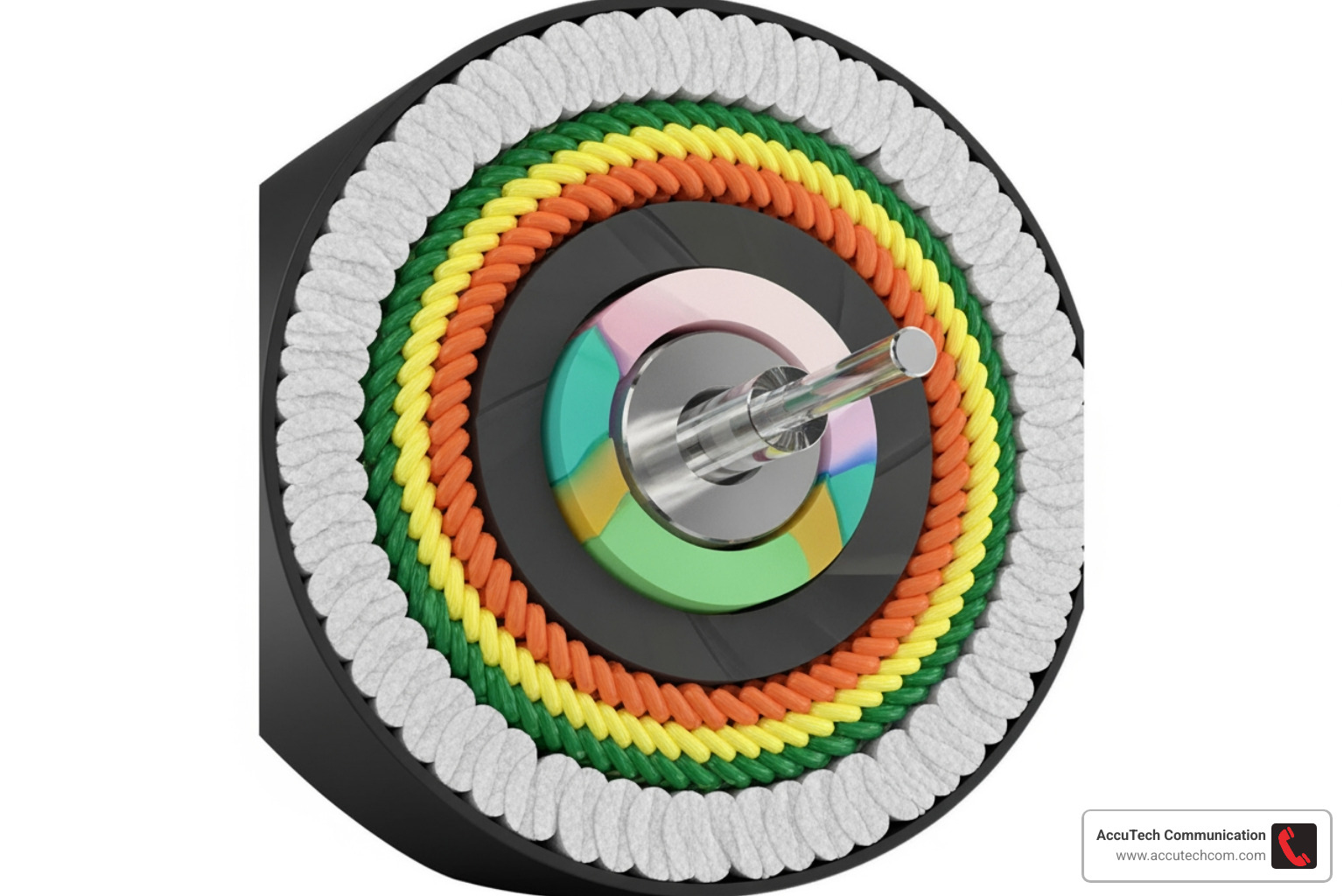
When it comes to raw speed, incredible distance, and immunity to interference, fiber optic cable installation stands in a league of its own. Unlike copper cables that transmit electrical signals, fiber optic cables transmit data as pulses of light through thin strands of glass or plastic. This fundamental difference open ups unparalleled performance.
Fiber optic cables are typically used for backbone connections within a building, inter-building links across a campus, or for connecting to external service providers. Their ability to carry massive amounts of data over incredible distances without signal loss makes them ideal for high-bandwidth applications. Furthermore, fiber optic cables are completely immune to electromagnetic interference (EMI) and radio frequency interference (RFI), which can degrade performance in copper cables, especially in electrically noisy environments common in manufacturing or industrial settings.
Beyond performance, fiber optics offer improved data security. It’s much harder to tap into a fiber optic cable without detection compared to copper, making it a more secure choice for sensitive data transmission. Understanding how fiber optic cables work reveals their efficiency and resilience in delivering critical network connectivity. Every fiber optic cabling we install is covered by a 15-year warranty, reflecting our confidence in its durability and performance.
Single-Mode vs. Multi-Mode Fiber
When considering fiber optic solutions, you’ll often hear about single-mode and multi-mode fiber. The primary difference lies in the diameter of their core and how light travels through them, which in turn affects their transmission distance and bandwidth capacity.
- Multi-Mode Fiber (MMF): Multi-mode fibers have a thicker core (typically 50 or 62.5 microns). This larger core allows multiple light paths, or modes, to travel simultaneously. While this enables the use of less expensive LED light sources and transceivers, it also limits the transmission distance due to modal dispersion (light signals arriving at slightly different times, causing distortion). Multi-mode fiber is ideal for shorter distances, such as within a single building, for connecting equipment rooms to telecommunications closets, or for LAN backbones. It provides bandwidth transmissions of a few hundred megahertz (MHz) per kilometer (km) and permits transmission distances of up to approximately 10 miles.
- Single-Mode Fiber (SMF): Single-mode fibers have a much narrower core (typically 8-10 microns). This tiny core allows only a single path for light to travel, eliminating modal dispersion. This enables single-mode fiber to transmit data over extremely long distances (tens or even hundreds of kilometers) with very high bandwidth, making it the choice for long-haul networks, data centers, and inter-building campus connections. However, single-mode fiber requires more expensive laser light sources and transceivers. Single-mode fiber transmits over distances greater than 10 miles.
To summarize, what are two characteristics of fiber optic cable? Speed and distance. Multi-mode is excellent for shorter, high-speed links within a local area, while single-mode is the champion for maximum distance and ultimate bandwidth capacity. We help you choose the right fiber type based on your specific application and budget.
The Professional Boston Data Cabling Installation Process
A professional Boston data cabling installation is a multi-stage process that ensures a high-quality, reliable, and standards-compliant network. It begins long before the first cable is pulled and extends through testing and documentation.
Navigating Boston’s Unique Building Environments
Boston, with its rich history and diverse architecture, presents unique challenges and opportunities for data cabling installations. From retrofitting historic brownstones and brick buildings to deploying cutting-edge infrastructure in modern high-rises, each environment demands a custom approach.
For historic buildings, we must often contend with thick walls, ornate architectural details, and strict preservation guidelines. Our team excels at installing cabling discreetly, often utilizing existing pathways or employing techniques like network cable metal conduit to protect cables while preserving aesthetics and structural integrity.
Modern lab spaces and healthcare facilities, common in the Boston area, require installations that meet stringent cleanliness standards, EMI shielding requirements, and often need specialized cabling for sensitive equipment. Manufacturing plants demand robust, industrial-grade cabling solutions that can withstand harsh conditions and support mission-critical machinery. We understand the nuances of these environments and ensure compliance with all relevant building codes and industry regulations. Our expertise ensures that your data cabling installation in Boston, MA is not only functional but also respects the unique character and operational demands of your space.
The Critical Role of Testing and Certification
Installation is only half the battle. A truly professional Boston data cabling project culminates in rigorous testing and certification. This step is non-negotiable for ensuring your network performs as expected and adheres to industry standards.
We use advanced testing equipment, such as Fluke testers, to thoroughly verify every cable run. This process checks for continuity, wire map errors, signal loss (attenuation), crosstalk, and overall performance against TIA/EIA standards. This comprehensive testing ensures error-free operation and validates that your cabling infrastructure can support the specified network speeds and applications.
Upon successful completion, we provide complete system documentation, including detailed test results and “as-built” drawings. This documentation is invaluable for future troubleshooting, maintenance, and upgrades. Furthermore, our manufacturer-certified field installers’ work is often warrantied for 25 years, providing you with long-term peace of mind. This commitment to quality and longevity is why we emphasize how to test network cable quality as a core part of our service.
Choosing the Right Boston Data Cabling Partner
Selecting the right provider for your Boston data cabling needs is a critical decision that can impact your business for years. You need a partner with proven experience, deep expertise, and an unwavering commitment to quality. We pride ourselves on being a trusted choice for structured cabling contractors in Boston, MA.
Key Qualifications and Certifications to Look For
When evaluating a data cabling provider, look beyond just a competitive quote. The qualifications and certifications of their team speak volumes about their capabilities and adherence to industry best practices.
Here’s what to look for:
- BICSI RCDD (Registered Communications Distribution Designer): This is one of the most prestigious certifications in the telecommunications industry. An RCDD has demonstrated a high level of expertise in the design, integration, and implementation of telecommunications distribution systems. They ensure your cabling infrastructure is designed to the highest standards.
- Certified Technicians: Ensure the technicians performing the installation are certified by reputable organizations and manufacturers. For instance, a certified fiber optic technician has specialized training in handling and installing delicate fiber optic cables.
- Manufacturer Certifications: Many leading cable manufacturers offer certification programs for installers. These certifications often come with extended warranties on the installed products, ensuring long-term reliability.
- Licensed and Insured: Always verify that your cabling contractor is fully licensed and insured. This protects your business from liability in case of accidents or issues during the installation.
- CORI/Background Checks: Especially important for installations in sensitive environments like schools or healthcare facilities, ensure the company conducts thorough background checks on its personnel.
Our team at AccuTech Communications holds industry-leading certifications and undergoes continuous training to stay ahead of technological advancements. We’ve been serving excellence for over 28 years, a testament to our enduring commitment to quality and client satisfaction.
Understanding the Cost of Professional Boston Data Cabling
The cost of professional Boston data cabling can vary significantly depending on several factors. While we don’t provide specific pricing without a detailed consultation, we can help you understand the elements that influence the overall investment. For a general understanding of commercial network cable installation pricing, it’s important to consider:
- Cable Type: Fiber optic cabling, while offering superior performance, typically has a higher material and installation cost than copper (Cat5e, Cat6, Cat6A). Within copper, Cat6A is more expensive than Cat5e or Cat6.
- Project Complexity: Factors like the size of your facility, the number of cable drops, the distance of runs, and the complexity of pathways (e.g., running cables through conduits, plenum spaces) will impact labor hours and material needs.
- Building Environment: As discussed, installations in historic buildings, challenging industrial environments, or sensitive areas like labs can require specialized techniques, materials, and more time, affecting costs.
- Labor Rates: These vary based on the experience and certifications of the technicians involved.
- Testing and Certification: Comprehensive testing and certification, while vital, are included in the overall professional service cost.
Disclaimer on Pricing: Please note that any pricing information found online or mentioned as industry averages should be considered general estimates and not a quote from AccuTech Communications. Actual costs can vary widely based on your specific project requirements, site conditions, and the current market for materials and labor. We provide transparent and detailed quotes custom to your unique needs.
While the initial investment in professional data cabling might seem substantial, consider the long-term return on investment (ROI). A robust, reliable network reduces downtime costs, improves productivity, and supports future technology upgrades, saving you money and headaches in the long run.
Frequently Asked Questions about Boston Data Cabling
We understand you likely have questions about your upcoming or ongoing Boston data cabling project. Here are some of the most common inquiries we receive:
What are the primary services offered by data cabling companies?
Data cabling companies like ours offer a comprehensive suite of services to ensure your business has a high-performing network infrastructure. These typically include:
- Structured Cabling Design: Custom design custom to your business’s current needs and future growth.
- Copper Cabling Installation: Installation of Cat5e, Cat6, and Cat6A Ethernet cables for various applications.
- Fiber Optic Cabling Installation: Deploying single-mode and multi-mode fiber for backbone connections, data centers, and long-distance links.
- Testing and Certification: Rigorous testing of every cable run to ensure performance and compliance with TIA/EIA standards.
- Network Infrastructure Installation: Setting up patch panels, racks, cabinets, and other components of a structured cabling system.
- Network Maintenance and Repair: Ongoing support, troubleshooting, and repairs to keep your network running smoothly.
- Voice and Data Installation: Integrating voice (VoIP) and data networks for seamless communication.
- Office Relocations and Expansions: Planning and executing cabling infrastructure for new offices or expanding existing ones.
- Data Center Cabling: Specialized cabling solutions for data center environments.
How long does a data cabling installation take?
The duration of a data cabling installation project can vary greatly. It depends on several factors:
- Project Scope: A small office with a few dozen cable drops will naturally take less time than a multi-floor corporate headquarters or a large manufacturing facility.
- Size of Facility: Larger buildings require more cable, more pathways, and more time for installation.
- Number of Cable Drops: Each data outlet requires time for running, terminating, and testing.
- Building Environment: As discussed, working in historic buildings, industrial sites, or occupied offices can extend the timeline.
- Team Size: The number of technicians deployed on a project will influence its speed.
Effective pre-planning is crucial for an efficient installation. We work diligently to assess your needs, create a detailed project plan, and provide a realistic timeline to minimize disruption to your business operations.
Can you install cabling in an occupied office?
Absolutely! We frequently perform installations in occupied offices and commercial spaces. Our goal is always to minimize disruption to your daily operations. This often involves:
- Phased Installation: Breaking the project into smaller stages that can be completed section by section.
- Working After Hours: Scheduling work during evenings, weekends, or holidays to avoid peak business hours.
- Professional Coordination: Our project managers work closely with your team to plan logistics, communicate progress, and address any concerns promptly.
- Cleanliness and Safety: We maintain a clean work environment, ensure all safety protocols are followed, and leave your space tidy at the end of each work period.
Our experience in diverse environments across Massachusetts, New Hampshire, and Rhode Island allows us to adapt our approach to suit your specific operational needs, ensuring a smooth and efficient installation process.
Conclusion: Build Your Business on a Foundation of Connectivity
In Boston’s dynamic business landscape, a robust and reliable network infrastructure is not a luxury—it’s a necessity. Professional Boston data cabling provides the speed, reliability, and scalability your business needs to thrive, supporting everything from everyday operations to advanced technologies like VoIP and Wi-Fi. It’s an investment that pays dividends by reducing costly downtime, enhancing productivity, and future-proofing your technological capabilities.
At AccuTech Communications, we bring over 28 years of expertise to every project. Our certified technicians, meticulous planning, and adherence to the highest industry standards ensure that your cabling infrastructure is a solid foundation, not a bottleneck. We understand the unique challenges of the Boston area and are dedicated to providing custom solutions that exceed your expectations.
Don’t let outdated or disorganized cabling hold your business back. Contact us for your network cabling installation services today, and let us help you build a network that truly empowers your business.