
Why the Right Data Cabling Services in Boston Can Make or Break Your Network
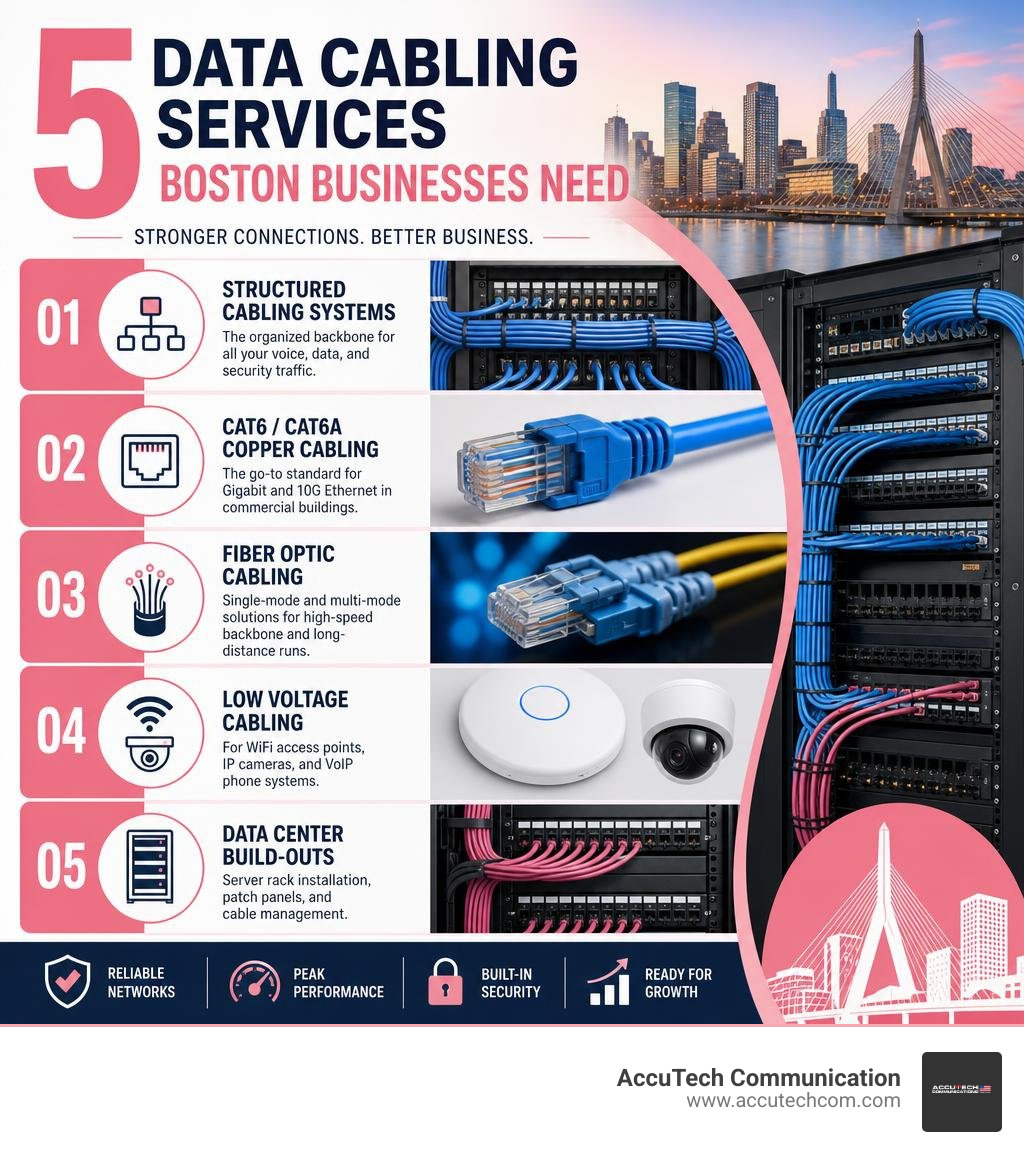
If you’re looking for professional data cabling services in Boston, here are the five services most recommended by local experts:
- Structured cabling systems — the organized backbone for all your voice, data, and security traffic
- Cat6 / Cat6a copper cabling — the go-to standard for Gigabit and 10G Ethernet in commercial buildings
- Fiber optic cabling — single-mode and multi-mode solutions for high-speed backbone and long-distance runs
- Low voltage cabling — for WiFi access points, IP cameras, and VoIP phone systems
- Data center build-outs — server rack installation, patch panels, and cable management
Your network is only as strong as the physical layer underneath it. Every email, video call, cloud application, and security feed your business depends on runs through your cabling infrastructure. Yet for many Boston-area companies, that infrastructure is an afterthought — until something breaks.
And when it does break, the cost can be severe. For 25% of businesses, a single hour of network downtime can cost up to $400,000. Poor or aging cabling doesn’t just slow things down — it puts your entire operation at risk.
The good news? The right cabling solution, installed correctly from the start, can prevent most of those problems entirely.
I’m Corin Dolan, owner of AccuTech Communications, and I’ve been delivering data cabling services in Boston and across Massachusetts, New Hampshire, and Rhode Island since 1993. Over the past three decades, I’ve seen how the right cabling infrastructure transforms business performance — and how the wrong choices lead to costly, avoidable problems.
Data cabling services Boston terms at a glance:
1. Essential Data Cabling Services Boston Companies Use for Scalability
When we talk to business owners in Boston, Worcester, or Cambridge, we often find they are struggling with what we call “cable chaos.” This happens when a company grows organically over time, adding new employees, computers, and printers one by one using a “point-to-point” cabling approach. In a point-to-point setup, every single device is connected directly to the main switch with its own long, independent run of wire.
As your office expands, this method quickly turns your server room into a tangled nest of mystery cables. If a connection fails, your IT specialist might spend hours untangling and testing lines just to find the source of the problem.
The modern solution that experts recommend is structured cabling services. A structured cabling system is a highly organized, standardized infrastructure designed to handle all your telecommunications traffic. Instead of a chaotic web of wires, structured cabling divides your network into neat, manageable blocks. It includes patch panels, horizontal cabling runs, main distribution frames, and clearly labeled work area outlets.
Investing in professional structured cabling solutions offers three massive benefits to commercial enterprises:
- Unmatched Network Efficiency: Did you know that network cabling represents only a fraction of your overall IT budget, yet it can account for upwards of 80% of a network’s efficiency? High-quality, organized physical cabling ensures your data packets travel without loss, interference, or delay.
- Rapid Scalability: When it is time to add new desks, hire more staff, or move departments around, a structured system makes changes incredibly simple. Technicians can perform “moves, adds, and changes” (MAC work) in minutes at the patch panel, rather than running entirely new lines through walls and ceilings.
- Long-Term Cost-Effectiveness: The worldwide structured cabling market was worth $7.7 billion in 2016 and is expected to expand by 7.6% through 2025. This rapid growth is driven by businesses realizing that structured systems drastically reduce long-term maintenance costs and save thousands of dollars in IT troubleshooting hours.
2. High-Performance Copper Network Cabling (Cat6 and Cat6a)
While wireless networks are fantastic for mobility, the backbone of any reliable office network is still physical copper cabling. It is secure, impervious to local radio interference, and capable of delivering unmatched speeds.
Over the years, copper cabling has evolved through several standards, commonly known as “Categories.”
- Cat5e: For many years, Category 5e was the standard for commercial installations. While it still works fine for basic networks and supports Gigabit speeds over short distances, it is rapidly becoming obsolete for modern, high-demand business environments.
- Cat6: This is the baseline standard we recommend for new office setups today. Cat6 cabling is designed to support speeds up to 10 Gbps over distances up to 55 meters, and it operates at a frequency of 250 MHz. It features tighter twists in the internal copper pairs, which significantly reduces crosstalk (interference between cables).
- Cat6a: If you want to truly future-proof your office, Category 6a (the “a” stands for augmented) is the gold standard. Cat6a supports 10 Gbps speeds across the full 100-meter maximum channel length and operates at 500 MHz. It features advanced shielding that virtually eliminates “alien crosstalk” (interference from adjacent cables in a bundle), making it ideal for high-density environments, server rooms, and Power over Ethernet (PoE) applications.
When planning an upgrade, choosing professional Cat6 installation ensures that your copper lines are run without exceeding their maximum bend radius, avoiding performance-degrading kinks. Partnering with certified providers for your Ethernet cabling services guarantees that your copper infrastructure is tested to meet rigid industry performance standards.
Selecting the Right Copper Standard for Data Cabling Services Boston
Choosing between Cat5e, Cat6, and Cat6a depends entirely on your business’s current bandwidth requirements and your plans for future growth.
While Cat5e is the most budget-friendly option upfront, it simply cannot keep pace with modern data-heavy applications. If your team relies on video conferencing, cloud storage, large file transfers, or VoIP phones, Cat6 or Cat6a is highly recommended. Investing in the higher standard now prevents you from having to rip out and replace your walls’ cabling just a few years down the road.
By working with professional network cabling services, you can perform a thorough site assessment to determine exactly which copper category fits your building layout and performance needs.
3. Fiber Optic Cabling for High-Speed Backbone Networks
When your network needs to span long distances—such as connecting different floors in a Boston high-rise, linking separate buildings on a campus in Waltham, or connecting massive server clusters—copper cabling reaches its physical limits. Copper signals degrade significantly after 90 to 100 meters.
That is where fiber optic cabling comes in. Fiber optic cables transmit data using pulses of light through tiny strands of glass or plastic. This technology allows for mind-bogglingly fast speeds, massive bandwidth, and zero susceptibility to electromagnetic interference (EMI).
There are two primary types of fiber optic cabling used in commercial installations:
- Single-Mode Fiber (SMF): Single-mode fiber has a very small core diameter (typically 8 to 10 microns) that allows only a single pathway, or “mode,” of light to travel down the glass. Because there is minimal light reflection inside the core, signal loss is extremely low. This allows single-mode fiber to transmit data over incredible distances—often greater than 10 miles—making it the perfect choice for campus backbones and metropolitan networks. It utilizes precise, laser-based transmission equipment.
- Multi-Mode Fiber (MMF): Multi-mode fiber features a much larger core diameter (usually 50 to 62.5 microns). This larger core allows multiple pathways of light to travel simultaneously. While this increases the amount of data that can be sent at once over short distances, it also causes “modal dispersion” (the light pulses spread out and degrade over long runs). Multi-mode fiber is typically limited to distances of about 2,000 feet or less and uses more affordable LED or VCSEL light sources, making it a highly cost-effective choice for local server rooms and building-to-building links.
To help you choose the right fiber optic solutions for your business, here is a quick comparison:
| Feature | Single-Mode Fiber (SMF) | Multi-Mode Fiber (MMF) |
|---|---|---|
| Core Diameter | 8 to 10 microns | 50 to 62.5 microns |
| Light Source | Laser | LED / VCSEL |
| Max Distance | Up to 25+ miles | Up to 2,000 feet (typical) |
| Bandwidth | Virtually unlimited | High (ideal for LANs) |
| Primary Use | Campus backbones, long-distance telco | Local server closets, short building links |
| Equipment Cost | Higher (due to laser transceivers) | Lower (more affordable electronics) |
Integrating Fiber with Local Data Cabling Services Boston
You do not have to choose between copper and fiber; in fact, the most robust networks use a hybrid approach.
In a typical multi-story office building in downtown Boston, we run fiber optic cables vertically as a “backbone” to connect the individual telecommunications closets on each floor. From those closets, copper Cat6 or Cat6a cables run horizontally to the individual desks and wall outlets.
Using media converters and high-density fiber patch panels in your data center cabling setup allows you to seamlessly bridge the gap between light-speed fiber backbones and reliable copper workstations.
4. Low Voltage Cabling for Wireless, Security, and VoIP Integration
Modern offices require far more than just plugging computers into internet jacks. Today’s smart workplaces rely on a wide range of interconnected devices that depend on low voltage cabling to transmit data and, in many cases, draw power.
- Enterprise WiFi Access Points (WAPs): To enjoy seamless wireless coverage without dead zones, WAPs must be strategically mounted on ceilings and walls. These access points require high-performance data drops to handle hundreds of wireless devices simultaneously.
- IP Security Cameras (CCTV): Modern video surveillance systems use high-definition IP cameras that stream crystal-clear video back to a central network video recorder (NVR).
- VoIP Phone Systems: Traditional analog phone lines are a thing of the past. Modern business phone systems use Voice over IP (VoIP) technology, which runs voice traffic over the exact same Ethernet cabling as your computer data.
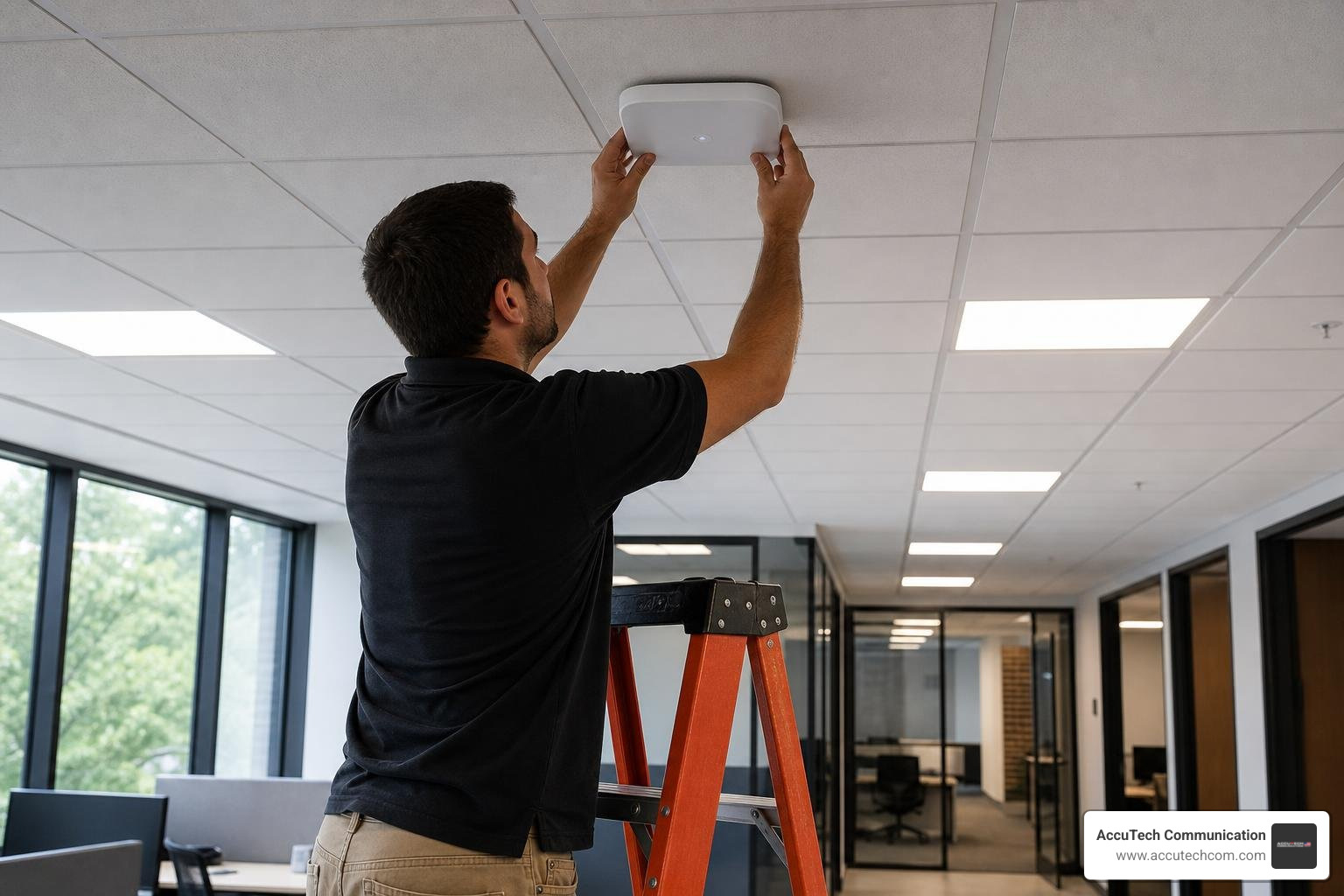
One of the greatest innovations in low-voltage technology is Power over Ethernet (PoE). With PoE, a single Cat6 or Cat6a cable delivers both high-speed data and electrical power to devices like IP cameras, wireless access points, and VoIP phones.
This eliminates the need to hire an electrician to run dedicated electrical outlets to difficult spots like high ceilings or outdoor walls, saving your business massive amounts of time and money during installation.
5. Data Center Build-Outs and Server Rack Optimization
Whether you are building a dedicated on-premise server room or setting up a cage in a major Boston colocation facility, your data center is the brain of your business. If your server racks are disorganized, you run a high risk of equipment overheating, accidental cable disconnections, and extended troubleshooting times during an outage.
Professional data center build out services focus on creating a highly structured, clean, and efficient environment for your critical IT hardware. This involves:
- Server Racks and Enclosures: Selecting and securely mounting the right open-frame racks or enclosed cabinets to house your servers, switches, and UPS systems.
- Patch Panel Integration: Terminating all incoming copper and fiber lines into organized patch panels, making it easy to route connections with short, neat patch cords.
- Horizontal and Vertical Cable Management: Using specialized trays, D-rings, and cable managers to keep wires bundled neatly and out of the way. This prevents “cable spaghetti” that blocks critical airflow.
- Cooling and Airflow Efficiency: Organizing cables behind servers so they do not block exhaust fans. Proper cable management directly improves cooling efficiency, extending the lifespan of your expensive server hardware and preventing thermal shutdowns.
Compliance, Standards, and Professional Installation Processes
You might be tempted to save money by having a handy office employee run a few network cables through the ceiling. However, low-voltage wiring is subject to strict building codes and industry standards. Failing to follow these rules can result in terrible network performance, expensive fines, or even serious fire hazards.
Professional installers design and deploy systems in strict accordance with industry standards:
- ANSI/TIA-568: This set of standards governs how commercial building telecommunications cabling should be designed, installed, and managed. It dictates everything from maximum cable lengths (90 meters for horizontal copper runs) to the exact order of the colored wires inside an RJ-45 connector.
- BICSI (Building Industry Consulting Service International): This global association certifies individual technicians and designers. A BICSI-certified installer has undergone rigorous training to ensure they understand the absolute best practices for structured cabling layout and safety.
- NECA (National Electrical Contractors Association) and National Electrical Code (NEC): These codes mandate safety practices, particularly concerning fire prevention. For example, any cable run through “plenum” spaces (the open areas above drop ceilings used for heating and air conditioning circulation) must use plenum-rated cabling. Plenum cables are coated with a special fire-resistant plastic that does not emit toxic, heavy smoke if it catches fire.
When you work with a certified professional, they do not just pull the wires and walk away. A true expert follows a rigorous, multi-step process:
- Site Survey and Consultation: Assessing your floor plans, identifying electromagnetic interference hazards, and understanding your bandwidth goals.
- Custom Design: Creating an optimized blueprint for your cable pathways, server rack layouts, and outlet locations.
- Neat Installation: Pulling, bundling, and labeling every single cable according to industry-standard labeling schemes.
- Testing and Certification: Using state-of-the-art diagnostic equipment, such as Fluke networks certifiers, to test every line for speed, continuity, and signal loss.
- As-Built Documentation: Providing you with a complete map of your network, including certified test results for every single port.
For a deeper dive into what a professional deployment looks like, check out our data cabling installation guide or learn more about Boston structured cabling standards.
Frequently Asked Questions About Boston Network Cabling
What is the average cost of data cabling services in Boston?
Because every commercial building is unique, the cost of data cabling services in Boston varies widely based on the size of your office, the type of cable used (Cat6 vs. fiber), and the complexity of routing cables through walls or historical brick-and-beam buildings.
Based on general industry averages and online data, a typical commercial installation can range anywhere from $150 to over $450 per cable run (or “drop”), depending on the architectural challenges of the space. For complex, high-density data centers or multi-floor buildings, the overall project cost can easily scale to several thousand dollars.
Please note that these are average industry costs sourced from publicly available internet data and do not reflect the actual rates or guarantees of AccuTech Communications. Every project requires a custom site survey to provide an accurate estimate.
How does structured cabling prevent expensive network downtime?
When your cables are neatly labeled and terminated at a central patch panel, troubleshooting is incredibly fast. If a workstation loses its connection, your IT technician can easily isolate the specific line on the patch panel and test it in seconds.
In a chaotic, unorganized system, finding a bad cable can take hours of tracing wires through ceilings and under desks. Given that network downtime can cost businesses up to $400,000 per hour, an organized structured cabling system quickly pays for itself by minimizing repair times.
What certifications should a Boston cabling contractor hold?
When evaluating a cabling contractor in Massachusetts, you should look for companies that employ BICSI RCDD (Registered Communications Distribution Designer) certified professionals.
Additionally, look for installers who hold direct manufacturer certifications from leading hardware brands. These manufacturer certifications allow the contractor to offer extended warranties (often up to 25 years) on the performance of the cabling hardware they install.
Conclusion
Your physical network infrastructure is the foundation of your business’s digital operations. Skimping on quality installation or clinging to outdated, messy wiring is a recipe for slow speeds, frustrating dropouts, and incredibly expensive network downtime.
Since 1993, AccuTech Communications has been the trusted partner for commercial network infrastructure across Massachusetts, New Hampshire, and Rhode Island. We pride ourselves on offering certified, highly reliable service, competitive pricing, and an absolute commitment to quality. Whether you need a few extra Cat6 drops for an office expansion or a complete multi-story fiber optic backbone, our team is ready to design a solution tailored to your business.
Ready to build a faster, more reliable network for your business? Request an Estimate today to schedule your commercial site survey.
