A, Z Guide to Second Phase Data Center Build Out
Why the Second Phase Data Center Build Out Is Reshaping Infrastructure in 2026
A second phase data center build out is one of the most complex, and most consequential, infrastructure decisions a developer or operator will make. Once a first phase is energized, the pressure is on to scale faster, smarter, and with fewer mistakes.
What is a second phase data center build out?
- The construction of additional buildings, power capacity, and infrastructure on an existing campus after the first phase is operational
- Typically expands total power capacity from hundreds of megawatts to gigawatt scale
- Involves more workers, tighter timelines, and more complex supply chains than phase one
- Requires upgrading or integrating cabling, cooling, and power systems across both old and new buildings
- Often tied to hyperscaler pre-commitments, joint venture financing, or AI workload demand
Here is a snapshot of where things stand as of June 2026:
- 190 GW of hyperscale data center capacity has been announced globally across 777 projects
- ~21 GW is currently under construction and ~12 GW is already operational
- Global spending on data centers could reach $7 trillion by 2030
- Construction costs average $9.5 million per megawatt in the U.S.
- Peak construction crews have grown from roughly 750 workers during the cloud era to 4,000-5,000 workers on today’s largest campuses
The stakes could not be higher. A quarter of data center projects slated for 2025 were delayed due to power, permitting, and construction constraints. Getting phase two right, from cabling to cooling to crew size, separates projects that deliver on time from those that don’t.
I’m Corin Dolan, owner of AccuTech Communications, and I’ve spent decades helping commercial clients across Massachusetts, New Hampshire, and Rhode Island build the structured cabling foundations that make second phase data center build out projects work at every scale. In the sections ahead, I’ll walk you through what the latest large-scale projects reveal, and what it means for your infrastructure decisions.
Handy second phase data center build out terms:
The Macro Landscape: Driving the Second Phase Data Center Build Out
The global demand for computational power is growing at a rate never seen before in human history. With experts predicting that global spending on data center development could reach $7 trillion by 2030, we are in the midst of an unprecedented infrastructure cycle.
According to data from early 2026, 190 GW of hyperscale data center capacity has been announced across 777 projects. This massive pipeline includes approximately 148 GW in the planning stages, 21 GW in active construction, and 12 GW already operational. Capital expenditure in this sector is projected to expand beyond $500 billion by 2027, driven by the intense computational demands of generative AI models.
This massive surge is forcing a shift in how campuses are designed and built. The industry has entered a “bring your own power” (BYOP) era, where waiting in 5-to-7-year utility interconnection queues is no longer an option. Instead, developers are launching multi-phase projects that scale from modest initial footprints to gigawatt-scale “AI factories.”
To understand how these forces are shaping the industry, we must look at how leading developers integrate physical infrastructure, power generation, and advanced software. For a deeper look at this shifting dynamic, explore Bessemer Venture Partners’ Roadmap: The AI data center stack and our own analysis on The Data Center Building Boom Are You Ready.
Scaling Up: The Abilene 1.2 GW AI Factory Case Study
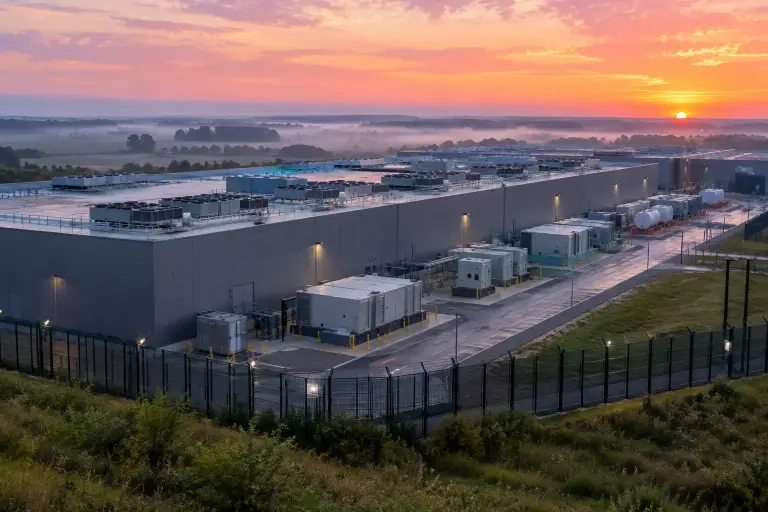
The most prominent real-world example of this scaling strategy is the massive joint venture in Abilene, Texas, funded by Crusoe, Blue Owl Capital, and Primary Digital Infrastructure. This $15 billion project represents the vanguard of gigawatt-scale AI infrastructure.
The project is structured in distinct phases to manage construction logistics and accelerate speed-to-market:
- Phase One: Began in June 2024, delivering over 200 megawatts of capacity across two buildings spanning 980,000 square feet. These initial buildings are energized in the first half of 2025.
- Phase Two: Initiated in March 2025, this phase adds six additional buildings to the campus, bringing the total to eight buildings and approximately four million square feet.
This second phase is expected to be fully energized by mid-2026, scaling the entire campus to a staggering 1.2 gigawatts of compute capacity. By phasing the build-out, the joint venture managed to get its first 200+ MW online in under a year, while concurrently preparing the civil, structural, and utility infrastructure required to support the remaining 1 GW.
The economic impact on the local community is equally massive. While the first phase was projected to generate $1 billion in direct and indirect economic value over 20 years, the peak construction workforce is scaling from 3,000 daily workers in Phase One to nearly 5,000 daily workers during the second phase. To read more about this project, check out Crusoe’s $15B Texas AI Data Center: Phase Two Begins | AIM Media House and Crusoe begins construction on second phase of Abilene, Texas, data center campus, will add six buildings, DCD.
Regional Expansion: Lessons for a Second Phase Data Center Build Out in New England
While gigawatt-scale projects in places like Texas dominate the national headlines, the lessons learned from these mega-campuses are directly shaping how we approach a second phase data center build out here in New England.
In Massachusetts, New Hampshire, and Rhode Island, developers are facing unique regional challenges. Land is scarcer, environmental regulations are strict, and local communities are highly engaged in the planning processes. For instance, in Andover, Massachusetts, which hosts a growing cluster of high-tech facilities, developers must design within tight physical footprints. You can view the current regional landscape on the Andover Data Centers, List of Data Centers in Andover, Massachusetts directory.
Furthermore, regional policy debates are actively shaping the future of these builds:
- In Rhode Island, state lawmakers are debating how to define and regulate these facilities, even as local municipalities like Smithfield take steps to restrict them. Read more on the As Smithfield moves to ban data centers, Smith Hill is still debating … update.
- In New Hampshire, legislators are weighing how to encourage development while protecting the local electrical grid, as detailed in AI is driving a data center boom. Some lawmakers want New … .
- Meanwhile, in Western Massachusetts, multi-billion-dollar projects are actively being planned to capture spillover demand from the Boston metro area, as highlighted by A multibillion-dollar data center project is coming to … .
For New England businesses planning an expansion, navigating these local regulatory waters requires a partner who understands both the local landscape and advanced infrastructure design. At AccuTech Communications, we specialize in helping businesses deploy scalable physical layers that comply with local guidelines while preparing for future capacity demands. Learn more about our regional expertise through our Data Center Services New England solutions.
Accelerating Timelines and Overcoming Supply Chain Constraints
In the race to deploy AI capabilities, speed-to-market is the primary metric of success. Traditional data center construction timelines, which historically took 18 to 24 months, are being compressed down to 12 to 18 months for phase two expansions.
To achieve this acceleration, developers are relying heavily on prefabricated modular construction. By manufacturing structural ceiling solutions, power skids, and modular cooling units off-site in controlled factory environments, field crews can focus on rapid assembly rather than stick-building complex systems on-site.
Additionally, executing a phased build-out allows for sequential building activation. While Building 1 is operational and generating revenue, Building 2 can undergo structural framing, and Building 3 can begin foundation piling. This repeatable mechanical, electrical, and plumbing (MEP) scope allows subcontractors to move seamlessly from one building to the next, maintaining consistent staffing levels and high build quality.
Managing this level of complexity requires expert project oversight. Selecting the right leadership is critical to keeping these concurrent timelines on track, which is why we recommend reviewing our guide on 8 Smart Ways to Hire a Data Center Build Out Project Manager.
Mitigating the 2026 Supply Chain and Labor Bottlenecks
The rapid acceleration of data center construction has exposed severe bottlenecks in the global supply chain and labor markets. Equipment that once had predictable lead times now requires years of advance planning:
- Transformers: Demand increased 119% from 2019 to 2025, pushing lead times to as long as 5 years.
- Medium-Voltage Switchgear: Lead times in North America frequently reach 50 to 80 weeks.
- Labor Shortages: The U.S. construction industry faced a shortage of roughly 439,000 workers heading into 2026.
To mitigate these constraints, developers are shifting from traditional transactional purchasing to strategic, long-term partnerships. Instead of waiting for a project’s final design to issue Requests for Proposals (RFPs), hyperscalers are co-engineering systems directly with equipment manufacturers years in advance, locking in supply lines for entire multi-phase pipelines.
A great example of managing these multi-phase permitting and wetland challenges is occurring in Virginia, where developers are expanding existing footprints to maximize built-out capacity. You can read about these permitting dynamics in the PowerHouse files to develop second phase of Spotsylvania data center campus in Virginia, DCD report.
Reclaiming Space and Upgrading Cabling in a Second Phase Data Center Build Out
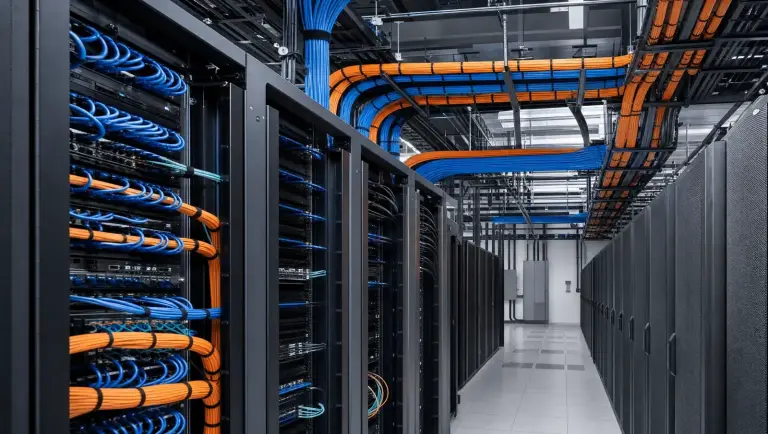
One of the most overlooked aspects of a second phase data center build out is the physical layer inside the white space. As rack densities climb, legacy cabling systems can quickly become a bottleneck, restricting airflow and choking performance.
During a phase two expansion, developers often have to integrate new high-density zones with legacy phase-one environments. A highly effective strategy for doing this is to reclaim physical space by decommissioning underutilized copper cabling. In many mature data centers, legacy Category 6/6A copper utilization drops over time as high-performance fiber optic cabling becomes the dominant medium. By removing bulky, unused copper, operators can free up valuable overhead tray space for high-density fiber pathways.
Modern phase two expansions rely on highly scalable fiber architectures:
- MPO (Multi-Fiber Push-On) Connectors: Allow for rapid, plug-and-play fiber deployment, reducing on-site termination labor.
- High-Density Fiber Cassettes: Fit into the exact physical footprint of legacy copper patch panels, dramatically increasing port density without requiring additional floor space.
- 10G to 100G+ Migration Paths: Designing the physical layer with single-mode fiber backbones ensures the campus can transition to 100G, 400G, and even 800G speeds in the future without a complete “rip-and-replace” overhaul.
At AccuTech Communications, we help New England businesses design and install these high-density structured cabling systems. Whether you are building a greenfield expansion or retrofitting an operational facility, our technicians ensure your physical layer is built for what’s next. Explore our specialized Data Center Cabling Services and learn how we build high-performance Fiber Optic Data Centers.
Advanced Infrastructure and Technology Features of Phase Two Campuses
The transition to generative AI has fundamentally altered the physical architecture of the modern data center. Traditional cloud data centers were built to support rack power densities of 2 to 4 kW. Today’s AI clusters require 130 kW per rack, with next-generation platforms like the NVIDIA GB200 NVL72 pushing densities toward 1 MW per rack.
This massive leap in density has rendered traditional air-cooling systems obsolete. Phase two builds are shifting entirely to direct-to-chip liquid cooling systems. By circulating specialized coolant directly through cold plates mounted on the GPUs, heat is dissipated far more efficiently than air cooling allows.
| Infrastructure Feature | Phase 1 Standard (Cloud Era) | Phase 2 Standard (AI Era) |
|---|---|---|
| Average Rack Density | 2 kW, 10 kW | 100 kW, 130 kW+ |
| Cooling Technology | Raised-floor air cooling | Direct-to-chip liquid cooling |
| Water Consumption | Evaporative cooling (up to 500k gal/day) | Closed-loop zero-water evaporation |
| Cabling Backbone | Multi-mode fiber & Cat6A copper | Single-mode fiber (MPO/MTP) |
| Primary Network Fabric | Standard Ethernet | High-performance RDMA fabric |
| Peak On-Site Crew Size | ~750 workers | 4,000-5,000 workers |
To achieve true sustainability, these advanced cooling systems are paired with zero-water evaporation, closed-loop water recirculation systems. This ensures that the facility does not deplete local municipal water supplies, addressing a major point of friction with local communities. For more on designing sustainable, high-density facilities, read our guide on Green Giants How to Build and Operate Energy Efficient Data Centers.
Balancing Speed-to-Market with Grid Resilience and Sustainability
As data center power demands scale into the gigawatt range, operators must balance their need for rapid deployment with grid resilience and environmental stewardship.
To secure the massive amounts of power required for phase two builds, developers are increasingly co-locating facilities next to abundant, low-cost renewable energy sources, such as wind farms. However, because wind and solar are intermittent, developers are also deploying behind-the-meter natural gas turbines and large-scale battery storage systems (BESS) to provide clean, continuous baseload power.
Additionally, developers are finding creative ways to mitigate the physical and visual impact of these massive facilities on local communities:
- On-Site Substations: Commissioning dedicated high-voltage substations early in the construction phase ensures the local utility grid is protected from sudden, massive load swings. Read about substation integration on the Prime Data Centers Breaks Ground on Three Buildings at $3B, 240MW Avondale Campus groundbreaking.
- Living Walls: To address aesthetic and biodiversity concerns, some modern developers are incorporating massive living walls covered in local plants onto data center facades. This helps with noise reduction, improves air quality, and supports local wildlife, as seen on the Pure DC appoints Glencar for next phase of its 90MW Brent Cross campus build-out | Markets Insider expansion.
Frequently Asked Questions about Second Phase Data Center Build Outs
What is the average construction cost per megawatt for a second phase data center build out?
According to publicly available internet data, the average construction cost for a data center in the U.S. is approximately $9.5 million per megawatt. However, because high-density AI infrastructure requires advanced liquid cooling, high-voltage power distribution, and complex fiber architectures, costs can vary wildly.
Depending on the specific density requirements, regional labor rates, and supply chain constraints, developers can expect a wide range of $5 million to $30 million per megawatt for a second-phase expansion.
Please note: These figures represent broad industry averages compiled from online data and are not reflective of AccuTech Communications’ actual pricing.
How do developers solve power and cooling challenges in phase two expansions?
To solve the extreme thermal and electrical demands of phase two builds, developers are transitioning away from municipal grid-dependence and air cooling. They are deploying direct-to-chip liquid cooling systems that utilize closed-loop, zero-water evaporation technology, ensuring no water is lost to the environment. On the power side, developers are utilizing “behind-the-meter” generation, co-locating facilities directly with renewable energy sources like wind and solar, and backing them up with on-site natural gas turbines and battery storage.
Why is structured cabling critical for second phase data center integration?
Structured cabling serves as the physical nervous system of the data center. In a phase two build-out, you must connect thousands of high-performance GPUs across multiple buildings on a single, ultra-low-latency network fabric.
Using modular cabling designs, high-density patch panels (which can support up to 48 ports in a single rack unit), and scalable MPO fiber paths ensures that you can scale your network bandwidth without having to re-cable your entire facility. For a complete look at how to execute a flawless cable installation, consult our Data Center Cable Installation Complete Guide.
Conclusion
A successful second phase data center build out requires a perfect alignment of capital, power, advanced technology, and physical infrastructure. As we look ahead through 2026 and beyond, the companies that build the most modular, scalable, and sustainable physical layers will be the ones that dominate the digital landscape.
At AccuTech Communications, we specialize in building those foundations. Based in Massachusetts, we provide reliable commercial network cabling, business phone systems, and data center technologies for businesses throughout Massachusetts, New Hampshire, and Rhode Island. Since 1993, our commitment to quality, competitive pricing, and reliable service has made us the trusted partner for New England’s commercial infrastructure needs.
Ready to plan your next infrastructure phase? Request an Estimate with our team today, and let’s build something amazing together.