
Why Access Control Cabling Is the Foundation of Every Secure Building
Access control cabling is the physical wiring infrastructure that connects every door reader, lock, sensor, and controller in a building’s security system — and getting it right determines whether your system performs reliably for years or becomes a constant source of headaches.
Quick answer: What is access control cabling?
- What it does: Carries power and data signals between access control devices — card readers, electric locks, door contacts, and request-to-exit (REX) sensors — and the central control panel
- Core cable type: Composite cables that bundle multiple conductor groups (typically 18 AWG for lock power + 22 AWG for signal/data) into a single, pullable assembly
- Key ratings to know: Plenum (CMP/CL3P) for air-handling spaces; Riser (CMR/CL3R) for vertical floor-to-floor runs
- Why it matters: Poor cable selection leads to signal interference, voltage drop, failed door hardware, and costly re-pulls
- Who needs it: Any commercial facility in Massachusetts, New Hampshire, or Rhode Island with controlled entry points — offices, data centers, schools, hospitals, government buildings
Most building owners and facilities managers focus on the access control hardware — the readers, panels, and software. But the cabling behind the walls is what holds the whole system together. A well-specified, properly installed cable run is invisible when it works and very expensive when it doesn’t.
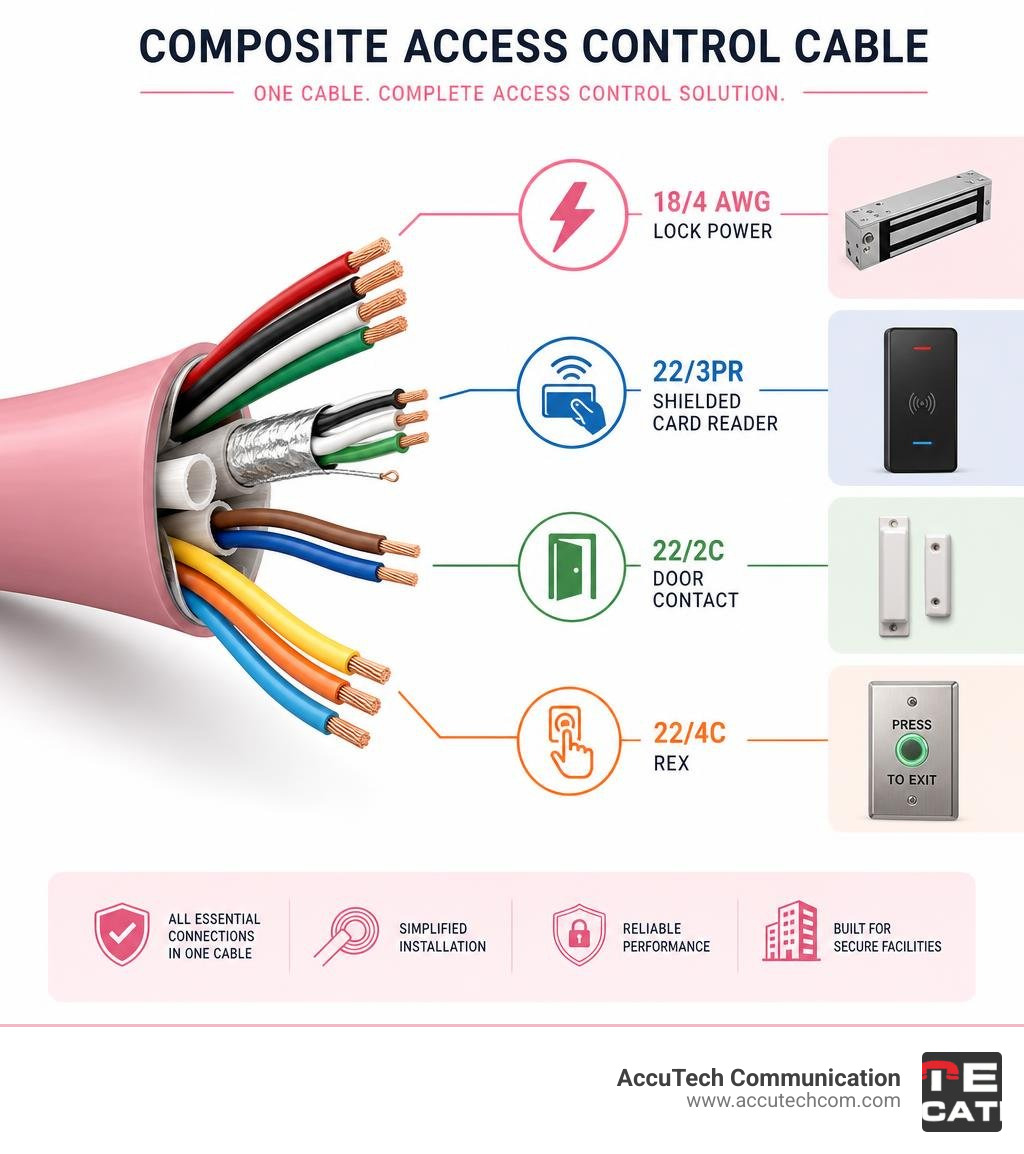
Modern access control installations have moved well beyond running a single wire to a door. Today’s systems combine lock power, card reader data, door position monitoring, and exit request signals — often through a single composite cable designed to handle all of it in one pull.
I’m Corin Dolan, owner of AccuTech Communications, and I’ve spent decades designing and installing access control cabling infrastructure for commercial clients across Massachusetts, New Hampshire, and Rhode Island. In this guide, I’ll walk you through everything you need to know to specify, install, and maintain a cabling system that keeps your facility secure and code-compliant.
Quick access control cabling definitions:
Understanding Access Control Cabling: Composite vs. Standard Low-Voltage
When designing a commercial security system, one of the first decisions we help clients make is choosing between running standard low-voltage wire or utilizing specialized composite cables.
Traditionally, low-voltage security wiring required pulling multiple separate “home runs” from the central controller to each door accessory. You would pull one cable for the card reader, a second cable for the electric door strike, a third for the door contact sensor, and a fourth for the request-to-exit (REX) motion detector.
This traditional approach often leads to congested conduits, messy cable management, and significantly longer installation times. Each individual run has to be labeled, pulled, and tracked separately, increasing the potential for installation errors.
By contrast, an access control composite cable bundles all four of these essential cables into a single, unified outer assembly. Utilizing composite cables drastically simplifies cable management, reduces physical conduit congestion, and cuts down on the physical footprint required in security closets.
When we design a Low Voltage Structured Cabling layout, we prioritize composite designs because they decrease the physical labor required to secure a commercial workspace, ensuring a clean and highly organized installation from day one.
To get a closer look at these specialized cable assemblies, you can review technical specifications such as the ACCESS CONTROL CABLE spec sheet, which illustrates how these multi-conductor bundles are manufactured. For import and global sourcing context, manufacturers like Access Control Cable from China, Access … – ZION Communication provide detailed cross-sections of these multi-conductor commercial setups.
Key Conductor Configurations in Access Control Cabling
Inside a standard composite access control cabling bundle, you will find four distinct, color-coded component cables. Each component is specifically engineered to support a unique device at the door opening:
- Lock Power (18 AWG, 4 Conductors): Electric strikes and magnetic locks require robust power delivery. We use 18 AWG (American Wire Gauge) copper conductors to prevent voltage drop over long distances. The four conductors allow for flexible wiring configurations, such as running dual-voltage locks or handling fail-safe/fail-secure monitoring.
- Card Reader / Keypad (22 AWG, 3 Pairs or 6 Conductors, Shielded): Card readers communicate sensitive credential data back to the controller. This component typically features 22 AWG conductors with an overall shield to protect data integrity from electromagnetic noise.
- Door Contact / Position Switch (22 AWG, 2 Conductors): This simple contact loop monitors whether the door is open or closed. Because it carries minimal current and simple binary data, a lightweight, unshielded 22/2 AWG cable is perfect for the job.
- Request-to-Exit / REX (22 AWG, 4 Conductors): REX motion sensors or push buttons require power and relay connections to tell the controller when someone is exiting the building. A 22/4 AWG configuration provides the necessary conductors for power and dual-contact relays.
Using stranded copper conductors across all these configurations is highly recommended. Stranded copper handles the physical bends, vibrations, and continuous movement near door frames far better than stiff, solid-core copper wire, which can fatigue and snap over time.
For an in-depth breakdown of these configurations, you can explore the Access Control Cable – Belden product portfolio, or look at commercial options like the Multi Conductor Access Control Cable – Primus Cable page, which details exact gauge and conductor counts.
Banana Peel® vs. Traditional Jacketed Designs
When selecting composite access control cabling, you will encounter two primary styles of physical construction: traditional overall-jacketed cables and jacketless composite designs, such as the patented Banana Peel® construction.
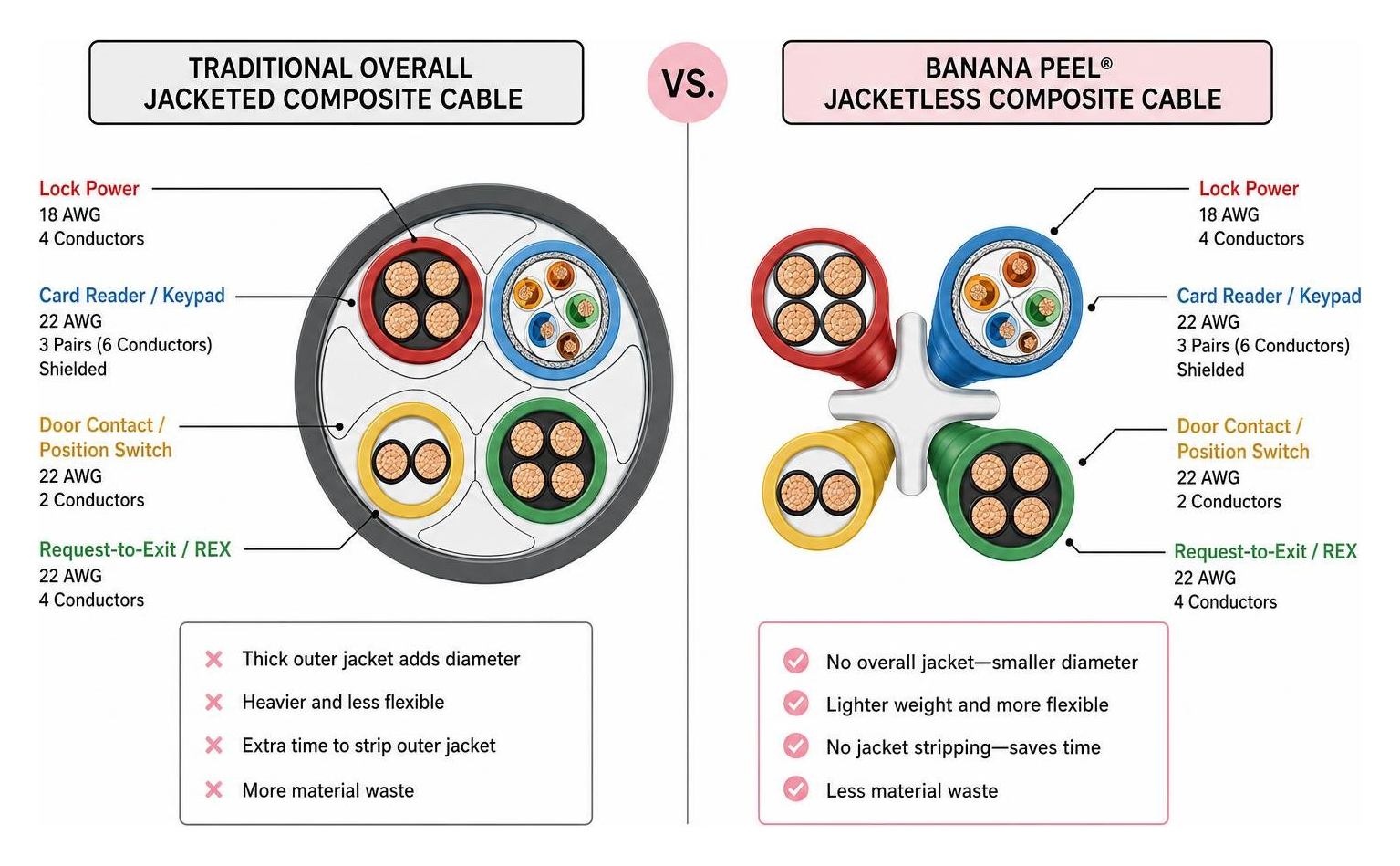
A traditional jacketed composite cable encloses all four individual cables within a heavy outer PVC sleeve. While protective, this outer jacket adds considerable weight, stiffness, and diameter to the cable bundle. It also requires installers to spend extra time stripping away the thick outer jacket at both the controller and the door opening before they can even begin terminating the individual conductors.
The jacketless Banana Peel design completely eliminates the overall outer jacket. Instead, the four color-coded component cables are affixed to a central spline or bonded directly to one another using a specialized, low-friction adhesive.
This design offers massive advantages:
- Up to 31% installation time savings: Installers can simply peel the individual cables away from the bundle without using a utility knife, eliminating the risk of accidentally nicking the inner conductor insulation.
- Reduced pulling friction: Technologies like SmartWire Glide reduce pulling friction by up to 70%, making it much easier to pull cables through tight conduits and around sharp corners.
- Tighter bend radius: Without a thick overall jacket, the cable is highly flexible, bending freely around structural obstacles.
- Smaller overall diameter: This allows you to fit more runs into a single conduit, reducing overall material and pathway costs.
If you are planning a large-scale commercial rollout, reviewing the Access Control Cable, Riser | Southwire catalog or examining the (800) 343 2579 • www.adcable.com EZ Access guide will help you visualize how these jacketless and EZ-strip cable designs save hours of labor on-site.
Fire Safety Ratings and Environmental Compliance
Selecting the correct fire safety rating for your access control cabling is not just a performance choice; it is a strict legal requirement governed by the National Electrical Code (NEC) and local building inspectors across Massachusetts, New Hampshire, and Rhode Island.
When running low-voltage wiring through commercial spaces, we must carefully evaluate where the cable will travel to ensure it meets fire safety compliance. Working with an experienced partner for your Commercial Structured Cabling needs guarantees that your infrastructure will pass local building inspections and protect building occupants in an emergency.
Plenum (CMP/CL3P) vs. Riser (CMR/CL3R) Applications
The two most common fire safety ratings you will specify for commercial access control systems are plenum-rated (CMP/CL3P) and riser-rated (CMR/CL3R) cables.
- Plenum (CMP/CL3P/FT6): Plenum spaces are the open areas above drop ceilings or below raised floors that are used for environmental air circulation. Because air flows freely through these spaces, a standard cable fire would rapidly spread toxic smoke and flames throughout the entire building. Plenum-rated cables are jacketed with flame-retardant, low-smoke materials (such as fluorinated ethylene propylene or specialized low-smoke PVC) that self-extinguish and emit minimal smoke. Plenum cable is required in schools, hospitals, and multi-floor commercial buildings with active plenum air spaces.
- Riser (CMR/CL3R/FT4): Riser spaces are the vertical shafts and pathways that run between floors of a building. Riser-rated cables are designed to prevent fire from traveling vertically from floor to floor. While highly flame-resistant, they do not have the strict low-smoke emission requirements of plenum cables. Riser cables are suitable for vertical shafts, elevator pathways, and non-plenum horizontal runs.
| Specification / Property | Plenum (CMP / CL3P) | Riser (CMR / CL3R) |
|---|---|---|
| Primary Installation Location | Air-handling spaces, drop ceilings, raised floors | Vertical shafts, floor-to-floor runs, non-plenum areas |
| Jacket Material | Low-smoke, flame-retardant PVC or FEP | Heavy-duty, flame-retardant PVC |
| Flame Test Standard | NFPA 262 / UL 910 (FT6) | UL 1666 (FT4) |
| Smoke Emission | Extremely low smoke generation | Standard smoke generation |
| Interchangeability | Can be used in place of Riser (CMR) | Cannot be used in Plenum spaces |
For specific project applications, you can consult resources such as the Access Control Composite Cable – Only Card Reader Pairs Shielded CMP 9888 specification sheet to see how manufacturers build high-performance plenum options.
Industry Standards and Certifications
When specifying access control cabling, always verify that the product carries the necessary third-party certifications to ensure performance and safety:
- NEC Article 725 & 800: Governs Class 1, Class 2, and Class 3 remote-control, signaling, and power-limited circuits, along with general communication circuits.
- UL 13 & UL 444: Underwriters Laboratories standards that certify the safety, electrical properties, and physical durability of power-limited circuit cables (UL 13) and communication cables (UL 444).
- RoHS Compliance: Ensures that the jacket and conductors are free from hazardous substances like lead, mercury, and cadmium, meeting modern environmental safety standards.
- CPR / Euroclass: For businesses operating internationally or looking for standardized European fire performance ratings (such as Cca or Dca), verifying Construction Products Regulation (CPR) compliance is standard practice.
Shielding and Signal Integrity in Access Control Systems
In commercial environments, low-voltage cables are constantly exposed to electrical noise. High-voltage power lines, fluorescent lighting ballasts, electric motors, and wireless networks all generate electromagnetic interference (EMI) and radio frequency interference (RFI).
If your access control cabling lacks the proper shielding, this interference can bleed into your data lines, causing signal degradation, corrupted credential data, and intermittent card reader failures. Ensuring signal integrity through proper shielding is a core element of robust Structured Cabling design.
Shielding Options for Access Control Cabling
Depending on the electromagnetic environment of your facility, you have several shielding configurations to choose from:
- Unshielded (UTP): Best suited for low-noise environments or simple contact closure loops (like door position switches and request-to-exit buttons) where minor electrical noise won’t impact binary on/off signals.
- Overall Shielded (OAS): Features an overall aluminum foil polyester shield (often referred to as Beldfoil®) wrapped around the conductor pairs, along with a tinned copper drain wire. The drain wire must be grounded at the controller end to safely discharge collected electrical noise.
- Individually Shielded Pairs: In highly sensitive environments, such as industrial manufacturing floors or data centers with high-density power distribution, choosing a cable with individually shielded pairs ensures that high-draw lock power lines don’t bleed noise into adjacent data lines within the same composite bundle.
For noise-sensitive environments, specifying a cable like the 9897 – Noise Sensitive Shielded CMR Composite Access Control Cable ensures that your card reader signals remain perfectly clean, preventing frustrating card-swipe delays or read errors.
Installation Efficiency and System Integration
Time is money during any commercial construction or renovation project. Modern composite access control cables are engineered with several built-in features designed to expedite pulls, eliminate termination mistakes, and simplify future troubleshooting.
Deploying Composite Cables in Commercial Environments
High-quality composite cables are designed with distinct physical markers that make life much easier for low-voltage technicians:
- Color-Coded Jackets: Each inner cable component features a bright, standardized color jacket (e.g., Orange for Lock Power, White for Reader, Blue for Door Contact, Green for REX) so technicians immediately know which wire connects to which device.
- Printed Application Legends: The outer jacket of each component is clearly printed with its intended application (e.g., “CARD READER,” “LOCK POWER”) to prevent termination confusion.
- Footage Markers: Sequential, descending footage markers (like FastFIND) let technicians know exactly how much cable is left on the reel, reducing scrap waste by 15% to 25%.
- Rip Cords: High-strength nylon rip cords allow installers to easily peel back the outer jacket without risking damage to the delicate conductor insulation inside.
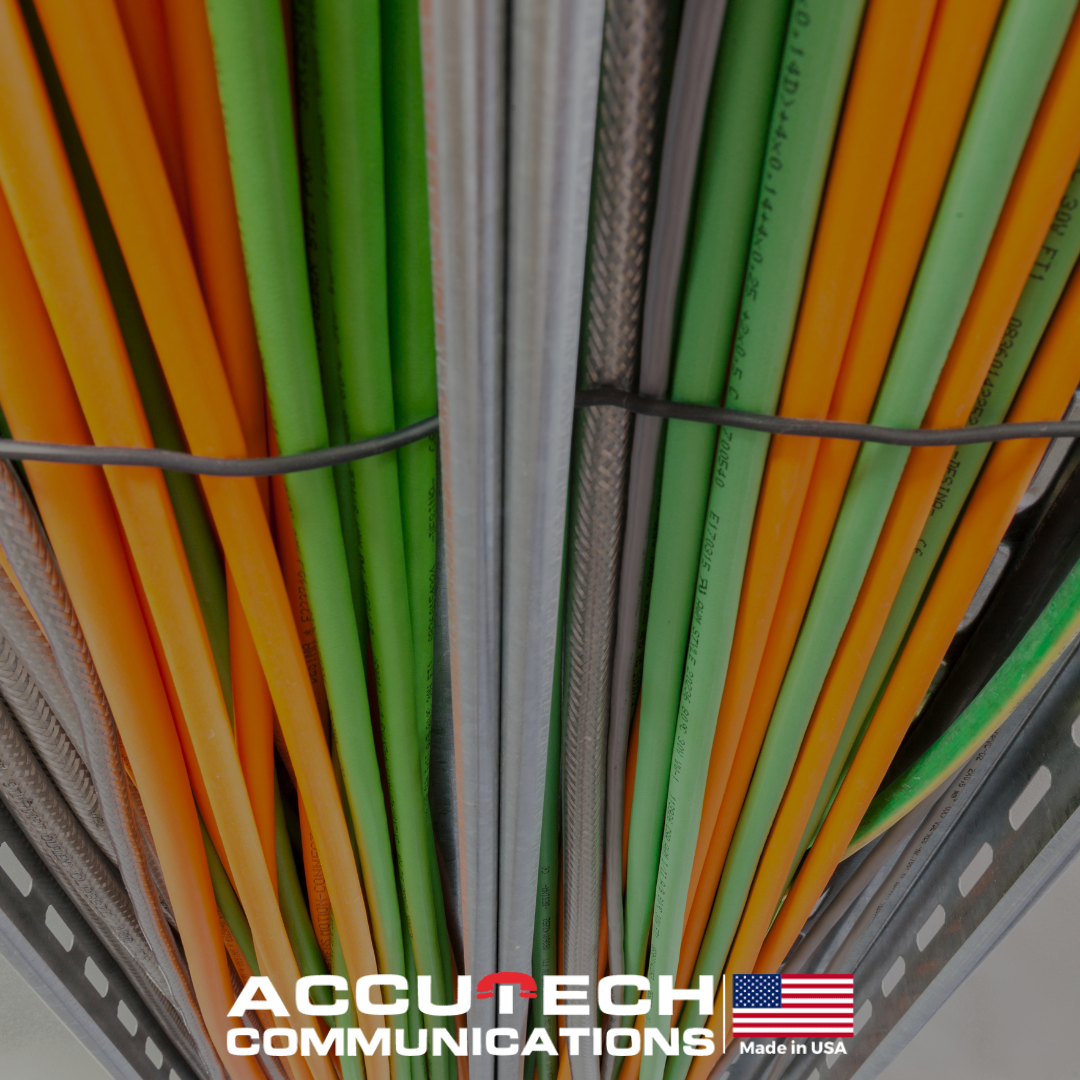
These efficiency features shine when deploying security infrastructure in complex commercial environments. Whether we are installing cabling across a large campus in Boston, routing runs through a manufacturing facility in Worcester, or setting up secure entry points in Manchester, NH, using composite cabling ensures the project is completed on time and on budget.
If you are looking for local installation context and professional low-voltage services, reviewing resources like Data Cabling & Network Wiring | NH & ME In-Building Cables or exploring regional deployment standards via Network Security Wiring Solutions – NSWS can provide valuable local insights.
For specialized access control system requirements in Eastern Massachusetts, you can check out regional resources such as Access Control System & Installer in Boston, MA , Boston Access Control Installation – FlyLock Security Solutions , and Access Control & Keyless Entry System Installation in Andover, MA to see how modern keyless systems are deployed in historic and modern commercial spaces alike.
Our structured cabling teams utilize these high-efficiency materials during every Network Cabling Installation Services project to deliver clean, traceable, and highly reliable security infrastructure.
Integrating Access Control with Other Building Systems
A modern commercial building relies on multiple interconnected low-voltage systems. Your access control cabling does not operate in a vacuum; it must seamlessly integrate with:
- CCTV Video Surveillance: Triggering cameras to record or pan toward a door when an unauthorized entry attempt occurs.
- Intrusion Detection Systems: Arming or disarming zone alarms based on valid badge swipes.
- Fire Alarm Systems: Crucially, fire alarm relays must cut power to fail-safe electric locks (like magnetic locks) automatically during an emergency to allow occupants to exit safely.
- Building Automation Systems (BAS): Integrating via BACnet or RS-485 protocols to adjust lighting and HVAC based on building occupancy.
Designing a unified physical infrastructure requires expert planning. Utilizing comprehensive Cabling Infrastructure Solutions ensures that all of your building’s security, safety, and network systems communicate reliably on a single, standardized physical layer.
Best Practices for Cable Pulling, Termination, and Maintenance
To ensure your access control system operates flawlessly for years to come, our technicians strictly adhere to industry-standard low-voltage installation best practices:
- Observe Pulling Tension Limits: Never exceed the maximum pulling tension of your cable (typically 80-100 lbs for composite cables). Pulling too hard can stretch the copper conductors, thinning their gauge and altering their electrical resistance, or tear the protective shielding.
- Maintain Minimum Bend Radius: Avoid sharp bends. A good rule of thumb is to maintain a bend radius of at least 10 to 12 times the outer diameter of the cable. Kinking the cable can damage the internal conductors and degrade signal performance.
- Maintain Pathway Separation: Always run your low-voltage access control cabling in pathways separated from high-voltage AC electrical lines. Keep a minimum of 5 inches of separation from high-voltage lines, and cross them only at 90-degree angles to minimize EMI.
- Proper Labeling and Documentation: Label both ends of every cable run with a clear, standardized naming convention (e.g., “DOOR-101-READER”). Document these runs on your building’s as-built drawings. This makes future troubleshooting, system upgrades, or moves, adds, and changes incredibly simple.

Following these strict installation standards is what separates a reliable, long-lasting security system from one prone to constant, mysterious failures. Our certified technicians design and deploy Network Cabling Systems using these exact best practices to guarantee maximum uptime and compliance for your business.
Frequently Asked Questions About Access Control Cabling
What is the maximum distance for access control reader cabling?
The maximum distance for a card reader run depends heavily on the communication protocol and the wire gauge used. For traditional Wiegand readers, the industry-standard limit is 500 feet when using a 22 AWG shielded cable. Going beyond 500 feet can result in severe signal attenuation and voltage drop, causing the reader to lose power or fail to transmit credential data to the controller.
For modern OSDP (Open Supervised Device Protocol) readers, which communicate via the robust RS-485 standard, distances can reach up to 4,000 feet using high-quality shielded twisted-pair cabling, though we always recommend consulting the specific manufacturer’s guidelines for your hardware.
Can I use standard Cat6 cable for access control systems?
While standard Cat6 cable is excellent for high-speed network data, it is generally not recommended as a catch-all solution for access control door hardware. Cat6 copper conductors are typically very thin (23 AWG or 24 AWG).
While a Cat6 cable can easily handle the data signals for an IP-based card reader, it is far too thin to safely and reliably carry power to electric strikes or magnetic locks. Running lock power over Cat6 can lead to massive voltage drop, causing the locking hardware to fail to latch or release, and can even cause the thin wires to overheat.
Why is shielding important for card reader cables?
Shielding is vital for card reader cables because credential data is transmitted via rapid, low-voltage electrical pulses. Nearby high-voltage electrical lines, fluorescent lighting, and wireless equipment can easily induce electrical noise (EMI/RFI) into unshielded wires.
This noise distorts the data pulses, leading to corrupted data packets, card reader read errors, or complete system lockups. A foil shield captures this noise and safely routes it to the ground via the drain wire, keeping the data signal perfectly clean.
Conclusion
Your access control cabling infrastructure is the silent guardian of your commercial facility’s physical security. Investing in high-quality composite cabling, selecting the appropriate plenum or riser fire ratings, and ensuring proper shielding will save your business thousands of dollars in installation labor, prevent system downtime, and guarantee code compliance.
Since 1993, AccuTech Communications has provided certified, reliable structured cabling, business phone systems, and data center technologies to businesses across Massachusetts, New Hampshire, and Rhode Island. Our commitment to competitive pricing, exceptional quality, and certified craftsmanship has made us the trusted low-voltage partner for hundreds of commercial clients.
Ready to secure your business with a professionally designed and installed access control cabling system? Request an Estimate from our team of certified low-voltage experts today, and let us build a secure, reliable foundation for your business.
